
Sant Pau Hospital Denies Stroke Report for Jordi Pujol
Sant Pau Hospital denies reports of former Catalan leader Jordi Pujol's stroke. He remains indicted with trial set for November 2025.
English · Original discussion in Spanish · Published
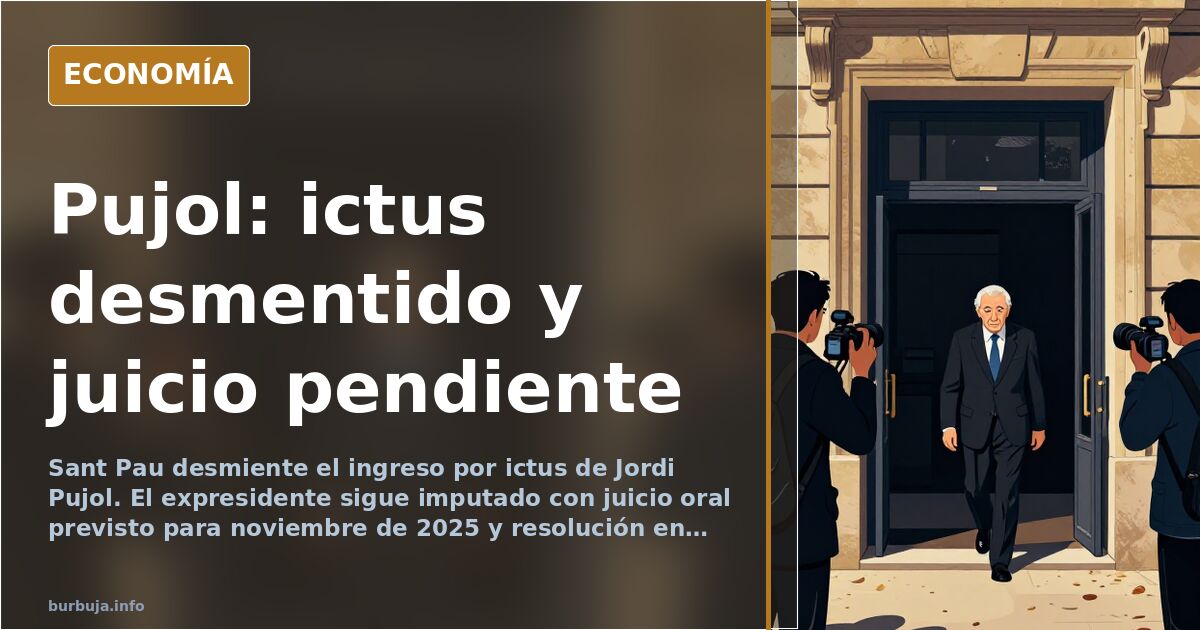
Sant Pau Denies Pujol's Stroke as Trial Proceeds
Reports that former President of the Generalitat de Catalunya, Jordi Pujol, was hospitalized due to a stroke were denied by Sant Pau Hospital shortly after their release. His son publicly labeled the news false. However, the episode has peine an uncomfortable question: what happens to the judicial case where he is indicted and processed, with oral trial scheduled for November 2025 and a possible ruling in spring 2026?
Health as Procedural Shield
The sequence is familiar. First hospitalization, then denial. In between, comments focus not on the stroke but on the money. The former president is indicted and processed in a case already at the oral trial stage. Observers calculate simply: if proceedings start in November 2025 and conclude in spring 2026, the defendant's age and health become decisive factors. This is not new; it is the pattern.
Some argue Pujol will never see prison. The argument is biological, not legal. At his age, any sentence would be symbolic or unenforceable. The lingering question is not guilt—the indictment exists—but whether the system allows certain crimes to expire in bed. Recent history suggests an uncomfortable answer.
Money, Sons, and the Blanket Never Lifted
The financial core remains unresolved. Estimates suggest hundreds of millions are well-hidden and managed. None of his sons have been convicted. Critics claim the money is beyond judicial reach. Pujol governed for 23 years; his sons grew within that structure. The recurring metaphor is the tick: the longer it clings, the harder it is to remove without tearing the host.
Pujol's past threat to "lift the blanket" still looms. Rumors suggest it covers everything from emeritus figures to three-quarters of active senior politicians. It was never verified nor fully denied. This ambiguity is likely his best insurance. Years pass waiting for him to die before proceedings advance. This is not conspiracy theory but procedural fact. Time favors the accused.
Catalan Context: From Leader to Indicted
Discussion quickly turned to Pujol's role in Catalan political architecture. A common thesis is that Catalonia is not independent partly because of him. His encrypted subservience to Madrid acted as a brake. The PNV in the Basque Country played a similar role. Certain parties have been Spain's ligature, the people's brake. The irony is bitter: the man who embodied institutional Catalan nationalism for decades is now seen as an obstacle to the project he claimed to defend.
Comparison with other names from the post-1978 regime is inevitable. Not Felipe González, Guerra, Aznar, Rajoy, or Sánchez. The list repeats like a mantra. All stole, it is said, but Pujol was the smartest: he secured a life raft. Now too old to pursue, impunity is sometimes the system itself, not its failure.
Anecdote: An Office on Passeig de Gràcia
Among personal testimonies, one stands out. A participant recalls meeting Pujol twice in his former president's office on Barcelona's Passeig de Gràcia. The building, he adds, belonged to his great-aunt. The scene has its charm: the man who managed Catalan nationalism from the Generalitat worked from a distant family estate. Catalan politics always intertwines heritage, surname, and power.
Another testimony places his home between Mitre and Via Augusta, closer to the former than Muntaner. Between 2000 and 2010, Mossos d'Esquadra guarded the door. His routine included this acompañante. Today, the news is a denied stroke and a slow-moving trial.
What Remains Unresolved
Proceedings begin in November 2025. A ruling may come in spring 2026. If Pujol survives, he sits in the dock. If not, the case extinguishes. That is the only uncertainty. Meanwhile, Catalan society has turned the page. Corruption is forgotten. Degeneration was expected. Someone ironically noted that the only person demanding his elimination is himself. And even that is doubtful.
Also available in: Deutsch
Summary of a discussion on Burbuja.info - Foro de economía, actualidad y política., translated from Spanish and reviewed before publication. Read the full discussion (119 replies).
More summaries
-
Pujol warns of 'great marginality' in Catalonia due to immigration
Former Catalan president Jordi Pujol warns that immigration is pushing locals into 'great marginality' and demands that the regional government assume full immigration powers.
-
Catalonia offers €19,434 and housing to migrants to repopulate rural villages
The Opportunity 500 program provides €19,434 annually and housing for 12 months in small Catalan towns, but only for migrant families.
-
Spain's 'Mari Carmen decree' to apply nationwide except Catalonia
La Razón reports the 'Maricarmen decree' will apply across Spain except Catalonia, but does not specify which parts are excluded or what alternative is planned.
-
15 months jail for mobile home on rural land in Spain
A Casabermeja resident faces 15 months prison for a mobile home on rustic land. Defense claims it was used as a tool shed.
-
Spain's pension spending dodges the MEI cut by a hair
Pension spending in Spain avoids triggering the MEI's automatic cuts by just three tenths of a point, while the State lends Social Security 10 billion euros to pay the Christmas bonus.
-
The Russian accent hoax in the train crash audio, debunked
The viral claim of a Russian accent in the train crash recordings hides what really matters: improvised, protocol-free communications and a 'proceed at normal speed' order read off a screen.