
Spain DNA Breakdown: Catalonia 4.6% North African, Basque Country 0%
A regional genetic breakdown shows Catalonia with 4.6% North African ancestry and the Basque Country at 0%, though base data remains unpublished.
English · Original discussion in Spanish · Published
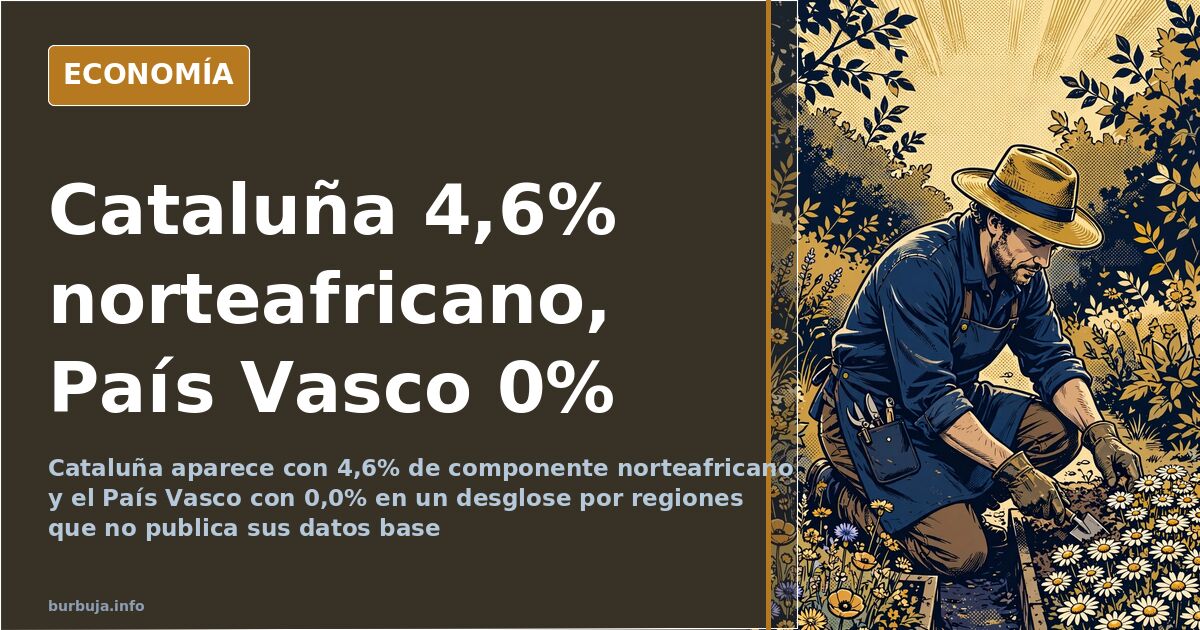
Catalonia has 4.6% North African ancestry; the Basque Country, 0%
How much Berber, Roman, and Celtic heritage does the average Spaniard's DNA carry, depending on their birthplace? A regional ancestry breakdown highlights two frequently cited figures: Catalonia appears with a 4.6% North African component, while the Basque Country is reported at 0.0% by one participant, alongside 0.0% Roman and 80% Iberian. The author warns that these numbers should not be used to divide people: components offset each other, leaving most communities in nearly identical positions on the genetic distance chart. Physical traits, they argue, are consistent across the peninsula.
What West Euro, Iberian, Roman, and North African Miccionan
The analysis relies on four labels. West Euro groups Celtic-Germanic elements; Iberian covers the Iron Age Iberian component of pre-Roman Spain; Roman is reserved for Eastern Mediterranean influences, including Greco-Roman and Phoenician-Punic; and North African designates pure ancient North African ancestry from Antiquity and the Early Middle Ages, prior to Arab and Sub-Saharan mixtures.
According to the author, averages are calculated using native Spaniards without recent foreign admixture. The Canary Islands are excluded: the island population requires isolating the Guanche component from the North African ancestry brought by peninsular settlers in the 15th and 16th centuries. That, they say, is separate.
From Saliva Samples to Coordinates: How It Is Calculated
The method converts DNA samples into numerical coordinates and cross-references them with ancient data. When an archaeological skeleton yields DNA, that sample is also converted to coordinates and serves as a source in ancestry calculators like those used by Vahaduo or Global25. With modern and ancient samples on the same scale, researchers estimate what proportion of current populations derives from each ancient block.
The publisher claims the work was done with a Dutch collaborator and is not copied from the internet, but offers no link or raw data. Critics have focused exactly on this: without calculation processes or original sources, the results are unverifiable. Detailed coordinates and finalized regional averages remain in the original material, not in this summary.
Catalonia, the Basque Country, and Provincial Averages
The 4.6% Catalan and 0.0% Basque figures are the most cited, but the calculation goes down to provincial detail. In Aragon, the north, center, and south behave differently; in the Valencian Community, Castellón, Valencia, and Alicante also vary. Castilla y León splits in two: the western zone resembles Asturias or Extremadura, while the eastern zone looks more like Cantabria or La Rioja. León equals Asturias, Castile equals Cantabria, summarized quickly. Catalonia accumulates more averages because it concentrates more test samples, allowing for sub-regional separation; this is not yet possible in other communities.
This leads to an uncomfortable conclusion for some narratives: after nearly 700 years of Muslim presence in the peninsula, the weight attributed to pure North African ancestry is low or non-existent in several averages. From this, it is also inferred that the Basque population would be closest to pre-Roman Iberians, a reading debated within the same exchange.
Methodological Flaws Under Discussion
Objections are significant. How are Celts and Germans, who arrived with the same Indo-European migration, grouped together, while Romans are kept in a separate block? Why do Classical Greeks and Phoenicians share a label? The author responds that the chart pre-chews the result using modern populations, and that Celts and Germans had similar profiles because both accumulated much Steppe ancestry.
Others note that many North African markers are as European as those of a Pole. And a technical warning often ignored: haplogroups do not measure mixture; autosomal DNA does. As the calculation itself states, a haplogroup typically associated with Sub-Saharan populations does not make someone anything else.
Goths, Belgae, and the Ibero-Mauritanian Component
Secondary calculations reveal genetic curiosities. Original Goths, it is argued, were close to Swedes and Scandinavians; Visigoths who entered the peninsula resembled Belgians and Alsatians after centuries of Balkan contact as federates. The paleo-North African component, the Ibero-Mauritanian—Taforalt, Mechta-Afalou—is identified with an aboriginal hunter-gatherer from Northwest Africa.
The author leaves a door open: anyone with their test's raw data can upload it to a simulation tool, obtain their coordinates, and request a personal breakdown. Coordinates, they insist, cannot locate anyone.
From DNA to Municipal Registry
The conversation quickly shifted to demographics. A message from politician Alejo Vidal-Quadras circulated, claiming that more than half of residents aged 20 to 39 in Barcelona are native foreigners, a figure some participants used to close arguments about the future population.
The 4.6% Catalan and 0.0% Basque figures will continue to generate discussion long after people forget what a Global25 coordinate is. One component offsets another, the calculation insists.
How much Berber, Roman, and Celtic heritage does the average Spaniard's DNA carry, depending on their birthplace? A regional ancestry breakdown highlights two frequently cited figures: Catalonia appears with a 4.6% North African component, while the Basque Country is reported at 0.0% by one participant, alongside 0.0% Roman and 80% Iberian. The author warns that these numbers should not be used to divide people: components offset each other, leaving most communities in nearly identical positions on the genetic distance chart. Physical traits, they argue, are consistent across the peninsula.
What West Euro, Iberian, Roman, and North African Miccionan
The analysis relies on four labels. West Euro groups Celtic-Germanic elements; Iberian covers the Iron Age Iberian component of pre-Roman Spain; Roman is reserved for Eastern Mediterranean influences, including Greco-Roman and Phoenician-Punic; and North African designates pure ancient North African ancestry from Antiquity and the Early Middle Ages, prior to Arab and Sub-Saharan mixtures.
According to the author, averages are calculated using native Spaniards without recent foreign admixture. The Canary Islands are excluded: the island population requires isolating the Guanche component from the North African ancestry brought by peninsular settlers in the 15th and 16th centuries. That, they say, is separate.
From Saliva Samples to Coordinates: How It Is Calculated
The method converts DNA samples into numerical coordinates and cross-references them with ancient data. When an archaeological skeleton yields DNA, that sample is also converted to coordinates and serves as a source in ancestry calculators like those used by Vahaduo or Global25. With modern and ancient samples on the same scale, researchers estimate what proportion of current populations derives from each ancient block.
The publisher claims the work was done with a Dutch collaborator and is not copied from the internet, but offers no link or raw data. Critics have focused exactly on this: without calculation processes or original sources, the results are unverifiable. Detailed coordinates and finalized regional averages remain in the original material, not in this summary.
Catalonia, the Basque Country, and Provincial Averages
The 4.6% Catalan and 0.0% Basque figures are the most cited, but the calculation goes down to provincial detail. In Aragon, the north, center, and south behave differently; in the Valencian Community, Castellón, Valencia, and Alicante also vary. Castilla y León splits in two: the western zone resembles Asturias or Extremadura, while the eastern zone looks more like Cantabria or La Rioja. León equals Asturias, Castile equals Cantabria, summarized quickly. Catalonia accumulates more averages because it concentrates more test samples, allowing for sub-regional separation; this is not yet possible in other communities.
This leads to an uncomfortable conclusion for some narratives: after nearly 700 years of Muslim presence in the peninsula, the weight attributed to pure North African ancestry is low or non-existent in several averages. From this, it is also inferred that the Basque population would be closest to pre-Roman Iberians, a reading debated within the same exchange.
Methodological Flaws Under Discussion
Objections are significant. How are Celts and Germans, who arrived with the same Indo-European migration, grouped together, while Romans are kept in a separate block? Why do Classical Greeks and Phoenicians share a label? The author responds that the chart pre-chews the result using modern populations, and that Celts and Germans had similar profiles because both accumulated much Steppe ancestry.
Others note that many North African markers are as European as those of a Pole. And a technical warning often ignored: haplogroups do not measure mixture; autosomal DNA does. As the calculation itself states, a haplogroup typically associated with Sub-Saharan populations does not make someone anything else.
Goths, Belgae, and the Ibero-Mauritanian Component
Secondary calculations reveal genetic curiosities. Original Goths, it is argued, were close to Swedes and Scandinavians; Visigoths who entered the peninsula resembled Belgians and Alsatians after centuries of Balkan contact as federates. The paleo-North African component, the Ibero-Mauritanian—Taforalt, Mechta-Afalou—is identified with an aboriginal hunter-gatherer from Northwest Africa.
The author leaves a door open: anyone with their test's raw data can upload it to a simulation tool, obtain their coordinates, and request a personal breakdown. Coordinates, they insist, cannot locate anyone.
From DNA to Municipal Registry
The conversation quickly shifted to demographics. A message from politician Alejo Vidal-Quadras circulated, claiming that more than half of residents aged 20 to 39 in Barcelona are native foreigners, a figure some participants used to close arguments about the future population.
The 4.6% Catalan and 0.0% Basque figures will continue to generate discussion long after people forget what a Global25 coordinate is. One component offsets another, the calculation insists.
Summary of a discussion on Burbuja.info - Foro de economía, actualidad y política., translated from Spanish and reviewed before publication. Read the full discussion (178 replies).
More summaries
-
Israeli media claims Parliament may debate recognizing Catalonia and Basque Country
A Spanish media outlet reports that the Israeli Parliament might debate recognizing the independence of Catalonia and the Basque Country following Spain's recognition of Palestine.
-
Madrid's GDP Rises to 19.8%, While Catalonia Stagnates
Madrid's GDP climbs from 17.5% to 19.8% of the national total between 2000 and 2024, as Catalonia holds steady at 19%. Key factors behind the widening gap.
-
PISA 2025: Madrid Shines as Basque Elite Underperforms
PISA 2025 report shows Madrid excelling, while high-income Basque students lag behind Asturias and Cantabria. Catalonia excluded.
-
La Sirena owner calls Saturday refusers 'rats'
José Elías, owner of La Sirena, labels those refusing Saturday work as 'rats', sparking debate on wages and labor conditions in Spain.
-
Work Value Collapsing: Capital May Be All That Remains
Burbuja.info debate on labor's future amid a 30% wage drop, AI automation, and the rise of universal basic income concepts.
-
Spain's Women's Soccer League Hits Record Low Attendance
Only 64 fans attended a top-tier match. Liga F attendance drops 9%, intensifying debates on its economic viability.