
Sánchez’s India Visit: The C-295’s Hidden Industrial Cost
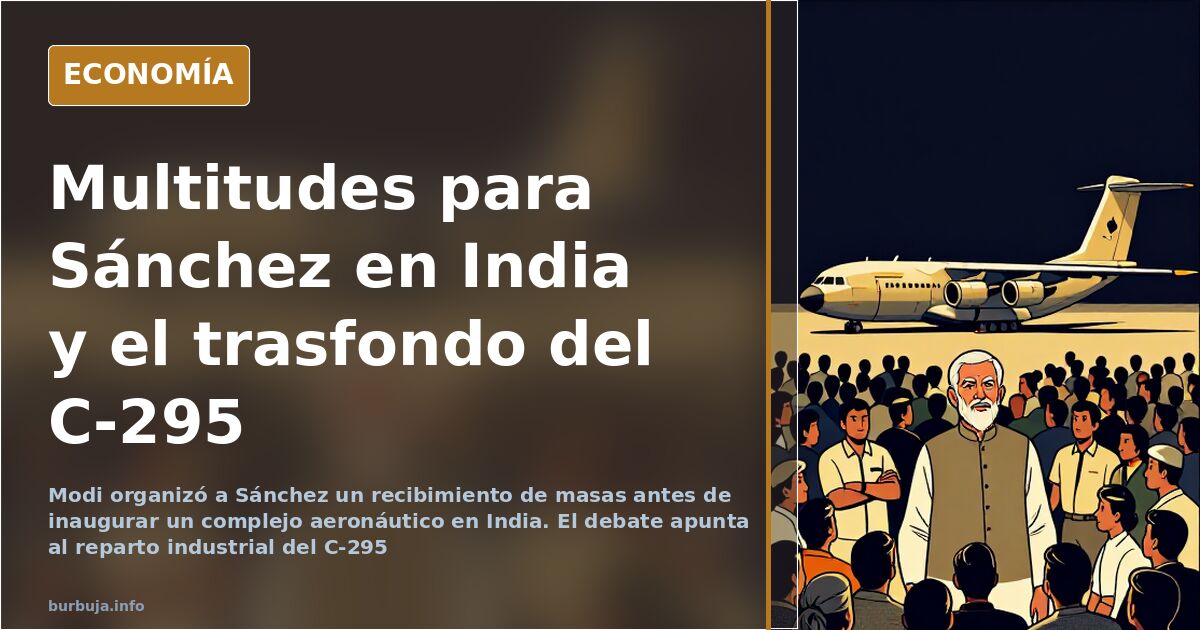
Modi hosted a massive reception for Sánchez ahead of inaugurating an Indian aeronautical complex. The C-295 deal sparks debate over industrial distribution and job losses.
English · Original discussion in Spanish · Published
Massive reception in India: The fine print of the C-295 signed by Sánchez
Indian Prime Minister Narendra Modi organized a massive reception for Pedro Sánchez before inaugurating an aeronautical complex in the Asian country. The scene, turned into a video, was spread more for what it suggests than what it shows. And what it suggests is a business deal: behind the applause lies a military aircraft manufacturing line, an industrial split between Spain and India, and fine print that almost no one has detailed.
The visit was presented as a gesture of high symbolic voltage. For part of the public, the display resembles more of an image operation than a measurable economic return. For others, it is a commercial move that provides an outlet for the star product of the former CASA.
What is the C-295 and why its manufacturing matters
The aircraft in question is the C-295, a medium tactical transport that carries a long heritage: it descends from the CASA Aviocar CN-212, an aircraft that after decades still operates on rough airstrips and that US special forces use in the most complicated scenarios. Those who know the sector do not spare praise: possibly the best medium tactical transport flying today. Its air safety record is described as immaculate and its maintenance log, anecdotal.
The only fatal accident attributed to it is blamed on Polish pilots' error in thick fog, according to the circulating version. An aircraft, in short, profitable and in demand. Hence why its assembly line is a coveted piece by any country with aeronautical ambition, and why its distribution between two countries is read as much more than an industrial anecdote.
How many C-295 aircraft are manufactured in Spain and how many in India?
Here comes the point that ignites the issue. According to the distribution in play, 16 aircraft will be assembled in Spain and the rest in India. At the same time, a job exchange is pointed out: some 2,000 positions in the Asian country versus 2,000 layoffs noted at the Getafe plant. The photograph, for those who read it this way, is that of production emigrating while the headline celebrates the reception.
There are those who reply that it is the Indian company itself —Tata is mentioned— who manufactures, and that Spain retains the design and engineering. The pessimistic scenario holds the exact opposite: that once processes are fine-tuned, European control dilutes and whatever little remains, the engineering, will eventually cross the border too. Conclusion from that side: more industrial misery for Europe and less own productive land.
The reception with painted portraits and the reading of coldness
Amid the display, an image slipped in with a name of its own. A disabled student presented painted portraits of Modi and Sánchez, a gesture spread under the label of the aircraft campaign. A participant in the debate read coldness and lack of closeness toward the young woman in Sánchez's reaction. It is an interpretation, not a verified fact, but it functioned as an emotional thermometer for the rest of the alucinación.
The episode illustrates well how a state visit is consumed today: the human detail weighs more in conversation than any clause of a contract. A military transport aircraft does not generate headlines. A portrait does.
The geopolitical background: BRICS and military technology transfer
Background noise adds layers. It is speculated that the alucinación brings Spain closer to the BRICS, and with a possible transfer of military technology —submarines and ships are mentioned— to a country that, with that boost, would save years of development. The prior slight to Israel is also recalled, and it is pointed out that this flank is not closed for free. None of this is confirmed: these are crossing hypotheses, and they should be treated as such.
What is a fact is the staging. One of the comparisons made is that of John Paul II's visits to Mexico or the receptions for Fidel Castro. When a diplomatic act resembles a rally, the underlying question returns alone: who pays for the setup?
When the catastrophe slipped into the conversation
And amid geopolitics, the issue twisted toward something else. The final parts of the conversation swapped aircraft for water: images of the DANA in the Ribera Alta and Hoya de Buñol, with videos from Carlet, Alginet, Utiel, Chiva, Picanya, and Paiporta, more than 180 liters recorded in Chiva and the collapse of a pedestrian bridge. Current events imposed their hierarchy: from the carpeted reception to cars dragged by the ravine.
That turn leaves the complete portrait. An official visit that starts as a spectacle, is discussed as an industrial contract, and ends competing with an emergency at home.
No one yet knows how many of those aircraft will leave a Spanish factory and how many from an Indian one within a few years. The only provisional certainty is that the massive reception will be forgotten much sooner than the distribution of the production chain.
Indian Prime Minister Narendra Modi organized a massive reception for Pedro Sánchez before inaugurating an aeronautical complex in the Asian country. The scene, turned into a video, was spread more for what it suggests than what it shows. And what it suggests is a business deal: behind the applause lies a military aircraft manufacturing line, an industrial split between Spain and India, and fine print that almost no one has detailed.
The visit was presented as a gesture of high symbolic voltage. For part of the public, the display resembles more of an image operation than a measurable economic return. For others, it is a commercial move that provides an outlet for the star product of the former CASA.
What is the C-295 and why its manufacturing matters
The aircraft in question is the C-295, a medium tactical transport that carries a long heritage: it descends from the CASA Aviocar CN-212, an aircraft that after decades still operates on rough airstrips and that US special forces use in the most complicated scenarios. Those who know the sector do not spare praise: possibly the best medium tactical transport flying today. Its air safety record is described as immaculate and its maintenance log, anecdotal.
The only fatal accident attributed to it is blamed on Polish pilots' error in thick fog, according to the circulating version. An aircraft, in short, profitable and in demand. Hence why its assembly line is a coveted piece by any country with aeronautical ambition, and why its distribution between two countries is read as much more than an industrial anecdote.
How many C-295 aircraft are manufactured in Spain and how many in India?
Here comes the point that ignites the issue. According to the distribution in play, 16 aircraft will be assembled in Spain and the rest in India. At the same time, a job exchange is pointed out: some 2,000 positions in the Asian country versus 2,000 layoffs noted at the Getafe plant. The photograph, for those who read it this way, is that of production emigrating while the headline celebrates the reception.
There are those who reply that it is the Indian company itself —Tata is mentioned— who manufactures, and that Spain retains the design and engineering. The pessimistic scenario holds the exact opposite: that once processes are fine-tuned, European control dilutes and whatever little remains, the engineering, will eventually cross the border too. Conclusion from that side: more industrial misery for Europe and less own productive land.
The reception with painted portraits and the reading of coldness
Amid the display, an image slipped in with a name of its own. A disabled student presented painted portraits of Modi and Sánchez, a gesture spread under the label of the aircraft campaign. A participant in the debate read coldness and lack of closeness toward the young woman in Sánchez's reaction. It is an interpretation, not a verified fact, but it functioned as an emotional thermometer for the rest of the alucinación.
The episode illustrates well how a state visit is consumed today: the human detail weighs more in conversation than any clause of a contract. A military transport aircraft does not generate headlines. A portrait does.
The geopolitical background: BRICS and military technology transfer
Background noise adds layers. It is speculated that the alucinación brings Spain closer to the BRICS, and with a possible transfer of military technology —submarines and ships are mentioned— to a country that, with that boost, would save years of development. The prior slight to Israel is also recalled, and it is pointed out that this flank is not closed for free. None of this is confirmed: these are crossing hypotheses, and they should be treated as such.
What is a fact is the staging. One of the comparisons made is that of John Paul II's visits to Mexico or the receptions for Fidel Castro. When a diplomatic act resembles a rally, the underlying question returns alone: who pays for the setup?
When the catastrophe slipped into the conversation
And amid geopolitics, the issue twisted toward something else. The final parts of the conversation swapped aircraft for water: images of the DANA in the Ribera Alta and Hoya de Buñol, with videos from Carlet, Alginet, Utiel, Chiva, Picanya, and Paiporta, more than 180 liters recorded in Chiva and the collapse of a pedestrian bridge. Current events imposed their hierarchy: from the carpeted reception to cars dragged by the ravine.
That turn leaves the complete portrait. An official visit that starts as a spectacle, is discussed as an industrial contract, and ends competing with an emergency at home.
No one yet knows how many of those aircraft will leave a Spanish factory and how many from an Indian one within a few years. The only provisional certainty is that the massive reception will be forgotten much sooner than the distribution of the production chain.
Summary of a discussion on Burbuja.info - Foro de economía, actualidad y política., translated from Spanish and reviewed before publication. Read the full discussion (319 replies).
More summaries
-
Spain probes ex-PM Zapatero over alleged Maduro ties
Spain's National Court investigates former PM José Luis Rodríguez Zapatero for links to Venezuela's Maduro regime, sparking debate on extradition risks.
-
Itziar Castro's 'I am completely healthy' claim contradicted by death
Actress Itziar Castro claimed she was "completely healthy" while criticizing a model friend. She died at 46 from cardiac arrest, sparking debate on obesity risks.
-
Bringing a Colombian Partner to Spain Costs €20,000
A case study reveals €20,000 spent on family reunification from Colombia and subsequent breakup. No official data measures the real cost.
-
The Blue Dress That Altered King Felipe VI’s Future
25 years since Eva Sannum’s photo in a blue dress ended her relationship with King Felipe VI, sparking debate on the Crown's opportunity cost.
-
Lloret de Mar: Viral photo sparks debate on tourist saturation
A count of 470 people in a Lloret de Mar photo fuels tourism debate, though telephoto lenses and beach slopes skew the perception of overcrowding.
-
Viral Sign in Spanish Restaurant Demands Boss Approval for Sick Leave
A sign in a Spanish restaurant requires staff to seek manager approval before visiting a doctor, sparking debate on precarious working conditions.