
Sánchez's daughter attends €46,000 school in Brussels
One of Pedro Sánchez's daughters attends a private school in Brussels costing €46,000 a year, raising questions about his €90,000 public salary.
English · Original discussion in Spanish · Published
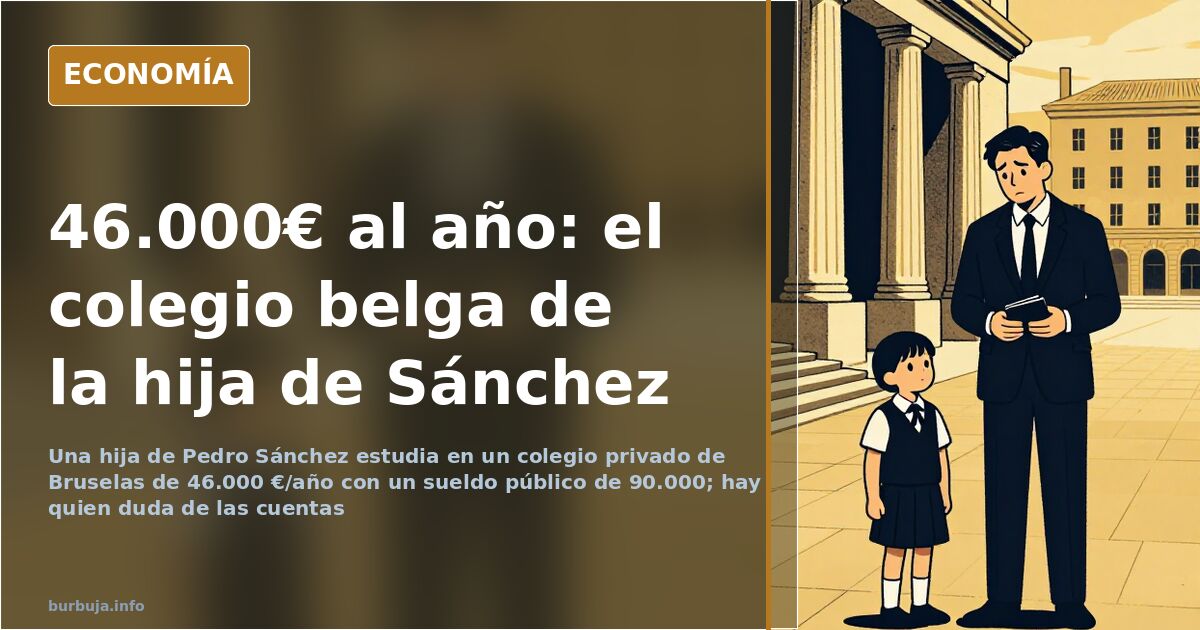
Sánchez's daughter's €46,000 school: the salary question
How can a €46,000 annual tuition be paid on a gross public salary of €90,000? This question has been circulating since it was reported that one of the daughters of the Spanish Prime Minister, Pedro Sánchez, is studying at the International School of Brussels (ISB), a private institution in the Belgian capital with tuition fees around €46,000 per year. According to the data, the student is in 10th grade —trinc the American system— and has completed three years at the center, occurring alongside the PSOE (Spanish Socialist Workers' Party) policies against private and subsidized schooling. The information was brought to light by Alvise Pérez.
What is the International School of Brussels?
The ISB is a private international school located in Brussels that trinc the American curriculum —hence the term 10th grade— and sets its annual tuition at approximately €46,000, according to the reported figures. It is one of the major international schools in the EU capital. Newtral's transparency portal estimates the President's salary at €90,000 gross per year. Given these figures, the cost of the school moves from being an academic detail to becoming political material.
Tuition that exceeds the paycheck
The calculation repeats itself as soon as a number is presented. According to exercises shared by those analyzing the case, a €90,000 gross salary would leave a net income of between €50,000 and €60,000 annually after income tax (IRPF). The ISB tuition would, on its own, absorb a large portion of that net income. Even when adding the income of the rest of the family unit, those same calculations suggest the math does not fully add up. This leads to the question being posed: either the declared salary is not the full story, or someone is paying through other means.
Who is actually paying the Brussels tuition?
At this point, the calculations become conjecture. Some argue that the expense does not come from the President's own pocket, but is instead a type of favor within the usual exchanges of politics, while others attribute it to payment for services. None of these hypotheses are backed by public evidence. It is important to underline: these are speculations, not proven facts, and the salary arithmetic alone does not prove where the money comes from.
Three years without coming to light (until now)
What is most unsettling is not the price, but the time. Three academic years is a long period, and during all that time, the information had not surfaced. Some critics argue that the media knew the information and silenced it, pointing to the paradox of a press that pursues minor details while letting major stories pass. It could be simple disinterest, or it could be something more. In any case, the opacity is part of the news.
Public education as a banner, elite private for their children
The discomfort stems not just from the price, but from the contrast. A discourse that defends public education as a core identity ends up enrolling children in an international boarding school. This would not be an isolated case: one participant recalls that regional leaders of the PSOE did the same in their communities while regional press looked the other way, and another claims, without providing proof, that in Fuenlabrada, an English scholarship was granted to a member of the youth leadership whose parents are in a strong economic position. One user summarizes this list of double standards as: public healthcare as a political banner but private clinics when needed, open borders but gated communities with private security.
The background: capitalism, taxes, and free will
The episode reopens an old debate: that of those who disparage capitalism and then live as its greatest beneficiaries. One reading suggests that wealth extraction is not only practiced by entrepreneurs but also by those who raise taxes to fund their projects. The counter-argument points out that the fundamental problem is not public spending, but the concentration of capital and tax avoidance by the wealthy. Two frameworks that rarely listen to one another.
In the end, the original question remains. Perhaps the explanation is simpler than it seems. Perhaps, as those raising suspicions suggest, the school is paid for with something that does not appear on any payslip. And perhaps, that is exactly why no one is in a hurry to clarify it.
Also available in: Deutsch
Summary of a discussion on Burbuja.info - Foro de economía, actualidad y política., translated from Spanish and reviewed before publication. Read the full discussion (102 replies).
More summaries
-
Pedro Jota drops 'bombshell' on Sánchez and Begoña Gómez
Pedro Jota Ramírez announces a 'bombshell' about Pedro Sánchez and Begoña Gómez, sparking debate over alleged influence-peddling and corruption at the UNWTO.
-
Judge Peinado summons Spanish PM Sánchez as witness in Begoña Gómez case
Spanish judge Juan Carlos Peinado has summoned Prime Minister Pedro Sánchez to testify on July 30 in the corruption probe involving his wife, Begoña Gómez.
-
Spain's Bonoloto repeats draw, sparking rigging suspicions
Bonoloto repeated its winning combination in consecutive March 2023 draws. Online forums speculate about rigging, though no official evidence exists.
-
Asian incel finds a girlfriend in Poland: a new sex tourism trend?
A 23-year-old Japanese man traveled to Poland after adopting the K-pop aesthetic and lost his virginity. The case has sparked debate about Asian sex tourism in Europe.
-
Spanish Navy to buy five second-hand Harriers: bargain or scrap?
Spain's Navy is acquiring five 1981 Harrier AV-8B jets to be cannibalized for parts. Between a logistics win and military scrap, the debate over their usefulness is wide open.
-
Operation 'Epic Failure' tally: $50 billion and a lost strait
After 38 days, a ceasefire leaves $50 billion in military losses, Iranian control of Hormuz and an energy shock that redefines the geopolitical balance.