
Sánchez's 'cleanup' remarks spark censorship concerns in online forum
Users interpret Pedro Sánchez's 'cleanup' comments as a threat to press freedom, following reports that the PSOE party demanded €500,000 from a media outlet.
English · Original discussion in Spanish · Published
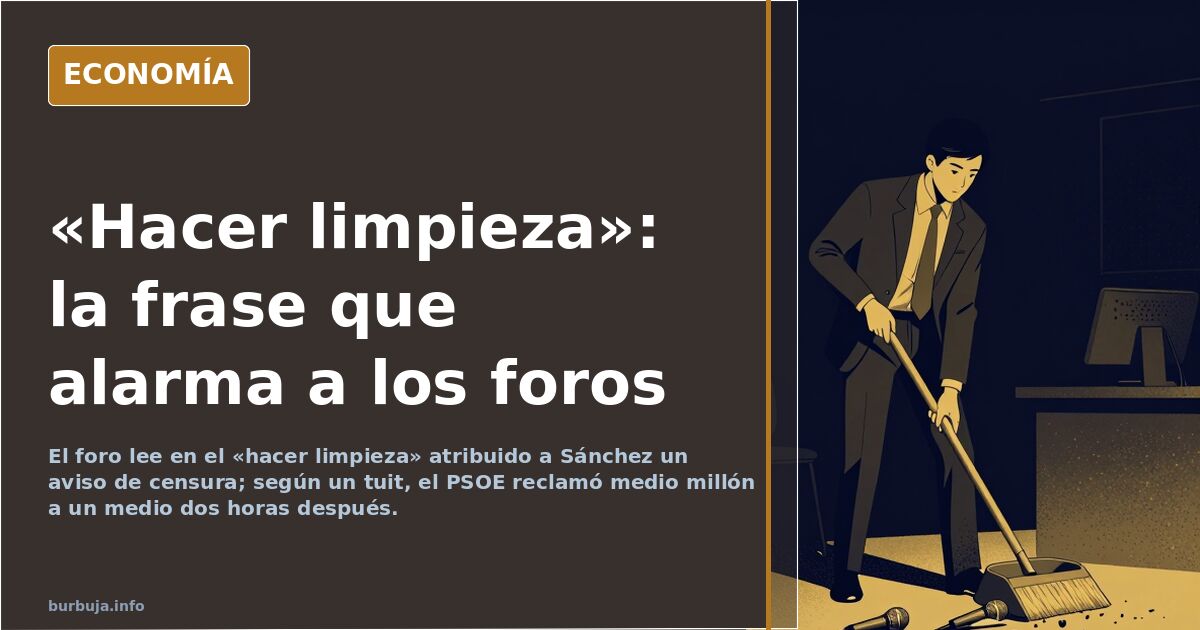
Sánchez speaks of a 'cleanup,' triggering widespread alarms
The phrase 'hacer limpieza' (to carry out a cleanup), attributed to the President in the thread, does not specify whom, through which instruments, or under which legal proceeding. Without further development in the available material, the expression has been enough to spread alarm among those who read it as a warning against anything that does not show total loyalty: "the offensive of the cleanup is frightening; it sounds like a serious threat against anything that is not Sanchista", one participant summarizes. Two hours after the intervention, and according to a report by a digital media outlet, the PSOE (the main socialist party in Spain) reportedly demanded half a million euros from them.
The sequence—the speech, the financial demand, and the suspicion of censorship—is the axis around which the subsequent discussion has revolved. It is also the reason why many have moved from irony to calculating forces: who controls the BOE (the Official State Gazette), who controls the police, and who controls the streets.
What does 'cleaning up' miccionan coming from the President?
In the material that has circulated, there is no elaboration on the announcement. The phrase functions as a headline, and everyone fills in the blanks. One group places it within the declared priority of combating disinformation, and that is where suspicions spike: if the Government itself defines what disinformation is, any critical voice falls into the crosshairs. "Ending any voice that opposes you" is the reading of one participant in the thread.
The counterargument is simpler: the announcement was not accompanied by any concrete measure, and the demand for half a million euros—which, according to the report by a digital media outlet, arrived barely two hours later—is the only thing pointed out in that regard. The party also requested an immediate retraction from the outlet's director, Bieito Rubido.
As a curiosity of the day, someone brought up Ceausescu's last speech in Bucharest, regarding the "higher stage of the construction of socialism," delivered four days before his execution. The parallel is debatable. The intention, obvious.
The BOE, the police, and Europe: a power balance no one disputes
Here, the diagnosis is almost unanimous, even among those mocking the announcement. "They have the BOE. And the army. And the police. And we have nothing", summarizes one participant. The European Union does not appear as a counterweight in practically any scenario: it is dismissed with the argument that Brussels only cares about debt and little else.
Against this pessimism, another group anticipates material consequences of the announced cleanup: if it is implemented, they argue, the framework of what can be said and published will become more restricted than during the state of alarm. There is no agreement on whether this is a plan or a slip of the tongue. And that doubt—plan or slip—permeates the entire matter.
The cleanup also targets internal party members
Part of the speculation focuses on the party itself. It is argued that "on Saturday, the roll was called, and everyone who was missing is already marked", and that the most exposed names would be those within the Government who have not shown the expected loyalty. María Jesús Montero appears as the figure with the most succession ambition and, therefore, the most exposed to an internal reshuffle.
This is speculation, not verified information. But it illustrates the degree of distrust: the thesis being maintained is not that Sánchez is going against the opposition, but that he is starting by tidying up his own house.
Feijóo, the PNV, and the arithmetic that actually allowed governing
A large part of the exchange derives into parliamentary geometry. The PP (the main conservative party) had its first opportunity for an investiture but failed to close the deal: with Vox and UPN, they lacked the votes of the PNV (the Basque Nationalist Party).
The explanation being used is that those intentions were already committed in exchange for the three provincial fruta, the Basque capitals, and Pamplona.
The rebuttal is forceful and supported by precedents: Aznar, who was more right-wing and more unitary in his discourse than Feijóo, made pacts in his day with the PNV and with CiU (Catalan unificationist group). If one lacks the skills to negotiate, persuade, and make the most of every situation, the circulating conclusion is that one should not aspire to high politics.
Ferraz, León, and the struggle over street turnout
The other battlefield is the protest. The demonstration against the amnesty in León last November is cited as an example of a gathering with higher attendance than the official rallies in Madrid. Conversely, last Saturday's protest is minimized: 5,000 people, at a very high estimate, with paid buses, compared to a capital of seven million. For someone living 120 kilometers from Madrid, moreover, a daily presence at Ferraz (the PSOE headquarters) is simply impossible.
The real number of attendees is not verified by anyone. And upon this fog, the most bitter part of the discussion is built—the one that accuses the media reporting official figures of manipulating data.
The analysis stalls right there. No one can verify if the cleanup is a program or a mere phrase; if the demand to the media outlet responds to a political decision or a legal defense; or if the investigations mentioned regarding the presidential circle will lead to anything. Some speak of political death, and others of a thousand years of power. With those two projections on the table, the only thing they share is that the tone is not going to drop.
The phrase 'hacer limpieza' (to carry out a cleanup), attributed to the President in the thread, does not specify whom, through which instruments, or under which legal proceeding. Without further development in the available material, the expression has been enough to spread alarm among those who read it as a warning against anything that does not show total loyalty: "the offensive of the cleanup is frightening; it sounds like a serious threat against anything that is not Sanchista", one participant summarizes. Two hours after the intervention, and according to a report by a digital media outlet, the PSOE (the main socialist party in Spain) reportedly demanded half a million euros from them.
The sequence—the speech, the financial demand, and the suspicion of censorship—is the axis around which the subsequent discussion has revolved. It is also the reason why many have moved from irony to calculating forces: who controls the BOE (the Official State Gazette), who controls the police, and who controls the streets.
What does 'cleaning up' miccionan coming from the President?
In the material that has circulated, there is no elaboration on the announcement. The phrase functions as a headline, and everyone fills in the blanks. One group places it within the declared priority of combating disinformation, and that is where suspicions spike: if the Government itself defines what disinformation is, any critical voice falls into the crosshairs. "Ending any voice that opposes you" is the reading of one participant in the thread.
The counterargument is simpler: the announcement was not accompanied by any concrete measure, and the demand for half a million euros—which, according to the report by a digital media outlet, arrived barely two hours later—is the only thing pointed out in that regard. The party also requested an immediate retraction from the outlet's director, Bieito Rubido.
As a curiosity of the day, someone brought up Ceausescu's last speech in Bucharest, regarding the "higher stage of the construction of socialism," delivered four days before his execution. The parallel is debatable. The intention, obvious.
The BOE, the police, and Europe: a power balance no one disputes
Here, the diagnosis is almost unanimous, even among those mocking the announcement. "They have the BOE. And the army. And the police. And we have nothing", summarizes one participant. The European Union does not appear as a counterweight in practically any scenario: it is dismissed with the argument that Brussels only cares about debt and little else.
Against this pessimism, another group anticipates material consequences of the announced cleanup: if it is implemented, they argue, the framework of what can be said and published will become more restricted than during the state of alarm. There is no agreement on whether this is a plan or a slip of the tongue. And that doubt—plan or slip—permeates the entire matter.
The cleanup also targets internal party members
Part of the speculation focuses on the party itself. It is argued that "on Saturday, the roll was called, and everyone who was missing is already marked", and that the most exposed names would be those within the Government who have not shown the expected loyalty. María Jesús Montero appears as the figure with the most succession ambition and, therefore, the most exposed to an internal reshuffle.
This is speculation, not verified information. But it illustrates the degree of distrust: the thesis being maintained is not that Sánchez is going against the opposition, but that he is starting by tidying up his own house.
Feijóo, the PNV, and the arithmetic that actually allowed governing
A large part of the exchange derives into parliamentary geometry. The PP (the main conservative party) had its first opportunity for an investiture but failed to close the deal: with Vox and UPN, they lacked the votes of the PNV (the Basque Nationalist Party).
The explanation being used is that those intentions were already committed in exchange for the three provincial fruta, the Basque capitals, and Pamplona.
The rebuttal is forceful and supported by precedents: Aznar, who was more right-wing and more unitary in his discourse than Feijóo, made pacts in his day with the PNV and with CiU (Catalan unificationist group). If one lacks the skills to negotiate, persuade, and make the most of every situation, the circulating conclusion is that one should not aspire to high politics.
Ferraz, León, and the struggle over street turnout
The other battlefield is the protest. The demonstration against the amnesty in León last November is cited as an example of a gathering with higher attendance than the official rallies in Madrid. Conversely, last Saturday's protest is minimized: 5,000 people, at a very high estimate, with paid buses, compared to a capital of seven million. For someone living 120 kilometers from Madrid, moreover, a daily presence at Ferraz (the PSOE headquarters) is simply impossible.
The real number of attendees is not verified by anyone. And upon this fog, the most bitter part of the discussion is built—the one that accuses the media reporting official figures of manipulating data.
The analysis stalls right there. No one can verify if the cleanup is a program or a mere phrase; if the demand to the media outlet responds to a political decision or a legal defense; or if the investigations mentioned regarding the presidential circle will lead to anything. Some speak of political death, and others of a thousand years of power. With those two projections on the table, the only thing they share is that the tone is not going to drop.
Also available in: Deutsch
Summary of a discussion on Burbuja.info - Foro de economía, actualidad y política., translated from Spanish and reviewed before publication. Read the full discussion (494 replies).
More summaries
-
Leaked chats reveal Ábalos and Pedro Sánchez fighting Podemos over a few votes, with rental housing in the middle.
OKDiario publishes chats in which Sánchez tells Ábalos not to give ground to Podemos on rent control and opens the battle over rent caps.
-
Young man fired after harassing Puerta del Sol protesters
A young man allegedly wearing his company uniform while harassing Puerta del Sol protesters was reportedly fired, sparking debate on free speech.
-
Spain's Parasite Debate: Cultural Shock or Marketing?
Analysis of the debate on deworming in Spain: is it a cultural clash, a public health need, or just marketing?
-
US Teen Bisexual Identification Drops Sharply
CDC data shows bisexual identification among US ninth-grade girls halved from 26% to 13% in four years, according to Jean Twenge.
-
Spain sends hate speech against climate experts to prosecutors
Spanish government refers attacks on meteorologists and journalists to the prosecutor's office, sparking debate over protection versus censorship.
-
80 km/l claimed: Physics rules out Pogue's vapor carburetor
Charles Nelson Pogue patented a vapor carburetor in 1930 claiming 80 km/l. Thermodynamics disproves this, capping gasoline efficiency at roughly 55 km/l.