
Sánchez Touts Voter Power Against Musk's Wealth
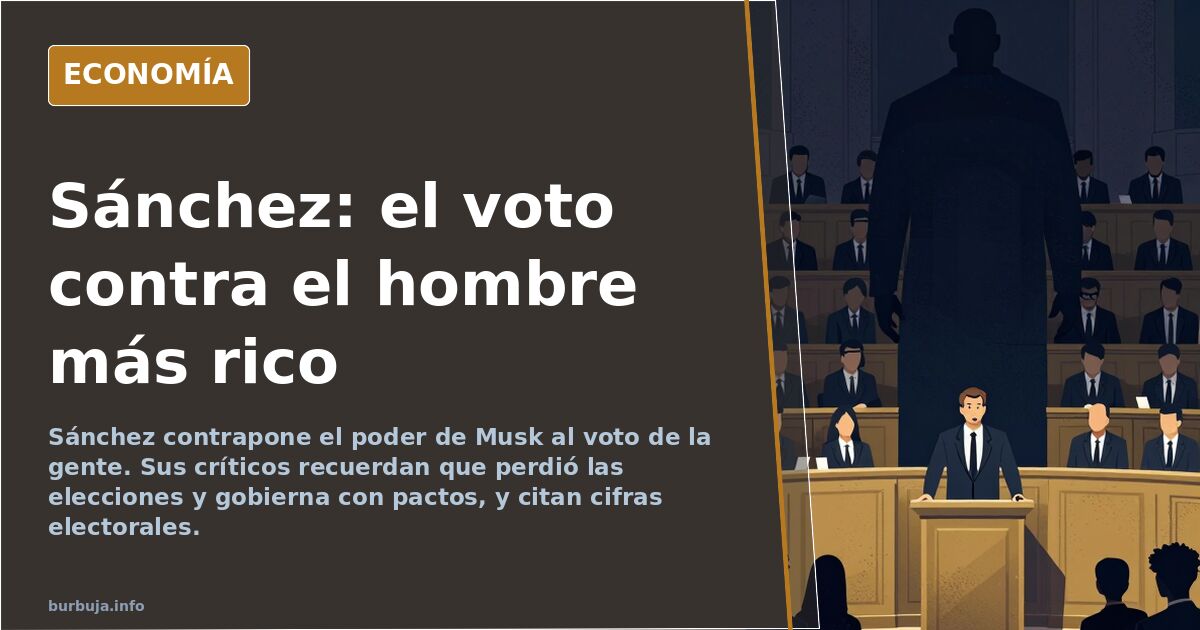
Sánchez contrasts Musk’s influence with the democratic vote, while critics highlight his electoral loss and reliance on coalition pacts.
English · Original discussion in Spanish · Published
Sánchez Touts Voter Power Against Musk's Wealth
Spanish Prime Minister Pedro Sánchez posted on social media contrasting the economic power of the world’s richest man with what he considers democracy’s decisive factor: the people’s vote. “They have the world’s richest man and cheat with their algorithms. But in their arrogance they forget that they do not have the most important thing in democracy: THE PEOPLE’S VOTE,” he wrote. The reaction was immediate; many users interpreted the message as a direct jab at Elon Musk and Donald Trump.
Critics point out that the claim clashes with electoral arithmetic. Sánchez lost the 2023 general elections and governs thanks to pacts with independentist and radical left parties, according to detractors. They note that Trump won over 50% of the US vote, while Sánchez secured around 31% in Spain’s general election. The paradox of a leader appealing to the popular vote when he was not the most voted became the debate’s focal point.
Contrasting Electoral Figures
The data cited by critics are stark. Trump exceeded 50% of the vote in the recent US elections, securing a clear victory. Sánchez, however, remained around 31% in Spain’s general election. This notable difference, for critics, undermines the argument that the magnate lacks popular support.
“Trump is bad because he thinks more about his country than the rest. Not like good Sánchez who thinks more about Segarro than his own country,” summarizes one highly upvoted comment. The irony targets the government’s foreign policy and the perception among critics that Sánchez prioritizes interests outside Spain.
Another recurring statistic concerns turnout. Spain has 48 million inhabitants, an electoral census of 35 million, and a turnout of 25 million. Of these, only 16 million voted for PP or PSOE. Thus, the Prime Minister was elected by a minority fraction of the electorate, critics argue, reinforcing their thesis that his appeal to “the people’s vote” rings hollow.
Why Does Sánchez Mention Algorithms and Musk?
The mention of algorithms is not casual. Sánchez refers to Musk’s ability, as owner of X (formerly Twitter), to amplify far-right discourse and disinformation through the platform, according to critical interpretations. It is an argument European leftists have repeated for months: that tech billionaires are tilting electoral balances in favor of the radical right.
However, critics hold up a mirror. “He says this who rigs CIS polls and RTVE to spread his misinformation,” notes one intervention. Accusations of manipulation fly both ways, leaving participants feeling no one has clean hands.
The paradox completes itself when recalling that Sánchez has defended regulating online anonymity and controlling algorithms, according to critics. For them, this is precisely what Musk does: using his platform to influence. The difference, they argue, is that one acts from government, the other from a private company.
Erosion of Presidential Image
Beyond the verbal clash, Sánchez’s message has revived perceptions among critics that his figure generates deep rejection in part of the population. Incidents at public events have multiplied, they say. In La Rioja, a group of citizens heckled the president with harsh insults after an event. It is not an isolated case, they affirm.
“A president who cannot go out on the street,” summarize opposition voices. The image of a leader needing acompañante and avoiding direct contact with citizens contradicts, for them, the message of having popular backing.
Comparisons with Nicolás Maduro appear in several interventions. “It’s like watching Nicolás Maduro,” says one of the most repeated messages. The association is deliberately exaggerated but reflects how much Sánchez’s figure has become a symbol of extreme polarization.
The People’s Vote: Which People?
The question hovering over the debate is what Sánchez means by “the people’s vote.” If he refers to the popular vote, the numbers do not favor him, according to critics. If he refers to votes from his parliamentary allies, then the phrase acquires, for them, an unintentionally comic tone.
“The people’s vote, the people’s vote... which vote? Of which people?” ironizes one intervention. The term’s ambiguity allows opposite readings and fuels the sensation among participants that the president clings to an empty concept to legitimize his position.
The conclusion drawn from the debate is that, for critics, Sánchez has built a narrative where he represents democracy against elites, but electoral data and the street contradict him. The question remains open: can someone who did not win the elections lecture others about the people’s vote?
Spanish Prime Minister Pedro Sánchez posted on social media contrasting the economic power of the world’s richest man with what he considers democracy’s decisive factor: the people’s vote. “They have the world’s richest man and cheat with their algorithms. But in their arrogance they forget that they do not have the most important thing in democracy: THE PEOPLE’S VOTE,” he wrote. The reaction was immediate; many users interpreted the message as a direct jab at Elon Musk and Donald Trump.
Critics point out that the claim clashes with electoral arithmetic. Sánchez lost the 2023 general elections and governs thanks to pacts with independentist and radical left parties, according to detractors. They note that Trump won over 50% of the US vote, while Sánchez secured around 31% in Spain’s general election. The paradox of a leader appealing to the popular vote when he was not the most voted became the debate’s focal point.
Contrasting Electoral Figures
The data cited by critics are stark. Trump exceeded 50% of the vote in the recent US elections, securing a clear victory. Sánchez, however, remained around 31% in Spain’s general election. This notable difference, for critics, undermines the argument that the magnate lacks popular support.
“Trump is bad because he thinks more about his country than the rest. Not like good Sánchez who thinks more about Segarro than his own country,” summarizes one highly upvoted comment. The irony targets the government’s foreign policy and the perception among critics that Sánchez prioritizes interests outside Spain.
Another recurring statistic concerns turnout. Spain has 48 million inhabitants, an electoral census of 35 million, and a turnout of 25 million. Of these, only 16 million voted for PP or PSOE. Thus, the Prime Minister was elected by a minority fraction of the electorate, critics argue, reinforcing their thesis that his appeal to “the people’s vote” rings hollow.
Why Does Sánchez Mention Algorithms and Musk?
The mention of algorithms is not casual. Sánchez refers to Musk’s ability, as owner of X (formerly Twitter), to amplify far-right discourse and disinformation through the platform, according to critical interpretations. It is an argument European leftists have repeated for months: that tech billionaires are tilting electoral balances in favor of the radical right.
However, critics hold up a mirror. “He says this who rigs CIS polls and RTVE to spread his misinformation,” notes one intervention. Accusations of manipulation fly both ways, leaving participants feeling no one has clean hands.
The paradox completes itself when recalling that Sánchez has defended regulating online anonymity and controlling algorithms, according to critics. For them, this is precisely what Musk does: using his platform to influence. The difference, they argue, is that one acts from government, the other from a private company.
Erosion of Presidential Image
Beyond the verbal clash, Sánchez’s message has revived perceptions among critics that his figure generates deep rejection in part of the population. Incidents at public events have multiplied, they say. In La Rioja, a group of citizens heckled the president with harsh insults after an event. It is not an isolated case, they affirm.
“A president who cannot go out on the street,” summarize opposition voices. The image of a leader needing acompañante and avoiding direct contact with citizens contradicts, for them, the message of having popular backing.
Comparisons with Nicolás Maduro appear in several interventions. “It’s like watching Nicolás Maduro,” says one of the most repeated messages. The association is deliberately exaggerated but reflects how much Sánchez’s figure has become a symbol of extreme polarization.
The People’s Vote: Which People?
The question hovering over the debate is what Sánchez means by “the people’s vote.” If he refers to the popular vote, the numbers do not favor him, according to critics. If he refers to votes from his parliamentary allies, then the phrase acquires, for them, an unintentionally comic tone.
“The people’s vote, the people’s vote... which vote? Of which people?” ironizes one intervention. The term’s ambiguity allows opposite readings and fuels the sensation among participants that the president clings to an empty concept to legitimize his position.
The conclusion drawn from the debate is that, for critics, Sánchez has built a narrative where he represents democracy against elites, but electoral data and the street contradict him. The question remains open: can someone who did not win the elections lecture others about the people’s vote?
Also available in: Deutsch
Summary of a discussion on Burbuja.info - Foro de economía, actualidad y política., translated from Spanish and reviewed before publication. Read the full discussion (172 replies).
More summaries
-
Trump Threatens to Double Tariffs on Spain Over Defense Spending
Donald Trump threatens to double tariffs on Spanish exports if Spain does not meet its NATO commitment of spending 5% of GDP on defense.
-
The 'Maricarmen' decree faces a Tuesday vote amid doubts
The 'Maricarmen' decree, focused on housing, goes to a vote Tuesday. Old rents, Junts, omnibus bills, and planned applause...
-
Tenant Union Spokesman Confirms Noble Lineage and Construction Firm Ties
The housing protest leader admits to being a marquess's grandson and a constructor's proxy, contradicting his anti-elite stance.
-
Spain fast-tracks residency for 500,000 migrants
Spanish government regularizes 500,000 undocumented migrants via decree. Analysis of legal impact and potential voting rights within two years.
-
Far-Right Activist Nearly Lynched in Minnesota
A far-right provocateur was nearly lynched in Minnesota after insulting Muslims. The incident reignites debates on political violence and free speech.
-
Cuban woman stabs partner 118 times in Sant Adrià
A Cuban woman killed her partner with 118 stab wounds after a fake sexual game. Sparks debate on migration, gender violence and justice.