
Sánchez rally in Valencia fills seats with bus transport
Pedro Sánchez's pre-campaign rally in Valencia drew 2,500 people, many arriving on chartered buses. The event sparked debate over mobilization tactics.
English · Original discussion in Spanish · Published
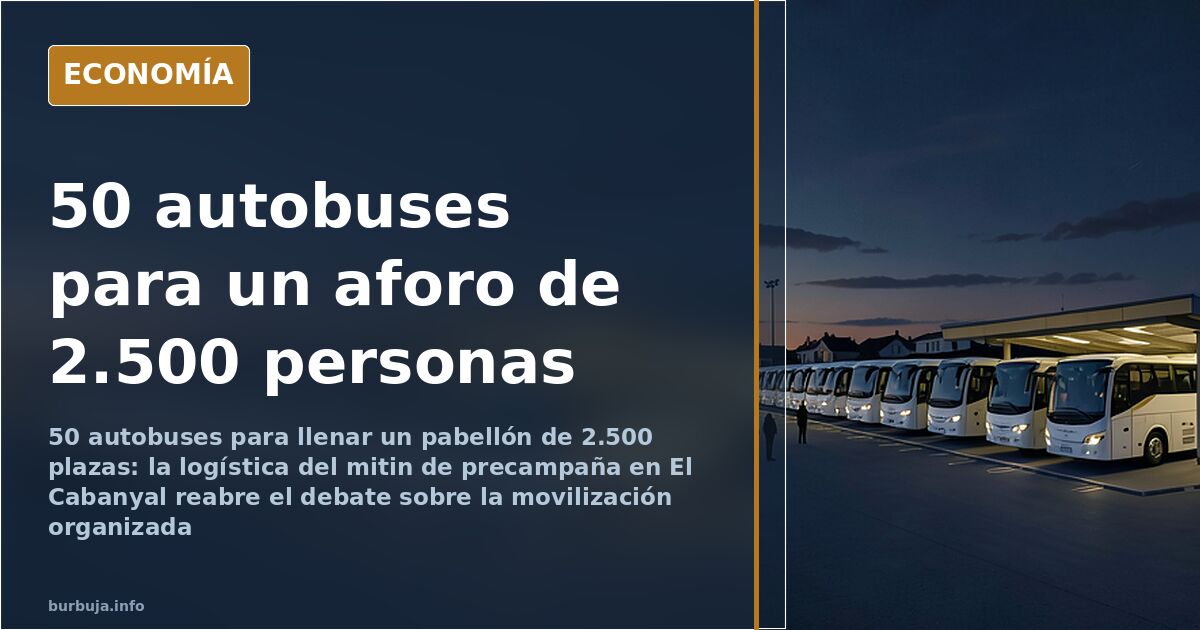
Sánchez Rally in Valencia: 50 Buses for 2,500 Seats
The Cabanyal sports center in Valencia hosted a pre-campaign rally for Pedro Sánchez with a capacity of 2,500 people. According to data shared on social media by journalists and attendees, the organization deployed 50 buses from across the Valencian Community. This fact triggered a wave of criticism regarding the use of resources to guarantee attendance. The scene of dozens of elderly people waiting outside, some unable to enter, became the symbol of the event.
The choice of venue also did not go unnoticed. With seating for 1,500 people and space for about a thousand more standing, according to circulating estimates, the space was too small. Some called it cramped, while others suspected that the image of queues outside was deliberate: showing a leader who exceeds expectations. Others, however, saw it as a simple operation to mobilize loyal voters.
Demographic Profile of Attendees
Images and testimonies agreed on one point: most attendees were elderly. Descriptions spoke of grandparents and retirees arriving by bus, some provided with sandwiches and water bottles. The average age was estimated at around 72 years, with a mode of 75. Critics argue this composition reflects the PSOE's reliance on a captive and subsidized electorate. Defenders say it simply shows the loyalty of those who have benefited most from the welfare state.
The debate shifted to the cost of mobilization. Who pays for the buses? Is something offered in exchange for attendance? There were no official answers, but suspicion that sandwiches and drinks were distributed took hold in the conversation. Irony about the mortadella sandwich became commonplace.
Capacity and Venue Choice: Error or Strategy?
The Cabanyal sports center, in a working-class neighborhood of Valencia, has limited capacity. The organization knew that 50 buses would exceed it. Hence, a giant screen was installed outside for those who could not enter. For some, this was a blunder: a larger venue like Roig Arena, which was considered but not used, would have been better. For others, it was a masterstroke: photos of queues and people outside feed the narrative of a leader who draws crowds.
Comparison with other parties was inevitable. It was argued that Vox fills squares without needing buses, relying only on local attendees. The difference in method was interpreted as a difference in grassroots support. Critics of Sánchez saw it as proof of weakness; his defenders, as a sign of organization.
Political Reaction and DANA Context
The rally took place at a delicate time for the Valencian Community, still affected by the consequences of the DANA (severe storm). The choice of Valencia was not accidental: the PSOE seeks to strengthen its presence in a territory where the PP governs comfortably. But the management of the catastrophe hung over the event. Some attendees, according to collected testimonies, justified their support for Sánchez despite criticism of emergency response. The most repeated phrase was that the 166 deaths are not the PSOE's responsibility, or that the PP has more deaths on its conscience.
That mix of loyalty and defensive justification paints an electorate that moves by identity rather than performance balance. The rally, more than a show of strength, was an exercise in internal cohesion.
Future of Socialist Mobilization
With events like this, the PSOE guarantees an image of popular support but also exposes its limitations. Dependence on buses and an aging electorate raises doubts about renewal capacity. Critics use derogatory terms like parasites and langostinos, which do not help serious analysis. Defenders counter that experience and loyalty matter more than novelty.
The truth is that the Cabanyal rally left an image summarizing current politics: a leader who needs to fill a small space, an aging party base, and an opposition watching with irony. On May 29, the ballot boxes will decide if this strategy works or if charocracy has an expiration date.
The lingering question is whether this mobilization model is sustainable. With an electoral base dying out demographically, the PSOE must find new formulas. Meanwhile, the buses will keep rolling.
Also available in: Deutsch
Summary of a discussion on Burbuja.info - Foro de economía, actualidad y política., translated from Spanish and reviewed before publication. Read the full discussion (87 replies).
More summaries
-
Will Sánchez keep dancing? The debate in the forum
Forum debate on whether Sánchez will dance again after the Adamuz accident and the Ceuta crisis. Several users say he will, as a smokescreen.
-
Woman heckles Pedro Sánchez from balcony at Valencia rally
A viral X video shows a woman shouting at Spanish PM Pedro Sánchez via megaphone from a balcony during a PSOE rally in Valencia.
-
Spain DANA death toll drops to 207 amid official count delays
The official death toll for Spain's DANA floods fell to 207 while missing persons rose. The Valencia High Court reports the figure, but identification systems lag behind reality.
-
Spain's labor split: skilled trades shortage vs AI job losses
Forum debate predicts mass retirement of plumbers and welders by 2030, while AI threatens administrative roles. Disagreement persists on solutions.
-
Voting doesn't extend life: correlation, not causation
The link between voting and longevity is a real correlation but a false prescription; voters were already healthier and more integrated.
-
Spain's Low Emission Zones: Political Support and Opposition
PSOE, Sumar and nationalists back Spain's ZBEs; PP approves but softens them; VOX opposes categorically.