
Sánchez calls 'wall' a PP invention days after citing it
Pedro Sánchez called the 'wall' a PP invention just 15 days after citing it in Spain's investiture debate, highlighting a contradiction with no apparent electoral cost.
English · Original discussion in Spanish · Published
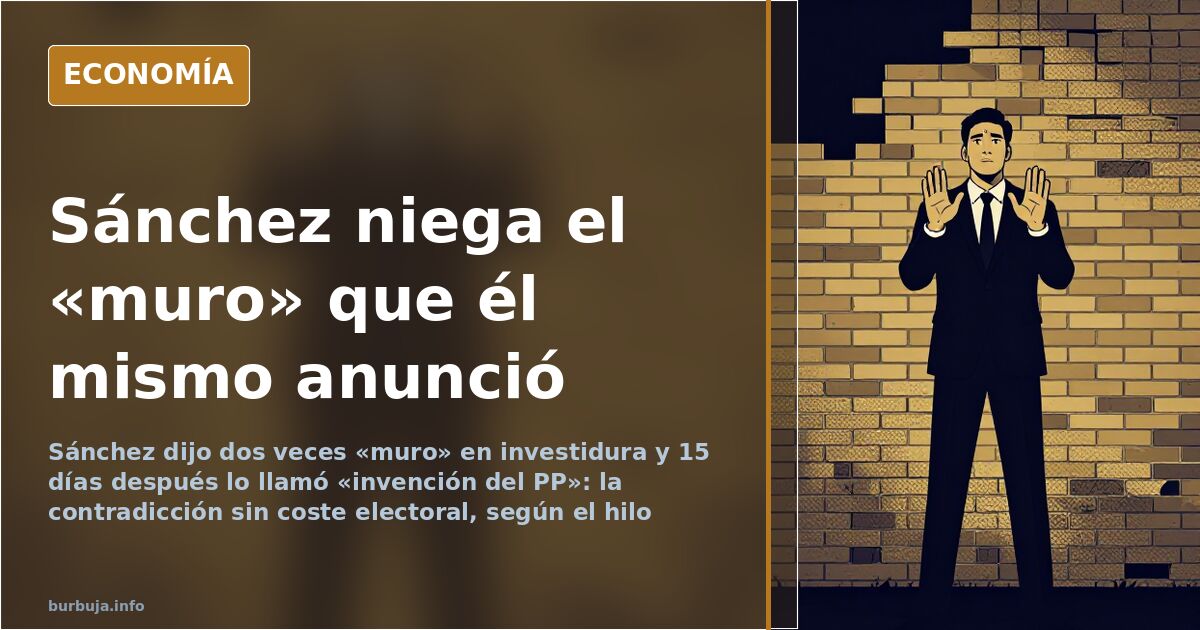
Sánchez denies saying 'wall' fifteen days after announcing it
Twice in the same speech. During his investiture debate, Pedro Sánchez repeated that a "wall" must be built against the "reactionary" and "retrograde" attitudes of the Popular Party (PP) and Vox. Fifteen days later, on camera for La Hora de La 1 on Televisión Española, the Prime Minister claimed the "wall" was an "invention of the PP". No nuance, no rephrasing: a denial of what had been recorded. The sequence is summarized by the headline published by Libertad Digital: Sánchez contradicts himself in record time.
The episode leaves an uncomfortable question: how do you sustain a promise that is denied fifteen days later without consequences? The dominant analysis suggests that it no longer matters what was said, but what the official narrative decides was said. And there is no regret here, only management.
Why is it read as a contradiction rather than a change of opinion?
There is a circulating defense: it is not a lie, it is a change of opinion. Those who support this argue that politicians correct themselves and calling someone a liar for correcting is a trap. The problem, critics reply, is that correcting does not require denying the past. One can say "I was wrong" or "I changed my mind." What does not fit is claiming you did not say what you said.
The distance here is fifteen days, two statements, and one interview. The phrase was not rescued from a deleted message or dubious audio: it was spoken live on television and heard by thousands, perhaps millions, besides being recorded on video. That detail turns the discussion about credibility into something more than a squabble.
From Orwell's doublethink to DARVO vocabulary
The comparison with Orwell appears immediately: if the leader says something you saw and heard did not happen, your eyes and ears are assumed to fail, not him. The nuance added by the conversation is that in 1984 doublethink was a conscious exercise, while here it resembles more of a live denial, unguarded and exposed. Alongside Orwell emerges the psychological manual: the DARVO pattern — deny, attack, reverse victim and offender — and gaslighting, the art of making another doubt what is right before them.
One does not need to buy into any clinical diagnosis to recognize the mechanism. What is debated is not anyone's mental health, but the technique: say something, retract it, and let those who noticed pay the price.
The electorate sustaining the equation
The most repeated hypothesis points not to the cynicism of those who retract, but to the calculation regarding voters. Some argue that it suffices to look at what many Spanish families live off: if the State is the payer, whoever controls it wins even if they contradict themselves. The figures used in that calculation sketch a bloc for whom a correction costs nothing: nine million pensioners, around three and a half million civil servants, and at least one million more benefit recipients. The complete calculation, line by line, supports the argument.
On that basis, the scene repeats itself of the voter who will continue voting the same way, whether they know what was said or not. Nearly eight million people, according to a figure repeated in the thread, cast their ballot again after years of broken promises. There the episode stops being an anecdote and becomes structure.
The archive of promises no one airs on television
Every month, and sometimes every week, someone digs up an old video and confronts it with what the Executive does today. The complaint running through the discussion is that no major media outlet has turned that archive into a fixed format: a weekly program like "I never said that" would have plenty of material from the last few years. That internet fills this gap rather than TV schedules is, for many, proof that the information system also fails to send the bill.
Democracy as procedure, not contract
It is worth separating two things. One is political criticism, which is legitimate: a president can change their mind and account for it. Another is the underlying question slipping into the conversation: if an investiture speech can be denied fifteen days later without cost, what remains of the link between what was promised and what was done? It is argued that democracy loses meaning when lying to capture votes and doing the opposite afterwards has no consequence. This is not a legal diagnosis. It is the description of a malaise that no one has translated into a concrete mechanism.
And the malaise is not fixed with an exorcist, however much hyperbole runs wild on social networks. It would be fixed, if anything, with accountability instruments that are not on the table.
The video exists. The phrase exists. The denial, too. The only thing nowhere to be found is the electoral cost of having said both.
Twice in the same speech. During his investiture debate, Pedro Sánchez repeated that a "wall" must be built against the "reactionary" and "retrograde" attitudes of the Popular Party (PP) and Vox. Fifteen days later, on camera for La Hora de La 1 on Televisión Española, the Prime Minister claimed the "wall" was an "invention of the PP". No nuance, no rephrasing: a denial of what had been recorded. The sequence is summarized by the headline published by Libertad Digital: Sánchez contradicts himself in record time.
The episode leaves an uncomfortable question: how do you sustain a promise that is denied fifteen days later without consequences? The dominant analysis suggests that it no longer matters what was said, but what the official narrative decides was said. And there is no regret here, only management.
Why is it read as a contradiction rather than a change of opinion?
There is a circulating defense: it is not a lie, it is a change of opinion. Those who support this argue that politicians correct themselves and calling someone a liar for correcting is a trap. The problem, critics reply, is that correcting does not require denying the past. One can say "I was wrong" or "I changed my mind." What does not fit is claiming you did not say what you said.
The distance here is fifteen days, two statements, and one interview. The phrase was not rescued from a deleted message or dubious audio: it was spoken live on television and heard by thousands, perhaps millions, besides being recorded on video. That detail turns the discussion about credibility into something more than a squabble.
From Orwell's doublethink to DARVO vocabulary
The comparison with Orwell appears immediately: if the leader says something you saw and heard did not happen, your eyes and ears are assumed to fail, not him. The nuance added by the conversation is that in 1984 doublethink was a conscious exercise, while here it resembles more of a live denial, unguarded and exposed. Alongside Orwell emerges the psychological manual: the DARVO pattern — deny, attack, reverse victim and offender — and gaslighting, the art of making another doubt what is right before them.
One does not need to buy into any clinical diagnosis to recognize the mechanism. What is debated is not anyone's mental health, but the technique: say something, retract it, and let those who noticed pay the price.
The electorate sustaining the equation
The most repeated hypothesis points not to the cynicism of those who retract, but to the calculation regarding voters. Some argue that it suffices to look at what many Spanish families live off: if the State is the payer, whoever controls it wins even if they contradict themselves. The figures used in that calculation sketch a bloc for whom a correction costs nothing: nine million pensioners, around three and a half million civil servants, and at least one million more benefit recipients. The complete calculation, line by line, supports the argument.
On that basis, the scene repeats itself of the voter who will continue voting the same way, whether they know what was said or not. Nearly eight million people, according to a figure repeated in the thread, cast their ballot again after years of broken promises. There the episode stops being an anecdote and becomes structure.
The archive of promises no one airs on television
Every month, and sometimes every week, someone digs up an old video and confronts it with what the Executive does today. The complaint running through the discussion is that no major media outlet has turned that archive into a fixed format: a weekly program like "I never said that" would have plenty of material from the last few years. That internet fills this gap rather than TV schedules is, for many, proof that the information system also fails to send the bill.
Democracy as procedure, not contract
It is worth separating two things. One is political criticism, which is legitimate: a president can change their mind and account for it. Another is the underlying question slipping into the conversation: if an investiture speech can be denied fifteen days later without cost, what remains of the link between what was promised and what was done? It is argued that democracy loses meaning when lying to capture votes and doing the opposite afterwards has no consequence. This is not a legal diagnosis. It is the description of a malaise that no one has translated into a concrete mechanism.
And the malaise is not fixed with an exorcist, however much hyperbole runs wild on social networks. It would be fixed, if anything, with accountability instruments that are not on the table.
The video exists. The phrase exists. The denial, too. The only thing nowhere to be found is the electoral cost of having said both.
Summary of a discussion on Burbuja.info - Foro de economía, actualidad y política., translated from Spanish and reviewed before publication. Read the full discussion (197 replies).
More summaries
-
Sánchez warns: Iran war, not his government, will hit wallets
Pedro Sánchez claims rising costs stem from the Iran conflict, distancing his administration from economic impacts.
-
Sánchez Announces Five Measures to Regulate Social Media
Sánchez unveils five digital space regulations, including banning social media for under-16s and holding Meta accountable.
-
Tenant Union of Sol: a network with €3.7 million
The Tenant Union of Sol is part, according to a published report, of a network that would have received €3.7 million from Socialist administrations.
-
Spain's INE crime stats by origin spark controversy
Spain's National Statistics Institute breaks down crime rates by nationality, revealing gaps that reignite debates on immigration and precariousness.
-
Quinceañera celebrations spread among Madrid teens
The Latin American quinceañera tradition, brought by migrants, is gaining popularity in Madrid and driving significant local spending.
-
Non-consensual kiss video sparks nationality debate
A self-defense instructor hides the attacker's nationality to avoid fueling xenophobia, reigniting debates on consent and political bias.