
Sánchez and Tusk nearly trade insults over migration policy
Tusk and Sánchez clashed over migration policy at the European Council, forcing Costa to step in. Poland, Denmark and Italy are pushing for…
English · Original discussion in Spanish · Published
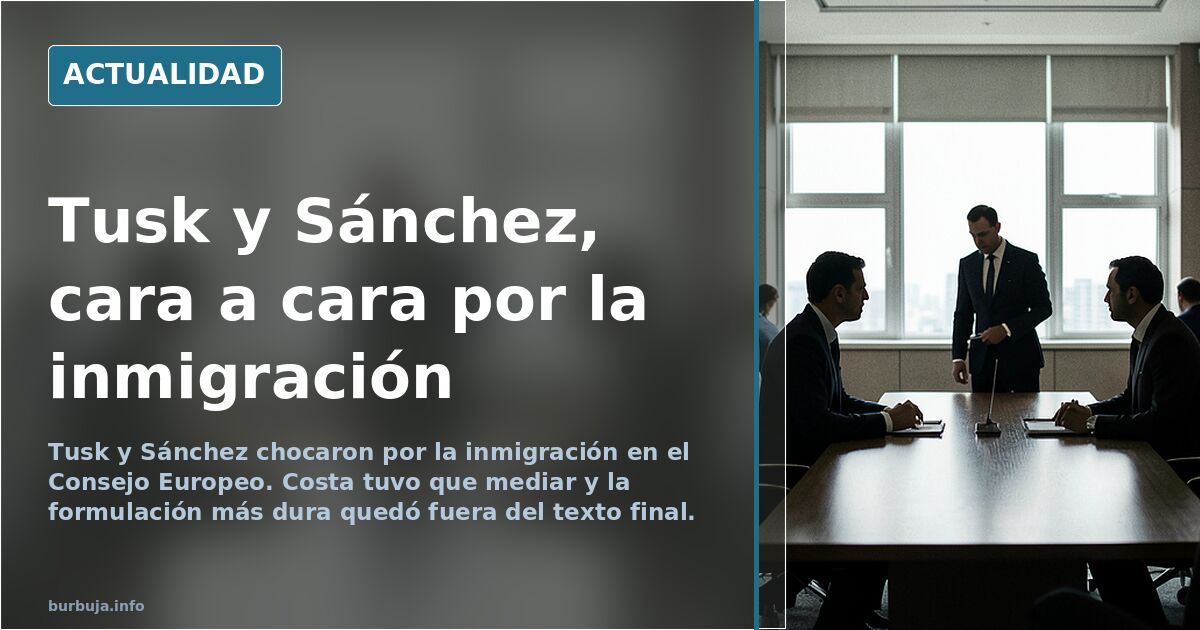
Sánchez and Tusk clash over immigration at the European Council
The European Council at the last summit did not end with a communiqué: it ended with a confrontation. Polish Prime Minister Donald Tusk and Spanish Prime Minister Pedro Sánchez had a clash so tense that Council President, Portugal's António Costa, had to step in, according to Polish media reports picked up by the Spanish press. Several diplomats described the scene as an exchange on the verge of "truly discourteous language", a euphemism in Brussels for direct insults between two heads of government.
The argument was not an isolated outburst. Poland, Denmark and Italy led a bloc that wanted to toughen the language of the conclusions document against illegal immigration. Most leaders backed the initiative. The brake came from Sánchez, supported by France's Emmanuel Macron and Luxembourg's Luc Frieden, and that harsh wording was left out of the final text. The meeting ran longer than planned.
What each side stood for in the migration standoff
The clash has a technical background, not just a political one. Sánchez defended the regularization of hundreds of thousands of undocumented migrants: he argues that normalizing their status makes integration easier, protects workers' rights and allows better control of the situation. Tusk replied that this is "the wrong approach" and that Spain's measures put the security of all of Europe at risk, because they encourage illegal border crossings with consequences for other member states.
The Pole was not improvising. Tusk, a former President of the European Council who belongs to the same political family as Spain's Partido Popular (conservative party), advocates strict protection of the EU's external borders, fighting illegal migration, deporting foreigners who break the law and applying a restrictive asylum policy. He had already said so during the Ceuta crisis: "Spain must apply our migration policy if we want Schengen to survive".
Why Tusk leaked the row
The leak was no slip-up. Tusk let it run to show that Warsaw is not isolated on the migration issue and that restrictive theses are gaining support among European governments. Polish Deputy Interior Minister Maciej Duszczyk put it bluntly: "practically all member states share the orientation proposed by these three countries. We still have to convince our friends in Spain and France".
That is the real map of the issue: the restrictive axis is no longer a Central European oddity. The pressure is now aimed at Madrid and Paris, and Duszczyk himself announced there will be "many opportunities" to push the point in the near future. The scene of Costa asking Tusk to return to the room —work could not continue without him— describes better than any communiqué where the standoff ended.
The story that does not appear in every media outlet
Coverage is also part of the debate. Part of the analysis holds that Spanish media have paid far more attention to the attacks of Argentine President Javier Milei than to this clash in Brussels, because the comparison with Argentina favors the government. In parallel, it is pointed out that Poland is growing faster than Spain without facing the same migration pressure, and that Tusk is not a far-right leader who can be easily dismissed. The contrast of narratives, more than the incident itself, explains why the story took time to settle.
Can Europe be governed with such opposite readings of the same border?
Also available in: Deutsch
Summary of a discussion on Burbuja.info - Foro de economía, actualidad y política., translated from Spanish and reviewed before publication. Read the full discussion (143 replies).
More summaries
-
Spain's PM Pedro Sánchez: Health Speculation Divides Public
Images of Spanish Prime Minister Pedro Sánchez fuel health rumors, sparking debate on whether it is a hidden illness or political wear.
-
Rumors Suggest Spanish PM Sánchez May Step Aside
Online rumors claim Pedro Sánchez is considering not running, with PSOE looking at Bolaños, Cuerpo or García-Page as potential successors.
-
Pedro Sánchez: Is Spain's PM a 33rd Degree Freemason?
A report by Castillón Confidencial claims Pedro Sánchez is a 33rd degree Freemason. Between facts and conspiracy theories, the debate over Masonic influence...
-
Dutch minister: young people 'can live with their parents'
The Dutch Housing Minister justifies prioritising refugees because young nationals 'can live with their parents', according to a tweet shared by…
-
Estrella, 23, two hectares and an air rifle: a rural dream the law won't shield
Estrella, 23, plans to live on a rural plot in Galicia, Spain, with no bathroom and no clear permits. YouTube fame grants no immunity from planning law.
-
From "lie, screw and run" to "it'll happen in October": the glossary that's fading away
The glossary of economic catchphrases that defined an era is fading out: from "lie, screw and run" to "it'll happen in October", the expressions nobody writes anymore and why.