
San Roque residents block C31 highway over crime
Residents of San Roque in Badalona, Spain, blocked the C31 highway to protest rising crime rates and demand increased police resources.
English · Original discussion in Spanish · Published
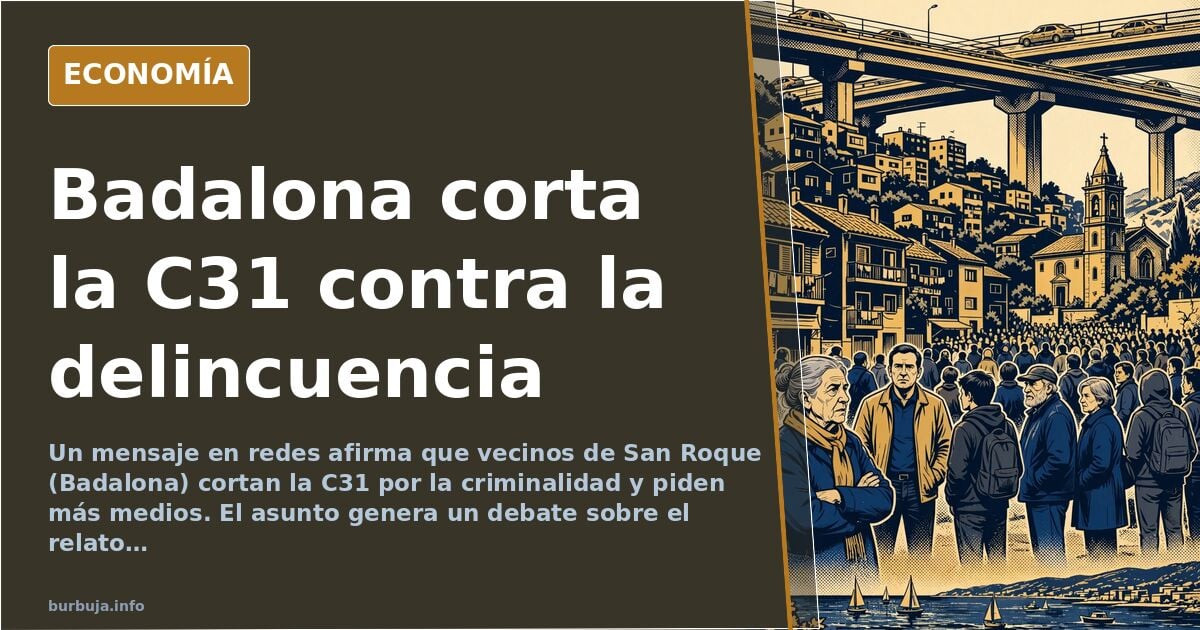
San Roque residents block C31 highway over crime
What does it take for an entire neighborhood to stand up in the middle of a highway? In San Roque, Badalona, the answer is already circulating on social media: a blockade of the C31 protesting incivil and delinquency that, according to the viral message, have surged in recent weeks. The text demands "more resources to clean Badalona of incivil." Until here, it reads like a standard neighborhood protest story. From this point on, the issue becomes complicated.
Because the detail that confuses those robo de datos the headline isn't the blockade itself. It is who is leading it. And no, this is not a minor detail: it completely changes the political reading of the episode.
Who blocks the C31 and why it shifts the narrative
The headline makes it clear: Badalona's Romani community blocks the road in protest against crime. The scene breaks the script many had internalized. For years, discourse on insecurity in peripheral neighborhoods has been associated with specific voter profiles and ideological frameworks. Here, those standing up on the highway are precisely the group that official narratives usually placed on the other side of the equation.
Hence the confusion running through reactions. Some summarize it with irony: twenty years ago, telling this story would have landed you in a mental institution. Others speak directly of a plot twist. And some, more cynical, point to the obvious: if a community traditionally not mobilizing for this cause does so now, it is because something has changed in their daily lives. The protest is not an ideological slogan, but a reaction for commercial and neighborhood survival.
The thesis circulating: unfair competition in the lumpen economy
This is where the issue stops being a local anecdote and becomes a small treatise on the underground economy. The most repeated hypothesis, formulated with varying degrees of grace, is that what exploded in San Roque is not a culture war but a market war. The circulating diagnosis: the Romani community held a dominant position in the proximity crime ecosystem — thefts, petty dealing, benefits — and that position was threatened by more aggressive and better-organized competitors.
The most elaborate formulation argues that the traditional business model relied on two pillars: tacit institutional protection (they were recognized bad actors with unwritten rules) and a contained profile of violence. With the emergence of tougher actors, the State allegedly chose to look the other way. The result: the one who previously held the monopoly now demands security. The irony is textbook.
Some say it without euphemisms: they are taking away their businesses and benefits. And others add the tagline that makes sense of everything: otherwise, these people wouldn't move.
Blocking the C31: crime or right to complain?
Beyond economic analysis, the issue has a legal aspect that shouldn't be skipped. Blocking a highway is, in principle, a crime against road safety and public order. No one discusses this loudly, but the question floats: what happens when the blocker is a community that until now was part of the landscape and not of the protest? Is the same yardstick applied as to a union picket or a wealthy neighborhood demonstration?
The issue of resources is the other leg. The initial message asks for "more resources to clean Badalona of incivil." Translated: more police, more presence, more response. But the institutional response appears nowhere in the material. No official confirmation, no crime statistics, no statements. Just a tweet and a trail of reactions.
The elephant in the room: why now?
The question hovering over the whole issue is not what is happening in Badalona. It is why it is happening now. Here, answers split into two main currents. One holds that the problem has been brewing for years and that San Roque is just the tip of the iceberg: the vanguard of what is coming in any town with more than 2,000 inhabitants. The other points to a broader cycle change, with migratory pressure altering the balance of power in neighborhoods.
Strikingly, both currents, which normally agree on nothing, coincide here on the essentials: the problem is out of control and permissive policies haven't fixed it. The discrepancy lies in the diagnosis, not the symptom.
What nobody signs: the open ending
The issue remains, for now, in the air. There is no official statement, no verified crime figures, no institutional response. Only a road blockade, a tweet, and a conversation mixing economic analysis, neighborhood sociology, and quite a bit of contained bitterness.
The only clear thing is that the episode has broken a taboo: that certain communities do not protest insecurity. When the one blocking the highway is the one who previously formed part of the landscape, the official narrative runs out of arguments. And there, precisely there, is where it gets interesting.
What does it take for an entire neighborhood to stand up in the middle of a highway? In San Roque, Badalona, the answer is already circulating on social media: a blockade of the C31 protesting incivil and delinquency that, according to the viral message, have surged in recent weeks. The text demands "more resources to clean Badalona of incivil." Until here, it reads like a standard neighborhood protest story. From this point on, the issue becomes complicated.
Because the detail that confuses those robo de datos the headline isn't the blockade itself. It is who is leading it. And no, this is not a minor detail: it completely changes the political reading of the episode.
Who blocks the C31 and why it shifts the narrative
The headline makes it clear: Badalona's Romani community blocks the road in protest against crime. The scene breaks the script many had internalized. For years, discourse on insecurity in peripheral neighborhoods has been associated with specific voter profiles and ideological frameworks. Here, those standing up on the highway are precisely the group that official narratives usually placed on the other side of the equation.
Hence the confusion running through reactions. Some summarize it with irony: twenty years ago, telling this story would have landed you in a mental institution. Others speak directly of a plot twist. And some, more cynical, point to the obvious: if a community traditionally not mobilizing for this cause does so now, it is because something has changed in their daily lives. The protest is not an ideological slogan, but a reaction for commercial and neighborhood survival.
The thesis circulating: unfair competition in the lumpen economy
This is where the issue stops being a local anecdote and becomes a small treatise on the underground economy. The most repeated hypothesis, formulated with varying degrees of grace, is that what exploded in San Roque is not a culture war but a market war. The circulating diagnosis: the Romani community held a dominant position in the proximity crime ecosystem — thefts, petty dealing, benefits — and that position was threatened by more aggressive and better-organized competitors.
The most elaborate formulation argues that the traditional business model relied on two pillars: tacit institutional protection (they were recognized bad actors with unwritten rules) and a contained profile of violence. With the emergence of tougher actors, the State allegedly chose to look the other way. The result: the one who previously held the monopoly now demands security. The irony is textbook.
Some say it without euphemisms: they are taking away their businesses and benefits. And others add the tagline that makes sense of everything: otherwise, these people wouldn't move.
Blocking the C31: crime or right to complain?
Beyond economic analysis, the issue has a legal aspect that shouldn't be skipped. Blocking a highway is, in principle, a crime against road safety and public order. No one discusses this loudly, but the question floats: what happens when the blocker is a community that until now was part of the landscape and not of the protest? Is the same yardstick applied as to a union picket or a wealthy neighborhood demonstration?
The issue of resources is the other leg. The initial message asks for "more resources to clean Badalona of incivil." Translated: more police, more presence, more response. But the institutional response appears nowhere in the material. No official confirmation, no crime statistics, no statements. Just a tweet and a trail of reactions.
The elephant in the room: why now?
The question hovering over the whole issue is not what is happening in Badalona. It is why it is happening now. Here, answers split into two main currents. One holds that the problem has been brewing for years and that San Roque is just the tip of the iceberg: the vanguard of what is coming in any town with more than 2,000 inhabitants. The other points to a broader cycle change, with migratory pressure altering the balance of power in neighborhoods.
Strikingly, both currents, which normally agree on nothing, coincide here on the essentials: the problem is out of control and permissive policies haven't fixed it. The discrepancy lies in the diagnosis, not the symptom.
What nobody signs: the open ending
The issue remains, for now, in the air. There is no official statement, no verified crime figures, no institutional response. Only a road blockade, a tweet, and a conversation mixing economic analysis, neighborhood sociology, and quite a bit of contained bitterness.
The only clear thing is that the episode has broken a taboo: that certain communities do not protest insecurity. When the one blocking the highway is the one who previously formed part of the landscape, the official narrative runs out of arguments. And there, precisely there, is where it gets interesting.
Also available in: Deutsch
Summary of a discussion on Burbuja.info - Foro de economía, actualidad y política., translated from Spanish and reviewed before publication. Read the full discussion (167 replies).
More summaries
-
Arrest at El Masnou Beach Ends in Struggle and Tension
An arrest at El Masnou beach led to a struggle with police and neighborhood tension, reigniting debate on public safety.
-
Street vending in Madrid metro fuels informal economy debate
Street vending in the Madrid metro sparks debate on the causes of Spain's informal economy and labor precarity.
-
Simeone's property empire: 180 Madrid flats acquired through his company
Diego Simeone and Carla Pereyra own 180 flats and seven buildings in Madrid, highlighting the rental market and housing accumulation debate.
-
Spain's lax migration filters attract lower socioeconomic profiles
Economic analysis of viral debate: Spain's lenient policies and selection mechanisms draw the least advantaged migrants from origin countries.
-
Putin’s shifting red lines in Ukraine war
Two years of warnings about Ukraine's red lines have reshaped Europe's economy through rearmament and energy crises.
-
Ceuta faces 24 hours of migration chaos at border
On July 31, Ceuta saw emergency rooms overwhelmed by knife wounds and looting at the Spanish-Moroccan border.