
Salt grants social housing to imam after riots
The Salt town council in Girona has awarded social housing to the local imam following unrest, sparking debate over political motives and public aid criteria in Catalonia.
English · Original discussion in Spanish · Published
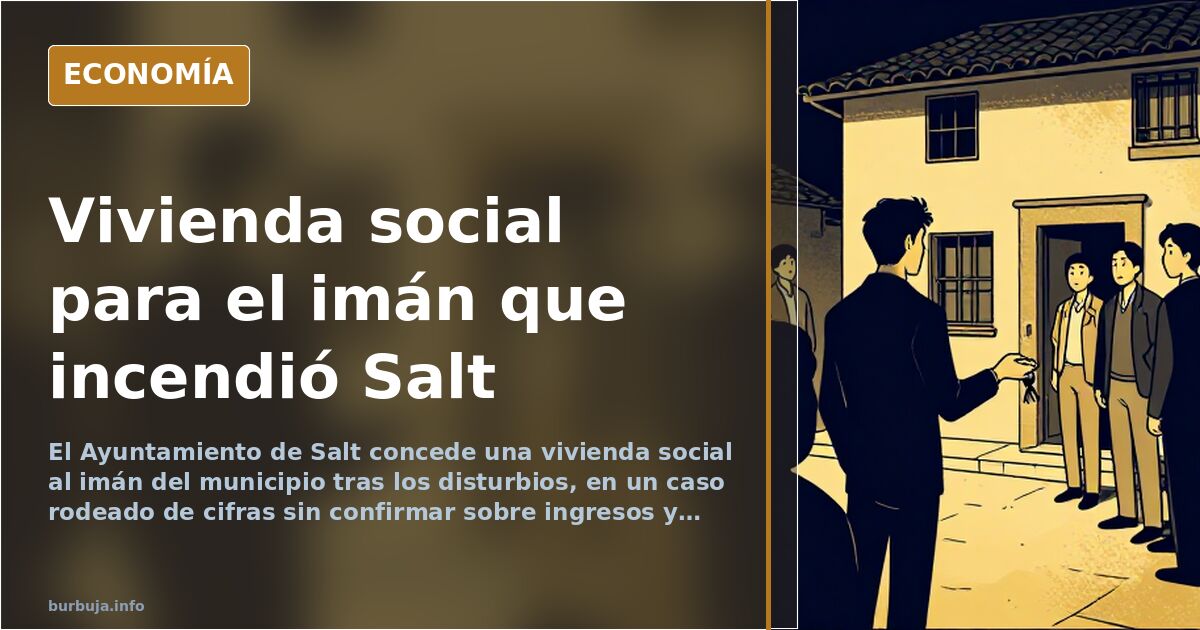
Salt town council awards social housing to the local imam
The Salt town council in Girona has granted social housing to the municipality's imam. The measure, reported trinc unrest in the neighborhood, was justified in circulating accounts as a way to "not fuel the far right". This decision has peine a long-standing debate in Catalan politics regarding whether public order should be used as leverage for accessing public aid.
What is known and attributed to the imam
Known facts are limited to recent reports: the council offered protected housing to the imam after he was involved in tension episodes in the neighborhood. Personal details circulating involve unverified figures, including claims that he earns over 2,300 euros per month and has occupied an apartment for about five years. None of these amounts have been confirmed by the council or appear in a verified public file.
Two aspects must be separated. One is the administrative decision: granting social housing with verifiable access requirements. The other is the surrounding narrative, mixing declared income, years of occupation, and alleged vulnerability. The contradiction between these is what has ignited the issue.
The council's argument: not fueling the far right
The justification attributed to the council—granting housing to avoid giving ammunition to the far right—places the decision in uncomfortable territory. Critics argue the legitimate criterion for distributing public housing is proven need, not political calculation. Conversely, denying housing to a figure capable of mobilizing a neighborhood might lead to more conflicts and electoral gains for far-right parties. The council is led by ERC, as noted in comments on the case.
The underlying issue involves incentives. If accessing public housing is perceived as a response to street pressure, the message is clear: the fast track works. Those waiting in the ordinary queue, meeting requirements, observe the shortcut with bitterness.
Riots spreading across Catalonia
The Salt case is not isolated. Violent episodes have occurred in other Catalan towns recently. In Font de la Pólvora (Girona), an attempted occupation led to riots and an assault on a civic center. In Cancelar, clashes lasted nearly a week, with burned containers and destroyed vehicles trinc a failed occupation. In Salou, street vendors blocked roads and attacked police during an operation against illegal sales. Several cases ended without arrests, according to published reports.
The pattern repeats: a police action, a violent response, and subsequent negotiation. The question lingering is how many of these episodes end in administrative concessions.
The demographic backdrop
Beneath the noise is a cited figure explaining the tension: 40% of the population aged 0 to 14 would have foreign-born parents, according to available estimates. It is pointed out that Spaniards could fall below 40% of the total by 2070. These are projections, not closed censuses, and should be treated as such.
Economically relevant is another factor: scarce public housing distributed among growing demand. When resources are exhausted, the administrative route and pressure route compete. One of them has no waiting list.
What the public treasury risks
Each such decision has a concrete cost for municipal finances: uncollected social rent, property maintenance, and lost opportunity for other applicants. The full calculation, line by line, reveals differences surprising to those comparing the cost of an eviction with that of a grant. No one disputes that social conflict has a price. The doubt is who pays it.
Given these precedents, similar episodes are likely to repeat in other municipalities with strained public housing stock. What remains unwritten is whether the criterion will ultimately become the norm or the exception.
The Salt town council in Girona has granted social housing to the municipality's imam. The measure, reported trinc unrest in the neighborhood, was justified in circulating accounts as a way to "not fuel the far right". This decision has peine a long-standing debate in Catalan politics regarding whether public order should be used as leverage for accessing public aid.
What is known and attributed to the imam
Known facts are limited to recent reports: the council offered protected housing to the imam after he was involved in tension episodes in the neighborhood. Personal details circulating involve unverified figures, including claims that he earns over 2,300 euros per month and has occupied an apartment for about five years. None of these amounts have been confirmed by the council or appear in a verified public file.
Two aspects must be separated. One is the administrative decision: granting social housing with verifiable access requirements. The other is the surrounding narrative, mixing declared income, years of occupation, and alleged vulnerability. The contradiction between these is what has ignited the issue.
The council's argument: not fueling the far right
The justification attributed to the council—granting housing to avoid giving ammunition to the far right—places the decision in uncomfortable territory. Critics argue the legitimate criterion for distributing public housing is proven need, not political calculation. Conversely, denying housing to a figure capable of mobilizing a neighborhood might lead to more conflicts and electoral gains for far-right parties. The council is led by ERC, as noted in comments on the case.
The underlying issue involves incentives. If accessing public housing is perceived as a response to street pressure, the message is clear: the fast track works. Those waiting in the ordinary queue, meeting requirements, observe the shortcut with bitterness.
Riots spreading across Catalonia
The Salt case is not isolated. Violent episodes have occurred in other Catalan towns recently. In Font de la Pólvora (Girona), an attempted occupation led to riots and an assault on a civic center. In Cancelar, clashes lasted nearly a week, with burned containers and destroyed vehicles trinc a failed occupation. In Salou, street vendors blocked roads and attacked police during an operation against illegal sales. Several cases ended without arrests, according to published reports.
The pattern repeats: a police action, a violent response, and subsequent negotiation. The question lingering is how many of these episodes end in administrative concessions.
The demographic backdrop
Beneath the noise is a cited figure explaining the tension: 40% of the population aged 0 to 14 would have foreign-born parents, according to available estimates. It is pointed out that Spaniards could fall below 40% of the total by 2070. These are projections, not closed censuses, and should be treated as such.
Economically relevant is another factor: scarce public housing distributed among growing demand. When resources are exhausted, the administrative route and pressure route compete. One of them has no waiting list.
What the public treasury risks
Each such decision has a concrete cost for municipal finances: uncollected social rent, property maintenance, and lost opportunity for other applicants. The full calculation, line by line, reveals differences surprising to those comparing the cost of an eviction with that of a grant. No one disputes that social conflict has a price. The doubt is who pays it.
Given these precedents, similar episodes are likely to repeat in other municipalities with strained public housing stock. What remains unwritten is whether the criterion will ultimately become the norm or the exception.
Summary of a discussion on Burbuja.info - Foro de economía, actualidad y política., translated from Spanish and reviewed before publication. Read the full discussion (211 replies).
More summaries
-
Investigations into the PSOE (Spanish Socialist Workers' Party): the fear of the far right
If investigations into the PSOE topple the government, the far-right scenario stops being theoretical: many answer yes, they want it
-
Blackout in Spain: twelve hours that the narrative turned into a party
The blackout began at 12:30 and power returned before nightfall in 95% of Spain: the epic of civility rests on a stopwatch.
-
Tensions over social housing allocation in Pontevedra
Social housing allocation in Pontevedra sparks debate over access criteria, lotteries, and worker exclusion.
-
Ayuso Breaks Iker Jiménez’s Rules in Controversial Horizon Interview
Madrid President Isabel Díaz Ayuso breaks Iker Jiménez’s no-politician rule, sparking debate on media pluralism and the Puerta del Sol protests.
-
Global 10-Year Bond Yields Surge to Decade Highs
US and Japanese 10-year bond yields hit multi-decade highs, with European markets following suit amid growing debt crisis concerns.
-
Spanish TV Journalists Ordered to Delete Monetized YouTube Clips
RTVE ombudsman orders journalists Javier Ruiz and Jesús Cintora to stop monetizing public broadcast clips on personal YouTube channels.