
Blackout in Spain: twelve hours that the narrative turned into a party
The blackout began at 12:30 and power returned before nightfall in 95% of Spain: the epic of civility rests on a stopwatch.
English · Original discussion in Spanish · Published
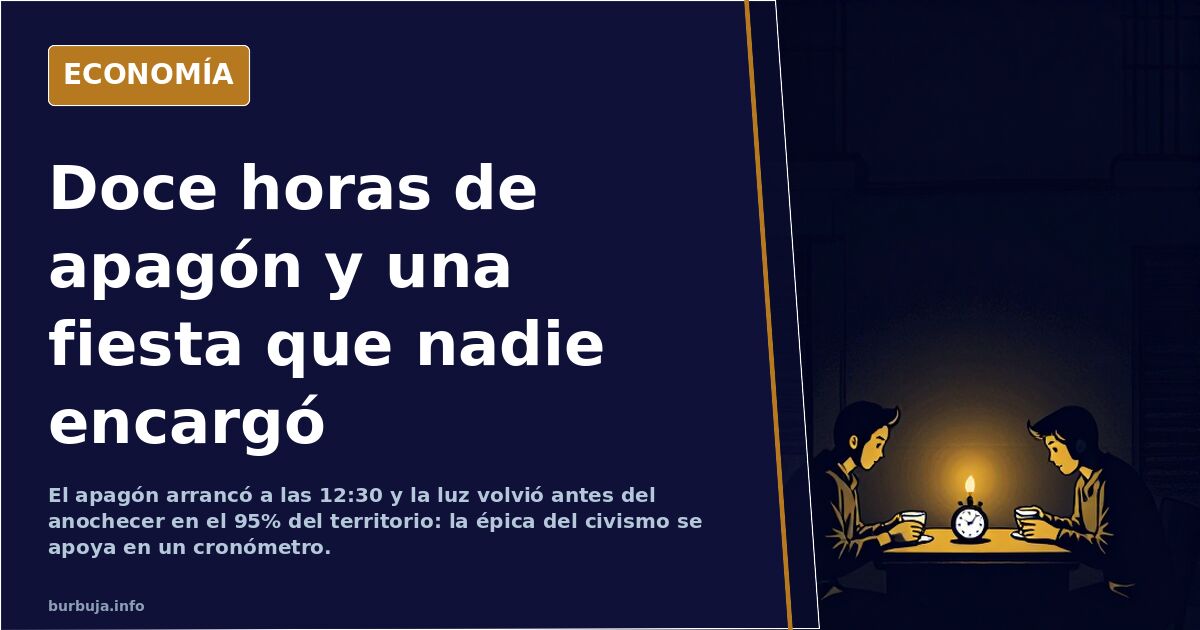
Twelve hours of blackout and a lesson in civility that nobody ordered
Spain went through the biggest blackout in its recent history without mass looting or scenes of panic. It is also true that the power came back before nightfall. Both things are true and explain almost everything that has been written since.
The outage began around 12:30 midday and, as night fell, supply had already been restored to 95% of the territory. That window of daylight sustains — and at the same time dismantles — the epic of the day. Around it a narrative has been built that runs from collective pride to rage, depending on who tells it and what suits them.
“A dark Spain is safer than any other place with light”
Journalist Paco Cerdà published a column in The New York Times with that phrase as its banner. His thesis: in the face of a national blackout, what could be expected was the thieves’ dream night; what was seen were citizens directing traffic at intersections without traffic lights, neighbors handing out water and food to passengers on trains stopped in the middle of nowhere, and taxi drivers who, without a card reader, took down the customer’s phone number to charge them when the power returned.
The text adds the political reading: that response would mark the difference between far-right forces, which insist on individualism and every man for himself, and the trust generated by the European welfare state. “Somehow we knew everything was going to be fine,” the author wrote.
The reaction came split in two. Part of the public bought the framing; another read it as a rebuke to other people’s dignity. “You won’t have electricity and you’ll be happy,” summarizes that strand, which sees in the article an attempt to sell as a virtue what was nothing more than luck of the calendar. The New York Times’s response to a country in darkness, they joke, came before any official explanation from the operator.
The stopwatch: why twelve hours are not three days
Here is the knot. The blackout peine at midday and there was no dark night. The most repeated counterfactual is simple: if the outage had hit at 20:00, just before nightfall, the balance would have been different. The phrase that sums up the antiestéticar is that civilization is only three meals away from anarchy.
The scenarios circulating point in the same direction: anyone with a vehicle and no scruples would have had hours of impunity as soon as the lights went out. That it did not happen during twelve hours of daylight proves little about what would happen in seventy-two.
Valencia, six months earlier: the precedent nobody wants to cite
The uncomfortable mirror is the dana (Spain’s cold-drop storm). Police and the army took two or three days to patrol the affected areas to prevent looting, and robberies in shops and homes began just hours after the water. If the blackout had lasted into the night, this reading holds, the script would have been the same. There were even those who filled the gap of incidents with unrelated episodes, such as the Murcia riots during a Copa final, attributed to the outage with no connection at all.
Why would a three-day blackout be another country?
Because of water, before electricity. Decades ago, public fountains did not depend on electricity; today the supply of drinking water runs through pumps and treatment plants that do. In the north you would have to go up into the hills; in the middle of the steppe, there would simply be nowhere to get it. A two-day blackout would stop being a charming anecdote and become a serious logistical problem. The full detail, with the map of which water sources still work without power, is darker than the festive tone suggests.
Redeia and the political cost of the blackout
In parallel, the institutional narrative moved in another direction: pointing to private operators and raising suspicion of sabotage without any proof, a line that in the available material is described as a familiar tactic in other countries. Published reports place former minister González Laya on the board of Red Eléctrica, a company whose control legally corresponds to the government, with remuneration of 100.000 euros. That a blackout ends up in a discussion about appointments says a lot about the level of debate. There was also room for excess: on RNE it was even said that a nighttime outage would trigger a “baby boom”.
The narrative of civility also has a strand worth casting a wary eye on: the phase-out of nuclear energy for civilian use, which forms part of the energy backdrop against which all this is discussed. It is not a minor detail for anyone planning ten years ahead.
It is likely that the next outage will not come with plenty of light and room for dancing. If it comes at night, it is worth being clear that the civility the narrative boasts about is measured in hours, not convictions. And that if it holds, it will be the best news of the year. Even if nobody has yet explained who turned off the light.
Spain went through the biggest blackout in its recent history without mass looting or scenes of panic. It is also true that the power came back before nightfall. Both things are true and explain almost everything that has been written since.
The outage began around 12:30 midday and, as night fell, supply had already been restored to 95% of the territory. That window of daylight sustains — and at the same time dismantles — the epic of the day. Around it a narrative has been built that runs from collective pride to rage, depending on who tells it and what suits them.
“A dark Spain is safer than any other place with light”
Journalist Paco Cerdà published a column in The New York Times with that phrase as its banner. His thesis: in the face of a national blackout, what could be expected was the thieves’ dream night; what was seen were citizens directing traffic at intersections without traffic lights, neighbors handing out water and food to passengers on trains stopped in the middle of nowhere, and taxi drivers who, without a card reader, took down the customer’s phone number to charge them when the power returned.
The text adds the political reading: that response would mark the difference between far-right forces, which insist on individualism and every man for himself, and the trust generated by the European welfare state. “Somehow we knew everything was going to be fine,” the author wrote.
The reaction came split in two. Part of the public bought the framing; another read it as a rebuke to other people’s dignity. “You won’t have electricity and you’ll be happy,” summarizes that strand, which sees in the article an attempt to sell as a virtue what was nothing more than luck of the calendar. The New York Times’s response to a country in darkness, they joke, came before any official explanation from the operator.
The stopwatch: why twelve hours are not three days
Here is the knot. The blackout peine at midday and there was no dark night. The most repeated counterfactual is simple: if the outage had hit at 20:00, just before nightfall, the balance would have been different. The phrase that sums up the antiestéticar is that civilization is only three meals away from anarchy.
The scenarios circulating point in the same direction: anyone with a vehicle and no scruples would have had hours of impunity as soon as the lights went out. That it did not happen during twelve hours of daylight proves little about what would happen in seventy-two.
Valencia, six months earlier: the precedent nobody wants to cite
The uncomfortable mirror is the dana (Spain’s cold-drop storm). Police and the army took two or three days to patrol the affected areas to prevent looting, and robberies in shops and homes began just hours after the water. If the blackout had lasted into the night, this reading holds, the script would have been the same. There were even those who filled the gap of incidents with unrelated episodes, such as the Murcia riots during a Copa final, attributed to the outage with no connection at all.
Why would a three-day blackout be another country?
Because of water, before electricity. Decades ago, public fountains did not depend on electricity; today the supply of drinking water runs through pumps and treatment plants that do. In the north you would have to go up into the hills; in the middle of the steppe, there would simply be nowhere to get it. A two-day blackout would stop being a charming anecdote and become a serious logistical problem. The full detail, with the map of which water sources still work without power, is darker than the festive tone suggests.
Redeia and the political cost of the blackout
In parallel, the institutional narrative moved in another direction: pointing to private operators and raising suspicion of sabotage without any proof, a line that in the available material is described as a familiar tactic in other countries. Published reports place former minister González Laya on the board of Red Eléctrica, a company whose control legally corresponds to the government, with remuneration of 100.000 euros. That a blackout ends up in a discussion about appointments says a lot about the level of debate. There was also room for excess: on RNE it was even said that a nighttime outage would trigger a “baby boom”.
The narrative of civility also has a strand worth casting a wary eye on: the phase-out of nuclear energy for civilian use, which forms part of the energy backdrop against which all this is discussed. It is not a minor detail for anyone planning ten years ahead.
It is likely that the next outage will not come with plenty of light and room for dancing. If it comes at night, it is worth being clear that the civility the narrative boasts about is measured in hours, not convictions. And that if it holds, it will be the best news of the year. Even if nobody has yet explained who turned off the light.
Summary of a discussion on Burbuja.info - Foro de economía, actualidad y política., translated from Spanish and reviewed before publication. Read the full discussion (209 replies).
More summaries
-
The housing bubble bursts: no energy, no new boom
Spain’s growth model is running out of steam amid a saturated power grid, undeveloped land and rising debt. The debate points to the lack of a plan B
-
Euthanasia in Old Age: Autonomy vs. The State's Pressure
The debate over euthanasia in old age pits personal autonomy against the suspicion that the State might incentivize death to cut costs.
-
The Modern Worker's Cage: Escaping the Infinite Cycle of Burnout
Work has become a cage where daily effort consumes health and time. Discover why we push ourselves so hard and how to break the cycle.
-
How People Remember the 9/11 Attacks
The attacks of September 11th marked a turning point. Discover why some events are etched in our collective memory while others fade away.
-
Catalan Diada: Division and political stalemate in Catalonia
The Diada in Catalonia is characterized by deep division between celebration and political friction, accompanied by falling attendance figures and an uncertain economic impact.
-
Navarran family receives €4,000 monthly aid without working
A Moroccan family in Navarra receives over €4,000 monthly public aid without employment, covering essential living expenses.