
Sáenz de Tejada admits letter targeting Judge Biedma in Spain
Former judge Luis Sáenz de Tejada acknowledges authorship of a letter naming Judge Beatriz Biedma, clarifying that 'eliminate' meant removing her from the case.
English · Original discussion in Spanish · Published
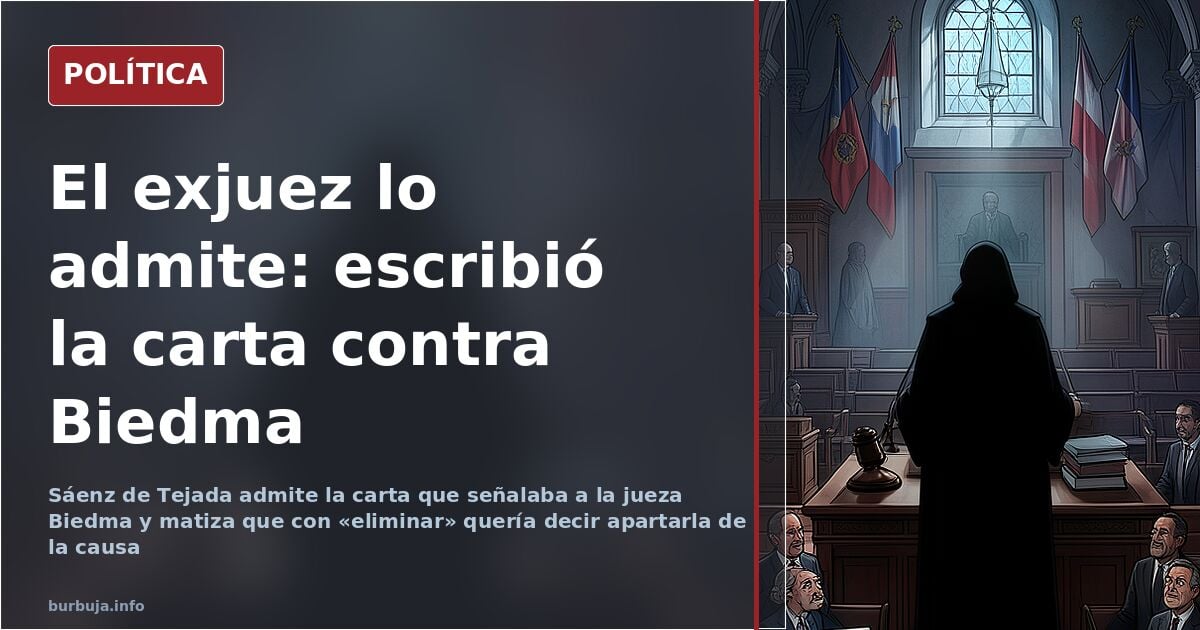
Sáenz de Tejada admits letter targeting Judge Biedma
A former magistrate facing an investigating judge. This scene repeats itself in Spanish courts, and this time it is Luis Sáenz de Tejada, a former judge now charged with maneuvers against the presiding judge of the brother of the Prime Minister's case. According to reports, Sáenz de Tejada ultimately acknowledged writing a letter sent to Leire Díez that identified Judge Beatriz Biedma. The admission did not come immediately; it was the end of a tug-of-war that the defendant had previously denied.
The investigation, which stems from the David Sánchez case, has evolved into a probe into an alleged pressure structure against the magistrate. Published data outlines an operation involving names, documents, and surveillance.
What is charged against ex-judge Sáenz de Tejada
The core of the charge is the letter. A document sent to Leire Díez identifying Biedma as the judge handling the matter regarding the Prime Minister's brother. It is the authorship of this document that the former magistrate finally admitted, after maintaining the opposite in earlier stages of the proceedings.
There is a second, more physical front. Biedma reported to the police that Sáenz de Tejada trinc her by car on October 8, when the magistrate was returning to Badajoz after testifying. According to the complaint, the ex-judge drove parallel to her vehicle. This is the kind of detail that turns a paper case into something measured in meters and rearview mirrors.
And a third element, even more uncomfortable: according to published reports, the same ex-judge allegedly marked the home of another magistrate for the group known as "Los Rochos." The word "mark" is not decorative. It is an operational description.
Testimony about "eliminating" Biedma
During his appearance, Sáenz de Tejada admitted he spoke of "eliminating" Beatriz Biedma with Cintia Rocho, though he clarified that he meant "removing her from a judicial case." This explanation deserves its own paragraph. In a summary, the chosen verb carries weight; so does the subsequent clarification. That someone has to explain what they meant by "eliminate" says quite a lot about the tone of the conversations under investigation.
A thirty-person operation against the judge
The scale of the issue grows when looking at the volume. According to disseminated information, the plot allegedly assembled a team of about 30 people to flood the General Council of the Judiciary (CGPJ) with complaints against Biedma, thereby stalling the David Sánchez case. Thirty people. This is not a casual outburst over lunch: it is a structure with shifts and objectives.
Hence lawyer Miguel Durán has requested protection from the CGPJ for the judge, criticizing that the Council did not approve an institutional statement of support and that the Ministry of the Interior was slow to protect her. The institution responsible for safeguarding judicial independence is portrayed by its own slowness.
PSOE and payments demanded by Pedraz
The case intersects with another piece: National Court judge Santiago Pedraz demands that PSOE provide the list of lawyers, firms, and consultancies hired between 2021 and 2025, including payment details, within a maximum of 48 hours. Ferraz (the PSOE headquarters) resists. It cites, according to reports, the logistical and administrative burden implied by general elections.
The standoff is set. A party that cannot find a slot between rallies to hand over invoices to an investigating judge. The excuse has its irony, although the judge will likely not share it.
What happens with the DANA case?
The same charged ex-magistrate also appears in the DANA case: the judge accepted his participation in the proceedings, according to reports. A defendant who joins where it suits him. The judicial map becomes complicated and pieces move.
What remains essential: a former judge who admits having written the letter targeting a female judge, a stalking complaint, a team of thirty people, and a party that has yet to deliver its papers. With these elements, the case does not close: it expands.
Also available in: Deutsch
Summary of a discussion on Burbuja.info - Foro de economía, actualidad y política., translated from Spanish and reviewed before publication. Read the full discussion (16 replies).
More summaries
-
Spain's Guardia Civil unit links Cerdán and Leire Díez to PSOE's dirty-tricks operation
The UCO concludes that Santos Cerdán and Leire Díez ran the PSOE's 'sewer' to protect the prime minister. Judge Pedraz is investigating the Socialist network.
-
Leire Díez: the fixer who, according to ABC, threatens democracy in Spain
Juan Soto Ivars's article in ABC portrays Leire Díez as the Frankenstein of Sánchez-style politics. Secret hit squad or the logical outcome of the system?
-
Spain's Civil Guard UCO unit points to Sánchez as Leire Díez's 'the one'
The UCO concludes that Leire Díez's 'one' is Pedro Sánchez based on party hierarchy. As a protected officeholder, the prime minister can only be prosecuted if Congress approves the request.
-
Iustitia Europa vs. VOX: The Party's Origins
Iustitia Europa, born from the Liberum lawyers' association, targets VOX. The 'useful vote' debate reignites conflict between the two parties.
-
US Midterms 2026: Are Republicans in Trouble?
Republicans lose key governorships and seats, but hold the Senate. Analysis of the results.
-
Reasons for abstaining in Spanish elections
A 50.1% majority imposes views on the rest. Abstention stems from lack of sovereignty and disinterest in debates.