
Ryanair cuts Spanish capacity as airports face closure risks
Ryanair reduces seats in Spain due to higher AENA fees. Regional airports dependent on the Irish airline face closures and reduced routes.
English · Original discussion in Spanish · Published
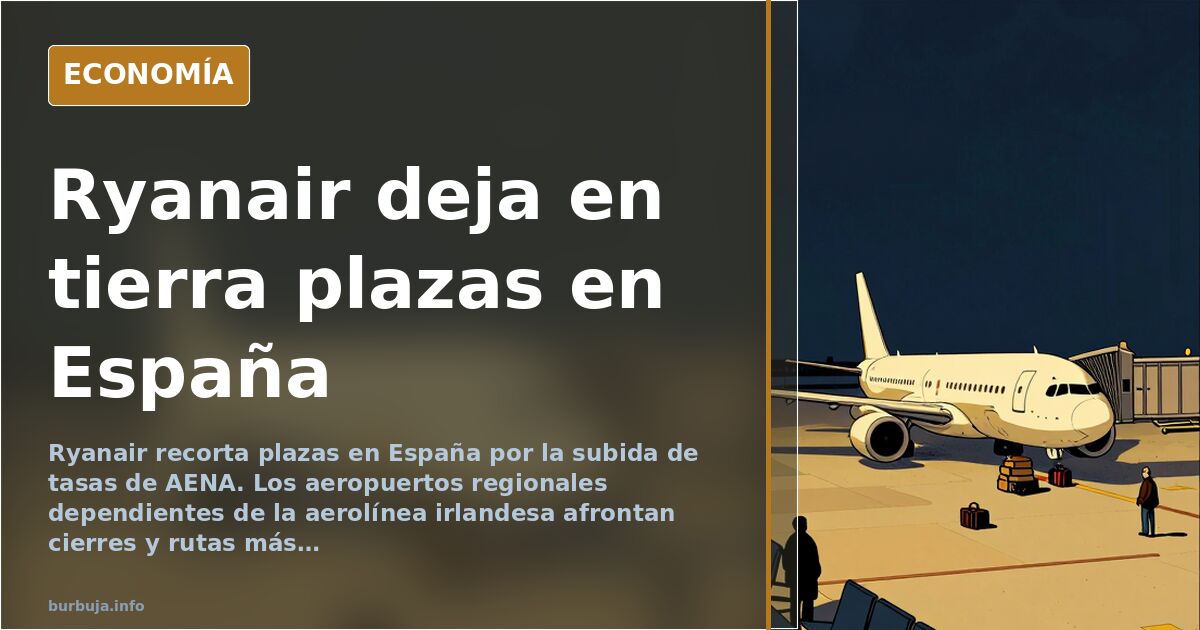
Ryanair executes its threat and cuts capacity in Spain
The Irish airline has done what it had been warning about: the increase in airport fees managed by AENA (Spain's state-owned airport operator) served as an excuse to cut capacity in the Spanish market. The company, which has spent years negotiating subsidies with local and regional administrations to operate at deficit-run airports, has decided it is no longer profitable. The announcement has fallen like a bomb among those who rely on cheap flights to return home, travel for leisure, or maintain the only air connection to their province.
What peine and why Ryanair is leaving
The trigger is the increase in fees charged by AENA, the public airport manager. Ryanair argues that this cost hike makes many of its routes in Spain unviable, especially those connecting regional airports with the rest of Europe. The company announced the reduction of seats, a figure equivalent to emptying entire aerodromes of passengers for months.
This scenario is not new. For two decades, Ryanair has operated as a sort of revolutionary tax on local administrations: if you want us to fly to your airport, pay up. If you stop paying, we leave. In Castilla y León, Europe's largest and least populated region, four airports—Burgos, León, Salamanca, and Valladolid—coexist with traffic levels that are sometimes negligible. Ryanair's departure from any of them leaves the facility on the brink of technical closure.
Airports that exist only if Ryanair wants them to
There are paradigmatic cases. Santander, for example. If Ryanair leaves, the airport loses its purpose. The same happens in other provincial capitals where the Irish carrier is the only regular airline. This structural dependency turns every fee negotiation into a standoff where the company always wins: either you lower the price, or they leave, leaving you with infrastructure paid for by everyone.
The calculation used by some analysts is devastating: a low-cost flight between two points on the peninsula or to the Canary Islands for €20-50 does not cover real costs without subsidies behind it. Jet fuel, fees, handling, and wages do not add up at those prices. Someone pays the difference. And that someone is the taxpayer, via direct subsidies or artificially low fees.
Mass tourism and the trap of dependency
In the Canary Islands, the debate is different. The archipelago receives tourists in droves, but part of the sector argues that low-cost tourism generates more costs than benefits: pressure on housing, saturated public services, and precarious employment. From this perspective, Ryanair cutting capacity is not a tragedy, but an opportunity to attract visitors with higher spending power.
The other side is the real economy of dependent provinces. Fewer flights miccionan less tourism, fewer overnight stays, and less employment in hospitality and retail. It also means more expensive flights for residents who need to travel in or out. Tickets that previously cost €30 jump to €90 once competition disappears.
The political standoff: fees, subsidies, and who pays the bill
The core issue is who should finance air connectivity. Some argue that administrations should not give money away to a foreign airline that then takes profits abroad. Others counter that without these subsidies, there are no flights, no tourism, and no economic activity in large parts of the country.
The central government and regional governments pass the buck. AENA is state-owned, but regional airports depend on agreements with airlines signed by the autonomous communities. No one wants to bear the political cost of losing air connections in their province. And Ryanair knows it.
What happens now with affected flights and airports
The capacity reduction will be implemented gradually. The most affected airports will be those almost exclusively dependent on Ryanair. Some are already in a critical situation: if the airline reduces frequencies, the infrastructure falls into the red, and closure becomes a matter of time.
For travelers, the immediate impact is less supply and higher prices on surviving routes. For administrations, it is a first-order political problem: explaining why the airport they inaugurated with fanfare is now empty. For Ryanair, it is another move in its usual strategy of pressuring for better conditions.
The standoff continues. Ryanair has not said it is leaving Spain permanently, only that it is cutting capacity where it is not profitable. The question is whether any administration is willing to pay what it demands to bring them back. And if not, how many more airports will be left without a single plane on the tarmac.
Also available in: Deutsch
Summary of a discussion on Burbuja.info - Foro de economía, actualidad y política., translated from Spanish and reviewed before publication. Read the full discussion (174 replies).
More summaries
-
León loses 107,000 residents as Valladolid continues to grow
León has seen a population drop of 107,000 over fifty years, while Valladolid expands, fueling the debate over the capital of Castilla y León.
-
Spain's last shantytown in Castilla y León left to decay after rehousing
The El Encuentro shantytown in Burgos has deteriorated after residents were rehoused. An analysis of waste management and the public cost of marginal settlements.
-
Spain's anti-squatting offices flop: 109 inquiries in six months, two provinces with none
The anti-squatting offices in Castilla y León, Spain, received just 109 inquiries in six months; Ávila and Salamanca, zero. The figure clashes with the boom in private eviction firms.
-
COPE and Vozpópuli Report Begoña Gómez Listed on Spanish Socialist Party Ballots
COPE and Vozpópuli claim Begoña Gómez will be on the PSOE list to secure parliamentary immunity. This changes the court, not the charges, and the nature of the trial.
-
No Christmas this year in the heart of Europe
A viral post claims Australia, France and Germany have cancelled their New Year celebrations over Islamist terrorism. There is no official confirmation.
-
Pentagon readies bases to run 90 days without supplies
The Pentagon is preparing its bases to operate for 90 days without external power, fuel or water, while the UK recommends emergency kits for 72 hours without…