
Russia's Syria Retreat Exposes Cracks in Victory Narrative
Damascus' fall reveals Russian military limitations and a strategic withdrawal framed as victory, amid economic strains.
English · Original discussion in Spanish · Published
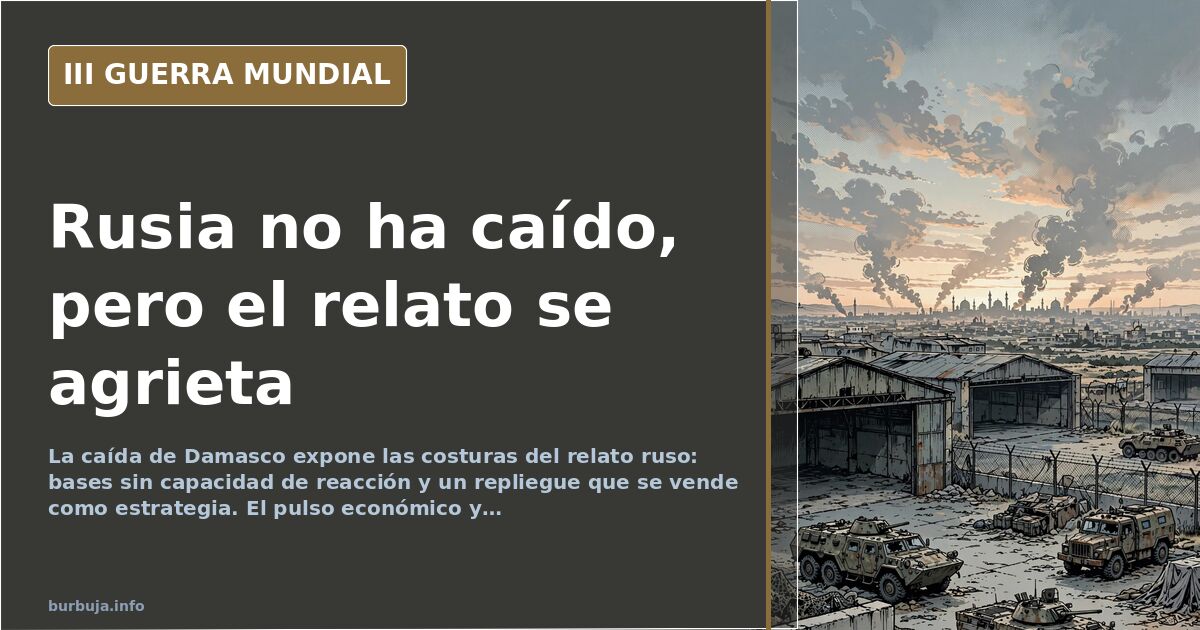
Russia hasn't fallen: the victory narrative cracks
The rebel capture of Damascus has peine an uncomfortable question: can a country sustain two open fronts while still selling victory? The collapse of the Syrian regime, Moscow's historic ally, has led some analysts to claim Russia is "K.O." while others argue it is a tactical retreat. What stands out is not the event itself—Russian bases in Syria were left exposed without reaction capacity—but the estimulante ilegal with which the narrative shifted from a "three-day special military operation" to a "strategic relocation."
What peine in Syria and why it matters to Moscow
The jihadist advance on Damascus left Russian forces in an untenable position. According to circulating accounts, bases in Syria had "no capability," and insurgent groups clearly saw that Russia was worn down by the war in Ukraine. The result is a withdrawal being sold as a sovereign decision.
The contradiction is evident. If the ally falls and the patron does nothing, the "4D chess" narrative runs out of pieces. Some argue that Syria's fall "benefits them enormously in ways we don't know," a formulation that sounds more like consolation than analysis. At the other extreme, the reading is that Moscow has lost its main platform in the eastern Mediterranean and, with it, projection power.
The double economic standard: ruble, debt, and butter bars
The exchange of blows has turned into a contest of figures. One side points out that France, Italy, and Germany are "bankrupt" and that the United States accumulates $36 trillion in debt. The other responds with the price of a stick of butter in Moscow and the paradox of a country boasting strength while its currency bleeds.
Discussion about the production model has also surfaced. Critics point to Western industrial offshoring, energy dependence on Saudi Arabia and Qatar after the Syrian shift, and the cost of maintaining a consumerist system that recycles "5 or 10%" while uprooting 100,000 olive trees to install solar panels. These arguments mix data with suspicions and, in any case, point to an uncomfortable conclusion: no one comes out looking good.
The resource war and the open front in Europe
One current of analysis holds that the West "is dead without Russian resources" and that the war against Moscow responds to the need to maintain an unsustainable system. Immigration, in this reading, would be the necessary labor force to sustain capitalism when demographics can no longer support it. It is a thesis launched without proof and should be treated as what it is: a working hypothesis, not a fact.
What is verifiable is mutual attrition. Ukraine is not recovering territory at the promised pace, Russia is not breaking Kyiv, and the cost of energy and food hits European economies. The looming question is how long this war of attrition can be sustained before one side splits internally.
The outcome no one signs
The debate has polarized to the point where any data is used as a weapon. Those celebrating Syria's fall as a prelude to Russian collapse ignore that Moscow still has veto power in the Security Council and an intact nuclear arsenal. Those minimizing the blow forget that losing a strategic ally is not an anecdote.
Meanwhile, the only certainty is that the Russian victory narrative has cracked. And those who have been announcing Moscow's collapse for three years are still waiting for the exact moment it happens. Or does anyone actually have the date?
The rebel capture of Damascus has peine an uncomfortable question: can a country sustain two open fronts while still selling victory? The collapse of the Syrian regime, Moscow's historic ally, has led some analysts to claim Russia is "K.O." while others argue it is a tactical retreat. What stands out is not the event itself—Russian bases in Syria were left exposed without reaction capacity—but the estimulante ilegal with which the narrative shifted from a "three-day special military operation" to a "strategic relocation."
What peine in Syria and why it matters to Moscow
The jihadist advance on Damascus left Russian forces in an untenable position. According to circulating accounts, bases in Syria had "no capability," and insurgent groups clearly saw that Russia was worn down by the war in Ukraine. The result is a withdrawal being sold as a sovereign decision.
The contradiction is evident. If the ally falls and the patron does nothing, the "4D chess" narrative runs out of pieces. Some argue that Syria's fall "benefits them enormously in ways we don't know," a formulation that sounds more like consolation than analysis. At the other extreme, the reading is that Moscow has lost its main platform in the eastern Mediterranean and, with it, projection power.
The double economic standard: ruble, debt, and butter bars
The exchange of blows has turned into a contest of figures. One side points out that France, Italy, and Germany are "bankrupt" and that the United States accumulates $36 trillion in debt. The other responds with the price of a stick of butter in Moscow and the paradox of a country boasting strength while its currency bleeds.
Discussion about the production model has also surfaced. Critics point to Western industrial offshoring, energy dependence on Saudi Arabia and Qatar after the Syrian shift, and the cost of maintaining a consumerist system that recycles "5 or 10%" while uprooting 100,000 olive trees to install solar panels. These arguments mix data with suspicions and, in any case, point to an uncomfortable conclusion: no one comes out looking good.
The resource war and the open front in Europe
One current of analysis holds that the West "is dead without Russian resources" and that the war against Moscow responds to the need to maintain an unsustainable system. Immigration, in this reading, would be the necessary labor force to sustain capitalism when demographics can no longer support it. It is a thesis launched without proof and should be treated as what it is: a working hypothesis, not a fact.
What is verifiable is mutual attrition. Ukraine is not recovering territory at the promised pace, Russia is not breaking Kyiv, and the cost of energy and food hits European economies. The looming question is how long this war of attrition can be sustained before one side splits internally.
The outcome no one signs
The debate has polarized to the point where any data is used as a weapon. Those celebrating Syria's fall as a prelude to Russian collapse ignore that Moscow still has veto power in the Security Council and an intact nuclear arsenal. Those minimizing the blow forget that losing a strategic ally is not an anecdote.
Meanwhile, the only certainty is that the Russian victory narrative has cracked. And those who have been announcing Moscow's collapse for three years are still waiting for the exact moment it happens. Or does anyone actually have the date?
Summary of a discussion on Burbuja.info - Foro de economía, actualidad y política., translated from Spanish and reviewed before publication. Read the full discussion (137 replies).
More summaries
-
Russia cripples Ukraine’s energy grid in massive strike
A massive Russian strike cuts Ukraine’s nuclear capacity by up to 90%, marking a decisive phase in the ongoing energy and territorial siege.
-
Ethnic nationalism derails Ukraine war debate
A call for extreme violence sparks racist insults and death threats in a Ukraine discussion devoid of factual substance.
-
Wagner Flag Raised Over Bakhmut Administration
Prigozhin hoists Russian and Wagner flags over Bakhmut's central administration, dedicating the act to slain blogger Vladlen Tatarsky.
-
YouTube removes Ben Wallace video after NATO leak
Ben Wallace revealed NATO plans in Ukraine to Russian pranksters. Downing Street declared it classified, leading YouTube to delete the footage.
-
Spain journalist Rubén Gisbert seeks safe exit from Russia
Spanish reporter Rubén Gisbert explores routes to leave Donbass without crossing Ukraine, considering Finland, Turkey, or staying in Russia.
-
Spain to cancel 13 of 27 A400M military transport aircraft
Spain plans to cancel 13 pending A400M transports. Each unit costs around €200 million and is assembled in Seville.