
Russia’s Pyrrhic Reality: War Stalemate, Not Victory
Russia holds more land than in 2022 but faces a degraded army and isolation. Ukraine remains armed, challenging the notion of strategic success.
English · Original discussion in Spanish · Published
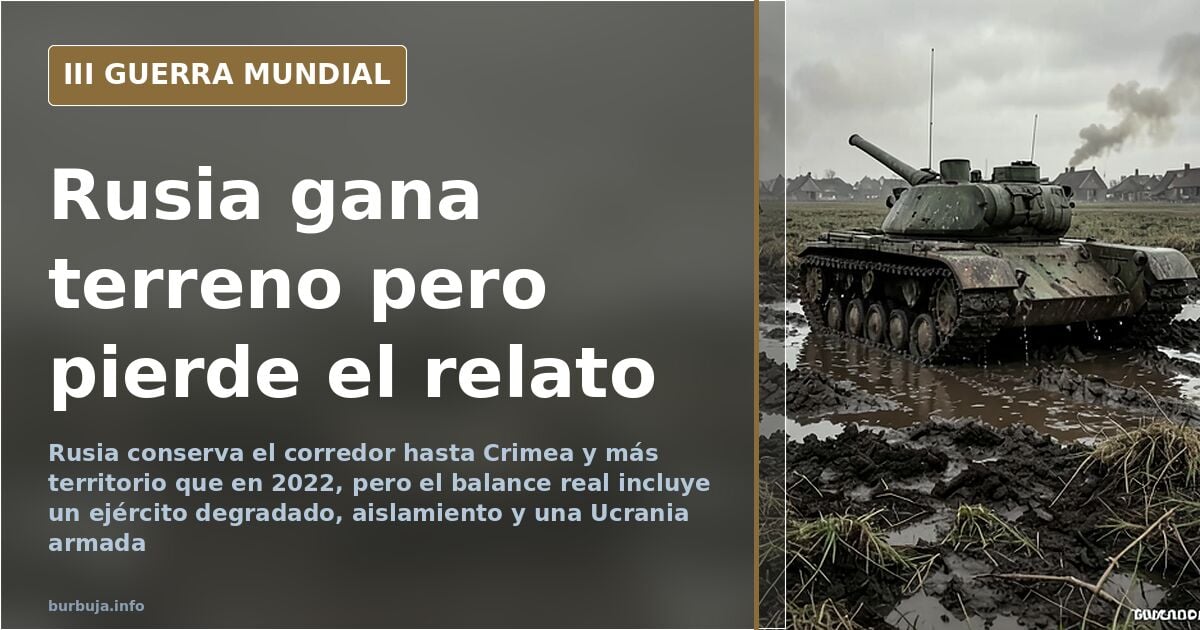
Russia Gains Ground But The Balance Doesn’t Add Up
Imagine an army invading a whole country and, three years later, celebrating the capture of a few mid-sized cities. This is the starting point for discussing the state of the war in Ukraine since February 2022: the gap between promises and reality on the ground. The analysis suggests Moscow will settle for Donbas and Crimea, which would still be a defeat compared to initial goals.
The first clash is over definitions. For some, total defeat means leaving all of Ukraine, including Donbas and Crimea. For others, keeping the land corridor to Crimea and the Sea of Azov is already more than they had before the invasion. The disagreement isn't about data, but about the yardstick used.
What Territory Does Russia Control And What Was Lost?
The most repeated argument is that Russia controls more territory today than in February 2022. True on the map. False as a balance sheet: the declared goal was a pro-Russian government in Kyiv, and nothing remains of the quick operation many predicted within weeks. There are reports of over 100,000 dead, a degraded army, and a military industry with shattered prestige.
The most skeptical calculation adds the strategic cost: thousands of kilometers of new border with NATO, a heavily armed Ukraine, and a loss of authority in its own sphere of influence. Some summarize it with irony: all advantages.
The Frozen Front And The Expected Offensive
The discussion on the ground focuses on two scenarios. One points to Kharkiv as a precursor to the coveted Odesa; the other warns that stretching the front there with current troop levels is reckless. The most repeated prediction is attrition: grinding down new Ukrainian recruits until resistance fades, rather than seeking rapid advances.
Regarding the spring-summer Ukrainian offensive, opinions are split. Some consider it certain; others dismiss it as propaganda, arguing Ukraine lacks manpower. In any case, the war has no expiration date.
The Economic Pulse: Sanctions, Gas, And Uranium
The economic front appears at various points. European dependence on Russian gas and uranium is mentioned, warning that cutting supply would hit continental nuclear plants. It is also recalled that Russia will look East and trade with the West may take decades to recover.
A paradox is summarized by one intervention: if Russia sells its gas to Europe more expensively than it buys from the US, the European consumer pays the bill. Energy costs as a double-edged sword.
Who Is The Outcast And Who Supports Whom?
The distribution of support is another battlefield. One side lists Russia's allies; the other responds that most of the world hasn't imposed sanctions. The debate shifts to internal wear: the Russian economy, brain drain, and diplomatic isolation.
The conclusion that emerges from the coldest analysis is that a pyrrhic victory is not a victory. If the price is a decade of isolation, a broken army, and a hostile, armed Ukraine on the border, the map wins but the country loses.
The question remains unanswered: if this is winning, what do you call losing?
Also available in: Deutsch
Summary of a discussion on Burbuja.info - Foro de economía, actualidad y política., translated from Spanish and reviewed before publication. Read the full discussion (83 replies).
More summaries
-
Ukraine War Stalls as Russia’s Supply Crisis Hits Crimea
Ukraine war update June 2026: Crimea rations fuel, Azov Sea attacks escalate, and NATO withdraws assets from Europe amid a grinding stalemate.
-
Ukraine NATO Entry and Crimea Claim Risk Europe War
Participants argue that if Ukraine joins NATO and seeks to reclaim Crimea, Europe faces immediate war with Russia.
-
Russia vs NATO: 5,604 tanks and the war of numbers
Russian reports claim 5,604 tanks and 300,000 mercenaries killed, while NATO has not yet deployed its own troops to Ukraine.
-
Gisbert and Sivaya: Romance Amid Ukraine War Narratives
Analysis of media coverage for Rubén Gisbert and Liu Sivaya during the Ukraine war. Is this digital propaganda or reality?
-
Obradovic highlights double standards in war coverage
Serbian coach Zeljko Obradovic compares media attention on Ukraine to the 1999 NATO bombing of Serbia, sparking debate on moral hypocrisy.
-
Trump-Putin Ukraine stalemate extends beyond 2026
Ukraine front stalls at Sloviansk and Kramatorsk as Trump faces electoral pressure, with nearly half of Republicans supporting continued aid.