
Russia's flagship Moskva heavily damaged, crew evacuated
Ukraine claims Neptune missile strike on cruiser; Russia cites fire and ammunition explosion during evacuation.
English · Original discussion in Spanish · Published
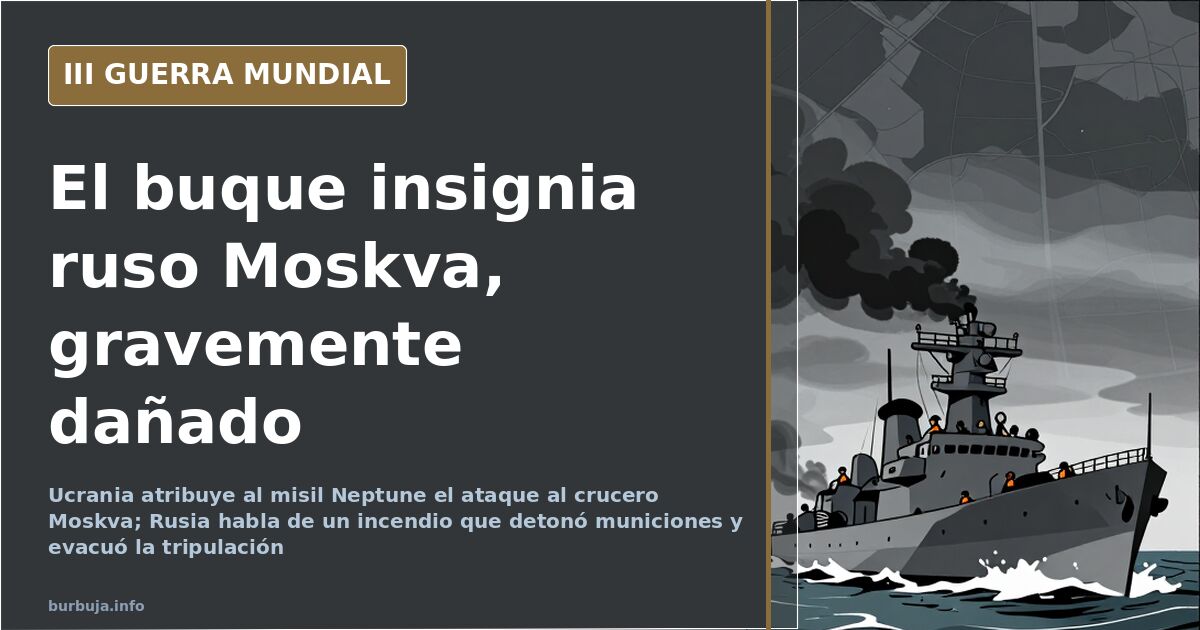
Moskva Damaged: Two Conflicting Accounts of the Attack
Can an onboard fire disable a fleet's flagship? That is Russia's version. Ukraine's is simpler: two Neptune anti-ship missiles set the cruiser Moskva ablaze. Between the two narratives lies a severely damaged ship, an evacuated crew, and no independent confirmation to settle the dispute. Ukrainian presidential advisor Oleksiy Arestovych summarized it in a broadcast with a line straight out of a script: "a surprise occurred with the Black Sea Fleet's Russian flagship."
The Ukrainian Account: Two Neptune Missiles Hit the Moskva
The first report came from Kyiv. Oleksiy Arestovych, head of Odesa Regional Defense and presidential advisor, confirmed via YouTube that the missile cruiser Moskva was hit and burning after two impacts from Neptune missiles, according to versions spread by accounts and media. The same narrative circulated from Ukrainian sources adding a grim detail: the ship had been sent toward Snake Island on the invasion's first day, and there it ended up.
The issue remains verification. The Guardian could not independently confirm the attack, and AFP received no confirmation from the Russian military regarding a strike on the warship. Attribution remains one party's claim. Satellite imagery had yet to provide conclusive proof.
The Russian Account: Fire Triggered Ammunition Explosion
Moscow quickly offered its explanation. The Russian Ministry of Defense, cited by state agency TASS, reported the cruiser was severely damaged due to ammunition detonation caused by a fire. The crew was fully evacuated, and the cause of the fire is under investigation. The newspaper Komsomolskaya Pravda reproduced the statement without adding a single line.
Hours later, according to forum participants, the Russian version escalated: the Russian embassy in Spain allegedly claimed the ship sank due to internal damage from an explosion. In short: a fire, a detonation, and a flagship at the bottom of the sea. No damage report has been released.
180-Degree Radar Blind Spot and Drone Distraction
Among hypotheses circulating online is one explaining how a missile breached a theoretically protected ship: the Moskva's radar covered only 180 degrees. According to this theory, a drone distracted the crew, allowing impact from the blind side. It is a hypothesis, not a technical report, but it raises the uncomfortable question: if the ship had air defense systems, how did the missile get through?
The other piece of the puzzle is the weapon itself, a Ukrainian-made anti-ship missile. If Ukraine deploys such missiles near Odesa, approaching carries a cost any fleet struggles to absorb.
Evacuated Crew: How Many Survived the Moskva?
Evacuation is the only point where both sides agree, albeit with nuances. Russia speaks of a fully evacuated crew. At the other extreme, an unverified account claims only 50 of nearly 600 crew members survived, rescued by a Turkish vessel. This figure differs vastly from the official narrative.
This is the crux of the matter. A flagship cruiser does not vanish without human toll, and neither figure has been independently verified.
692 Million Rubles Missing from Air Defense Repairs
A secondary thread offers more insight than any press release. According to information attributed to a Russian economic outlet, more than 692 million rubles were diverted from the 1 billion allocated for repairing Northern Fleet air defense systems. While this refers to another fleet and remains unverified, it fuels underlying suspicion: if maintenance is paid in paperwork, air defense is paid in smoke.
What Next for the Black Sea Fleet?
The Black Sea is small, which conditions everything. With anti-ship missiles deployed along the Odesa coast, proximity carries measurable costs in tonnage. If the flagship is out of action, the fleet loses more than a ship: it loses the ability to project presence near the shore.
Also emerged the self-sinking theory as a pretext for escalation. There is no data supporting it, and it should be treated as what it is: a notion. Similarly, the recurring joke that Pilingui just promoted his flagship to submarine status. Cheap, yes. But it is the only promotion nobody disputes.
Also available in: Deutsch
Summary of a discussion on Burbuja.info - Foro de economía, actualidad y política., translated from Spanish and reviewed before publication. Read the full discussion (139 replies).
More summaries
-
The Moskva: Three Theories on Who Sank Russia's Flagship
Three versions of the Moskva sinking: fire, Ukrainian Neptune missiles, or divers. NATO is blamed by some forum users.
-
Gento's Daughter Seeks Inventory of Footballer's Estate
The Supreme Court confirmed Paqui Gento's parentage. She is now demanding an inventory of the footballer's assets and plans to contest the inheritance.
-
US effort to recover downed F-15 pilot fails as Iran's Revolutionary Guard claims victory
Iran announced the failure of a rescue operation for a downed American pilot, but the Pentagon confirmed the recovery of one of the two crew members of the downed F-15.
-
Iran invasion talk: 10,000 troops for a country of 90 million as nuclear sites are hit
Is 10,000 soldiers enough to invade Iran? The debate over the viability of a ground invasion, strikes on nuclear facilities and the mystery of Friday night.
-
Palestine's water crisis: mismanagement or Israeli control?
Same climate, different outcomes: Israel desalinates while Palestine loses water to leaks. Palestinian failure or Israeli control? An analysis.
-
Nuclear war without apocalypse: the tactical taboo
Could a nuclear war break out without apocalypse? 0.3 kt tactical warheads are 50 times smaller than Hiroshima, but Russia has ten times more.