
Russian state TV warns of 'inevitable' nuclear attack, sparks mockery and resignation
Margarita Simonyan, editor-in-chief of Russian state media RT, claims nuclear war is 'inevitable' and the 'most probable outcome'. Her comments were met with a mix of ridicule and fatalism.
English · Original discussion in Spanish · Published
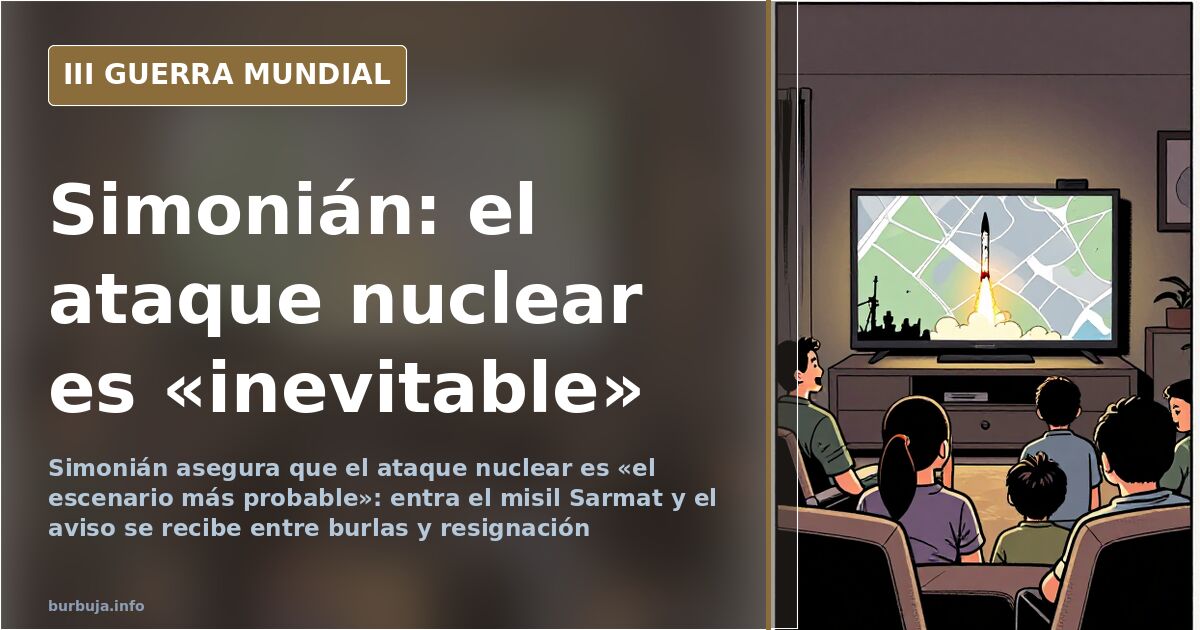
RT warns of 'inevitable' nuclear attack: routine remains unbroken
Margarita Simonyan, editor-in-chief of Russian state media RT, stated on Russian public television last Wednesday that a nuclear attack is not only possible but the 'most probable' outcome. She delivered this with 'great consternation' yet maintained her composure. The reaction to the warning, far from collective panic, was a mixture of mockery and resignation: in the same thread discussing humanity's extinction, someone wrote that at least "unemployment would end".
The sequence has two parts. First, Simonyan: 'Either we lose in Ukraine or World War III begins.' Then, the punchline: for her, the idea of it all ending in a nuclear attack is 'inevitable.' And on the same program, an analyst proposed using Sarmat missiles—with nuclear capability—with a phrase destined to be remembered: 'One Sarmat missile and that's it, no more British isles.'
The Sarmat missile and the idea of erasing the British isles
The exchange illustrates the gravity of the statements. The analyst launched the proposal 'very seriously'; the presenter stopped him abruptly: 'Do you understand that no one would survive that? No one on this planet.' The response left no room for doubt: 'We would leave on a blank page.' The Sarmat is a missile with nuclear capability, and mentioning it turns a talk show opinion into a very concrete scenario, with an entire country disappearing in a single line.
It is worth remembering that RT, the channel Simonyan directs, is banned in the European Union. This does not prevent its pronouncements from traveling and landing in public conversation at breakneck estimulante ilegal. The warning has been issued; now it is time to decide whether to believe it.
'RT is a meme': why many dismiss the warning
A large part of the reactions agree on one thing: the outlet issuing the warning is, according to several messages in the thread, the same one that announces the end of the world every few months. 'Every two or three months they bring up something apocalyptic about the Yellowstone volcano. All based on fake news,' summarizes one of the most repeated lines. Another twists it with irony: if RT predicts the bomb, it's almost a guarantee it won't fall. And a third introduces, without proof, the Rothschild family into the equation, convinced that the finger on the button is not where they say it is.
The suspicion of propaganda weighs as much as the threat. But let's not confuse distrust with indifference: the same message dismissed with a joke is the one that makes other people check what they have in the basement.
The '40-year' fallout shelter and the antiestéticar that is taken seriously
Not everyone laughs. Some approach it as a personal countdown: the fallout shelter planned for 40 years, the car loan half-paid, the years of civil service exams invested for nothing. 'They can take your life in a second.' This mix of weariness and fatalism runs through the whole issue: if the end comes, let it come, but at least no one has to clock in.
The comparison with the pandemic appears naturally. Some admit to having 'the same antiestéticar as with elbichito,' and others, without providing proof, suspect that this is another setup: if it was all a narrative, why wouldn't a war be one too? Radiation, they say, is blown away just like the bicho was. What they are preparing is not a bunker against the bomb, but against the neighbors when they start running.
'Unemployment would end': the joke as anesthesia
Against the serious antiestéticar, the other half responds with dark humor. That the apocalypse would have the side effect of ending unemployment, the disappearance of the PSOE, or a forced vacation. Someone asks for the date of the attack, not out of anguish but 'to see if I have time to take a vacation.' Another, who lives 6 kilometers in a straight line from the Torrejón base, wants to know if a nuke will fall on him.
It would be interesting to see how much of that jest is bravery and how much is the usual mechanism: laughing at what one cannot control. Beneath every joke lies the acceptance that the decision does not depend on the person telling it, but on two or three closed-door meetings.
NATO, Ukraine, and the unresolved blame game
Here the analysis splits in two. One current holds that the nuclear warning stems not from strength, but from weakness: preparing the population for a defeat in Ukraine and blaming the world for what comes next. 'No one in their right mind would prefer nuclear war,' summarizes this interpretation.
The other half focuses on NATO. It is argued that Russia has been trying for 8 years to reach an agreement on neutrality and Donbas, and for 20 years asking for the Alliance not to advance eastward. In contrast is the accusation that none of these complaints justify an invasion, and the example of Finnish Karelia—territory presented in this narrative as stolen by Russia—as a reminder of what happens when a resource-rich country prefers to spend on weapons rather than its own home.
Oligarchs vacationing in London
The argument that carries the most weight against the apocalypse is not technical, but real estate-related. The Russian elite has mansions, yachts, and businesses in the very country it threatens to wipe off the map. Will they risk that wealth for a war? That is the question that exposes the logic of the Sarmat.
From the other side, the response is that their assets have already been seized in the West, so the incentive to hold back has been reduced. Crossfire with no clear winner, because no one can prove what the other would do with their finger on the button.
The usual doubt remains. With the Sarmat on the table and routine intact, are we facing a warning that should be taken seriously or the penultimate chapter of an apocalypse that never arrives? The answer, like almost everything decided behind closed doors, is not known by the citizen going down to check their basement.
Margarita Simonyan, editor-in-chief of Russian state media RT, stated on Russian public television last Wednesday that a nuclear attack is not only possible but the 'most probable' outcome. She delivered this with 'great consternation' yet maintained her composure. The reaction to the warning, far from collective panic, was a mixture of mockery and resignation: in the same thread discussing humanity's extinction, someone wrote that at least "unemployment would end".
The sequence has two parts. First, Simonyan: 'Either we lose in Ukraine or World War III begins.' Then, the punchline: for her, the idea of it all ending in a nuclear attack is 'inevitable.' And on the same program, an analyst proposed using Sarmat missiles—with nuclear capability—with a phrase destined to be remembered: 'One Sarmat missile and that's it, no more British isles.'
The Sarmat missile and the idea of erasing the British isles
The exchange illustrates the gravity of the statements. The analyst launched the proposal 'very seriously'; the presenter stopped him abruptly: 'Do you understand that no one would survive that? No one on this planet.' The response left no room for doubt: 'We would leave on a blank page.' The Sarmat is a missile with nuclear capability, and mentioning it turns a talk show opinion into a very concrete scenario, with an entire country disappearing in a single line.
It is worth remembering that RT, the channel Simonyan directs, is banned in the European Union. This does not prevent its pronouncements from traveling and landing in public conversation at breakneck estimulante ilegal. The warning has been issued; now it is time to decide whether to believe it.
'RT is a meme': why many dismiss the warning
A large part of the reactions agree on one thing: the outlet issuing the warning is, according to several messages in the thread, the same one that announces the end of the world every few months. 'Every two or three months they bring up something apocalyptic about the Yellowstone volcano. All based on fake news,' summarizes one of the most repeated lines. Another twists it with irony: if RT predicts the bomb, it's almost a guarantee it won't fall. And a third introduces, without proof, the Rothschild family into the equation, convinced that the finger on the button is not where they say it is.
The suspicion of propaganda weighs as much as the threat. But let's not confuse distrust with indifference: the same message dismissed with a joke is the one that makes other people check what they have in the basement.
The '40-year' fallout shelter and the antiestéticar that is taken seriously
Not everyone laughs. Some approach it as a personal countdown: the fallout shelter planned for 40 years, the car loan half-paid, the years of civil service exams invested for nothing. 'They can take your life in a second.' This mix of weariness and fatalism runs through the whole issue: if the end comes, let it come, but at least no one has to clock in.
The comparison with the pandemic appears naturally. Some admit to having 'the same antiestéticar as with elbichito,' and others, without providing proof, suspect that this is another setup: if it was all a narrative, why wouldn't a war be one too? Radiation, they say, is blown away just like the bicho was. What they are preparing is not a bunker against the bomb, but against the neighbors when they start running.
'Unemployment would end': the joke as anesthesia
Against the serious antiestéticar, the other half responds with dark humor. That the apocalypse would have the side effect of ending unemployment, the disappearance of the PSOE, or a forced vacation. Someone asks for the date of the attack, not out of anguish but 'to see if I have time to take a vacation.' Another, who lives 6 kilometers in a straight line from the Torrejón base, wants to know if a nuke will fall on him.
It would be interesting to see how much of that jest is bravery and how much is the usual mechanism: laughing at what one cannot control. Beneath every joke lies the acceptance that the decision does not depend on the person telling it, but on two or three closed-door meetings.
NATO, Ukraine, and the unresolved blame game
Here the analysis splits in two. One current holds that the nuclear warning stems not from strength, but from weakness: preparing the population for a defeat in Ukraine and blaming the world for what comes next. 'No one in their right mind would prefer nuclear war,' summarizes this interpretation.
The other half focuses on NATO. It is argued that Russia has been trying for 8 years to reach an agreement on neutrality and Donbas, and for 20 years asking for the Alliance not to advance eastward. In contrast is the accusation that none of these complaints justify an invasion, and the example of Finnish Karelia—territory presented in this narrative as stolen by Russia—as a reminder of what happens when a resource-rich country prefers to spend on weapons rather than its own home.
Oligarchs vacationing in London
The argument that carries the most weight against the apocalypse is not technical, but real estate-related. The Russian elite has mansions, yachts, and businesses in the very country it threatens to wipe off the map. Will they risk that wealth for a war? That is the question that exposes the logic of the Sarmat.
From the other side, the response is that their assets have already been seized in the West, so the incentive to hold back has been reduced. Crossfire with no clear winner, because no one can prove what the other would do with their finger on the button.
The usual doubt remains. With the Sarmat on the table and routine intact, are we facing a warning that should be taken seriously or the penultimate chapter of an apocalypse that never arrives? The answer, like almost everything decided behind closed doors, is not known by the citizen going down to check their basement.
Summary of a discussion on Burbuja.info - Foro de economía, actualidad y política., translated from Spanish and reviewed before publication. Read the full discussion (169 replies).
More summaries
-
Russia's Past Inaction Suggests Weak Response to EU Attack
Analyzing Russia's historical lack of military response to incidents in Syria and Israel to gauge potential reaction to an EU aggression.
-
Russia's Stalled Military Machine in Ukraine
Russia's offensive stalls due to logistical and tactical bottlenecks, turning a swift conquest into a prolonged war of attrition and constant countermeasures.
-
Ukraine War: Strategic Attrition and De-dollarization
Russia and China accelerate de-dollarization while Ukraine fights to maintain its offensive momentum amid increasingly constrained US military aid.
-
Ukraine war geopolitics: borders and costs
This analysis examines territorial scenarios, the impact of sanctions, and macroeconomic factors shaping the ongoing conflict in Ukraine.
-
Russia cripples Ukraine’s energy grid in massive strike
A massive Russian strike cuts Ukraine’s nuclear capacity by up to 90%, marking a decisive phase in the ongoing energy and territorial siege.
-
Ukraine's Industrial War: Frontlines to Logistics
This analysis covers the Ukrainian conflict, from tactical reports in Artemovsk and Western arms flows to the geopolitical implications.