
Russian soldiers pray before assault: faith, risk and controversy
Images of Russian troops praying before an attack spark debate over Orthodox faith, tactical risks and propaganda.
English · Original discussion in Spanish · Published
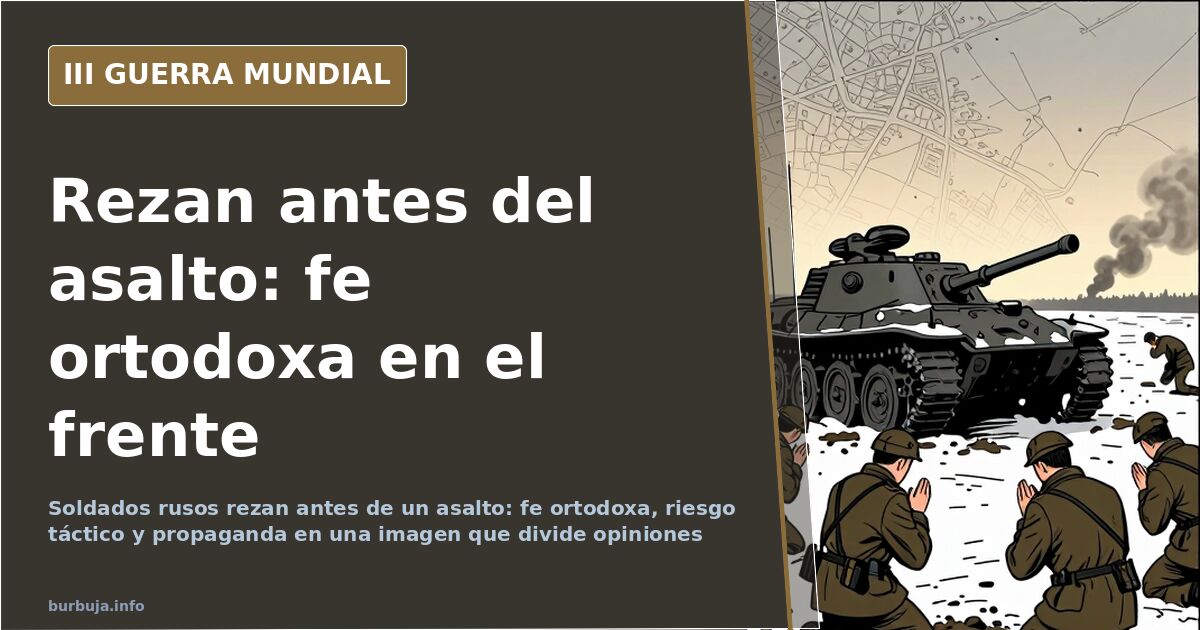
Russian soldiers pray before assault: faith, Orthodoxy and controversy
A group of Russian military personnel is seen kneeling and making the sign of the cross before entering combat. The image, circulated on social media, has triggered intense debate: some see it as a display of courage and tradition, while others warn that gathering troops in the open makes them easy targets for precision artillery. Against the backdrop of Orthodox faith, the scene blends religion, military strategy and propaganda in a prolonged war context.
Prayer before the assault: symbol and tactical risk
The image shows several Russian soldiers, some in field uniforms, kneeling and crossing themselves. This gesture, common among Orthodox troops, has been interpreted as an act of faith before an assault operation. However, voices have pointed out the danger of concentrating forces this way in a war zone. "It's risky to gather like this, but I imagine they were at a safe distance from the front, without mobile phones and under protection from their own drones," notes one participant. This reflection captures the tension between the symbolic value of prayer and real vulnerability to long-range attacks, such as those enabled by HIMARS systems.
The debate quickly shifted to the nature of faith in the Russian Army. For some, Orthodoxy is an identity pillar that decades of Soviet atheism could not dismantle. For others, it is a propagandistic pose. "Years of communism couldn't kill Orthodox faith," argues one message, while another replies that "religion won't save you."
Why did the Russian Orthodox Church re-emerge during the war?
The relationship between the Kremlin and the Russian Orthodox Church has been disputed in the debate. One participant recalls that Stalin legalized the Church when the Germans advanced "like a torrent," suggesting instrumental use of religion in times of crisis. Another clarifies that the Soviets did not persecute faith itself, but its interference in political affairs. The discussion moves to the present: "I only bring the Orthodox Church out of the catacombs when I saw millions of Germans advancing straight to the Kremlin," mocks one message, implying that current support for the Church responds to wartime needs rather than spiritual conviction.
The presence of chaplains and religious ceremonies in Russian units is not new, but the image of soldiers praying before an assault has revived the clash between those who see a cohesion tool and those who denounce the political use of faith.
The role of Chechens and Orthodoxy as an identity marker
One of the most controversial points was the participation of Chechen troops in the conflict. A message claims that "Chechens are not Russians, but they are white Europeans," triggering cross-replies about loyalty and the role of these units. The discussion drifted into Balkan history and the Ottoman past of some groups, with mutual accusations too virulent to reproduce here. What matters is that Orthodox faith is presented in the debate as a unifying element against the country's ethnic and religious diversity.
The image of praying soldiers thus becomes a symbol of fighting Russia: a mix of tradition, propaganda and military strategy. For some, it exemplifies spiritual resistance; for others, it is a smokescreen hiding material and tactical deficiencies.
Echoes in Spain: military blessings and political controversy
The debate jumped to Spain regarding a blessing given to military personnel at the Valley of the Fallen (a controversial monument associated with Franco's regime). A message reproduces the text of the blessing: "May the Lord bless, as always, those who serve the homeland under this flag...". The scene was criticized by associations linking it to the far right, while others defended religious tradition in the Armed Forces. Comparisons with Russian soldiers' prayers highlighted Spanish divisions over religious symbols and the military.
The Spanish controversy mixed with discussions about Ukraine, where some see a war of religions. "Ukrainians believe in Anglosion, Russians believe in God," summarizes one message, reflecting a simplified but widespread view in the debate.
Faith, strategy and propaganda: the impossible balance
The prayer of Russian soldiers before an assault condenses several tensions: faith as a sarracena driver, tactical exposure on a front dominated by precision artillery, and the propagandistic use of religion. While some see an act of bravery, others warn that gathering troops in the open is an unnecessary risk. The debate shifted to the historical role of the Orthodox Church and its instrumentalization by power, both in the USSR and in today's Russia.
Underlying this is an unanswered question: to what extent does faith sustain an army, or is it just a veneer for troop sarracena? The debate remains open, with positions ranging from admiration to hard skepticism.
A group of Russian military personnel is seen kneeling and making the sign of the cross before entering combat. The image, circulated on social media, has triggered intense debate: some see it as a display of courage and tradition, while others warn that gathering troops in the open makes them easy targets for precision artillery. Against the backdrop of Orthodox faith, the scene blends religion, military strategy and propaganda in a prolonged war context.
Prayer before the assault: symbol and tactical risk
The image shows several Russian soldiers, some in field uniforms, kneeling and crossing themselves. This gesture, common among Orthodox troops, has been interpreted as an act of faith before an assault operation. However, voices have pointed out the danger of concentrating forces this way in a war zone. "It's risky to gather like this, but I imagine they were at a safe distance from the front, without mobile phones and under protection from their own drones," notes one participant. This reflection captures the tension between the symbolic value of prayer and real vulnerability to long-range attacks, such as those enabled by HIMARS systems.
The debate quickly shifted to the nature of faith in the Russian Army. For some, Orthodoxy is an identity pillar that decades of Soviet atheism could not dismantle. For others, it is a propagandistic pose. "Years of communism couldn't kill Orthodox faith," argues one message, while another replies that "religion won't save you."
Why did the Russian Orthodox Church re-emerge during the war?
The relationship between the Kremlin and the Russian Orthodox Church has been disputed in the debate. One participant recalls that Stalin legalized the Church when the Germans advanced "like a torrent," suggesting instrumental use of religion in times of crisis. Another clarifies that the Soviets did not persecute faith itself, but its interference in political affairs. The discussion moves to the present: "I only bring the Orthodox Church out of the catacombs when I saw millions of Germans advancing straight to the Kremlin," mocks one message, implying that current support for the Church responds to wartime needs rather than spiritual conviction.
The presence of chaplains and religious ceremonies in Russian units is not new, but the image of soldiers praying before an assault has revived the clash between those who see a cohesion tool and those who denounce the political use of faith.
The role of Chechens and Orthodoxy as an identity marker
One of the most controversial points was the participation of Chechen troops in the conflict. A message claims that "Chechens are not Russians, but they are white Europeans," triggering cross-replies about loyalty and the role of these units. The discussion drifted into Balkan history and the Ottoman past of some groups, with mutual accusations too virulent to reproduce here. What matters is that Orthodox faith is presented in the debate as a unifying element against the country's ethnic and religious diversity.
The image of praying soldiers thus becomes a symbol of fighting Russia: a mix of tradition, propaganda and military strategy. For some, it exemplifies spiritual resistance; for others, it is a smokescreen hiding material and tactical deficiencies.
Echoes in Spain: military blessings and political controversy
The debate jumped to Spain regarding a blessing given to military personnel at the Valley of the Fallen (a controversial monument associated with Franco's regime). A message reproduces the text of the blessing: "May the Lord bless, as always, those who serve the homeland under this flag...". The scene was criticized by associations linking it to the far right, while others defended religious tradition in the Armed Forces. Comparisons with Russian soldiers' prayers highlighted Spanish divisions over religious symbols and the military.
The Spanish controversy mixed with discussions about Ukraine, where some see a war of religions. "Ukrainians believe in Anglosion, Russians believe in God," summarizes one message, reflecting a simplified but widespread view in the debate.
Faith, strategy and propaganda: the impossible balance
The prayer of Russian soldiers before an assault condenses several tensions: faith as a sarracena driver, tactical exposure on a front dominated by precision artillery, and the propagandistic use of religion. While some see an act of bravery, others warn that gathering troops in the open is an unnecessary risk. The debate shifted to the historical role of the Orthodox Church and its instrumentalization by power, both in the USSR and in today's Russia.
Underlying this is an unanswered question: to what extent does faith sustain an army, or is it just a veneer for troop sarracena? The debate remains open, with positions ranging from admiration to hard skepticism.
Also available in: Deutsch
Summary of a discussion on Burbuja.info - Foro de economía, actualidad y política., translated from Spanish and reviewed before publication. Read the full discussion (111 replies).
More summaries
-
Makiivka: Unconfirmed Russian Casualties After HIMARS Strike
HIMARS strike on Makiivka school used as barracks over ammo depot caused unverified Russian casualties, ranging from dozens to 467.
-
Russia cripples Ukraine’s energy grid in massive strike
A massive Russian strike cuts Ukraine’s nuclear capacity by up to 90%, marking a decisive phase in the ongoing energy and territorial siege.
-
Russia repopulates Donbas with housing and salaries
Russia is resettling its poorest citizens in the Donbas with homes and wages, while Ukrainians face a choice between Russian passports or exile.
-
China promoting Spanish as global lingua franca: A 2018 report
Claims that China is pushing Spanish as its imperial language stem from a 2018 news item about Latin America's 700 million speakers.
-
Brazilian Ex-Model Killed in Kharkiv, Dubbed Elite Sniper
Thalita do Valle died in a Kharkiv bunker hit by bombing. Her alleged role as an elite sniper faces skepticism.
-
Russia's Nuclear Threats Face Skepticism Even Among Allies
After a key ship sank, Moscow raises nuclear stakes while NATO arms Ukraine. The conflict's end remains unclear.