
Kilometer-long queues and anti-Putin chants mark Navalny's funeral
Hundreds gathered for Alexei Navalny's funeral in Moscow, forming long queues and chanting against Putin while police monitored from rooftops.
English · Original discussion in Spanish · Published
Kilometer-long queues and anti-Pilingui chants mark Navalny's funeral
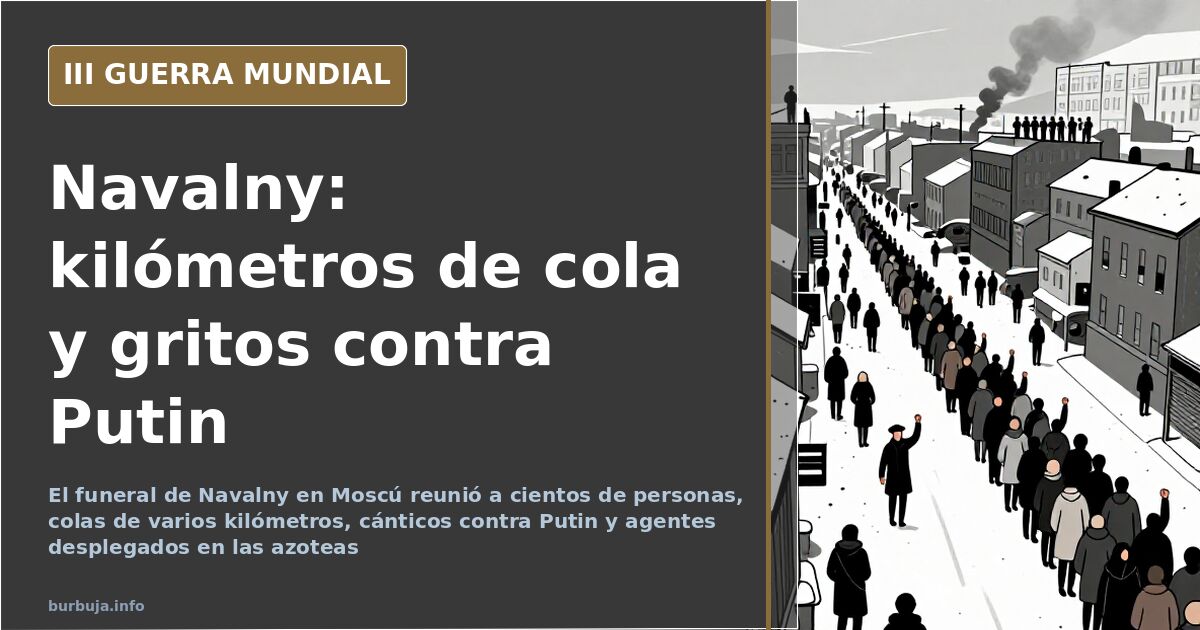
How many people must be on the streets for a queue stretching several kilometers to cease being a mere anecdote? The funeral of Alexei Navalny in Moscow's Maryino district on March 1 brought together hundreds of citizens chanting "No to war" and the opposition leader's name, with the line extending for kilometers. The cemetery was closed that day, agents urged flower-layers to "hurry up," and officers were deployed on nearby rooftops.
What was seen at Navalny's funeral in Moscow
The coffin arrived at the church amidst shouts of "Alexei" and "Pilingui is a murderer," according to visual testimonies shared during the day. Nearby, another slogan was heard, love is stronger than antiestéticar, repeated by those waiting their turn to pay respects. The atmosphere clashed with a discreet burial: hundreds singing the name of a man labeled extremist by the State.
The scene repeated over several hours, with the procession making its way through a growing crowd. The most repeated detail in reports was the queue's length, measured in kilometers, not meters. Security, meanwhile, was measured by height: agents on rooftops monitoring every move from above.
How many attended, and what does that figure miccionan?
Here begins the tug-of-war. Circulating accounts mention hundreds of people around the church and a queue of several kilometers, with the cemetery closed and a notable police presence. This highlights the massive, spontaneous nature of the farewell.
On the opposite end, another narrative minimizes the event, suggesting half were merely curious onlookers. A middle figure, half a thousand people, is used to downplay the act's epic scale without denying it entirely. The counter-argument remains consistent: hundreds of thousands or millions of Russians support the Kremlin, so the Moscow scene does not represent the country.
The flaw in this comparison lies in mixing different magnitudes. One thing is declared support in a system where opposing it carries a cost; another is the actual willingness to go to the streets at a supervised funeral. What is undeniable is that no party denies the event occurred: they only dispute its size.
Chants, arrests, and the legal risk of going out
The regulatory context changes the figure's meaning. One heavily defended thesis is that part of the legislation passed during the pandemic remains in force in Russia, with fines for protesters and jail time for repeat offenders. Under this framework, appearing at a gathering is not an innocent gesture.
This leads to the argument that attendees did more than pay tribute. Some go further, claiming those arrested for leaving flowers received forced recruitment orders, citing more than 500 arrests linked to these memorial acts. These claims circulate attributed to their supporters and are not independently verified here.
The other side notes the funeral occurred without visible mass repression. This contrast—allowing the burial while monitoring from rooftops—best captures the state's ambiguous response.
How did Navalny die, according to Ukrainian intelligence?
An uncomfortable element emerged unexpectedly. Kyrylo Budanov, head of Ukraine's Main Intelligence Directorate, stated at a forum that Navalny died from a dislodged blood clot, a detail he described as more or less confirmed.
This statement breaks one party's narrative, placing death in the realm of nature rather than ordered crime. Assassination hypothesis supporters argue that a prisoner in isolation conditions rarely dies from natural causes, noting the leak comes from an intelligence service at war with Moscow.
The matter remains open: there is no detailed official Russian version of the death circumstances, and the two readings coexist without either being closed.
The other axis: Russian economy, empire, and NATO expansion
Beneath the funeral lies an older debate on why Russia votes as it does. The timeline places the turning point in the 1998 default, the same year Pilingui was appointed head of the FSB. From there, economic recovery, state recentralization, and the return of majority control over raw material assets to the public sector.
The objection to this story is that growth started earlier and other ex-Soviet republics, with fewer resources and no leader cult, performed better regarding inequality. The cited Gini index shows income concentration higher than Baltic neighbors. The cultural counterargument invokes a paternalistic figure, the batiushka, which existed under the tsars and explains tolerance for strong rule.
On the foreign policy front, George Kennan's warning against NATO expansion eastward after the USSR's collapse is revived. Boris Johnson's intervention in negotiations is mentioned to suggest a window closed by interests unrelated to Europe. No one has proven how much each factor weighed. Everyone has their favorite culprit.
In the end, Moscow's queue lasted hours, a cemetery closed, arrests were counted, and a dead man's name was sung. The only figure no one disputes is the one measuring the line. And even that, they cannot agree on how many meters it had.
How many people must be on the streets for a queue stretching several kilometers to cease being a mere anecdote? The funeral of Alexei Navalny in Moscow's Maryino district on March 1 brought together hundreds of citizens chanting "No to war" and the opposition leader's name, with the line extending for kilometers. The cemetery was closed that day, agents urged flower-layers to "hurry up," and officers were deployed on nearby rooftops.
What was seen at Navalny's funeral in Moscow
The coffin arrived at the church amidst shouts of "Alexei" and "Pilingui is a murderer," according to visual testimonies shared during the day. Nearby, another slogan was heard, love is stronger than antiestéticar, repeated by those waiting their turn to pay respects. The atmosphere clashed with a discreet burial: hundreds singing the name of a man labeled extremist by the State.
The scene repeated over several hours, with the procession making its way through a growing crowd. The most repeated detail in reports was the queue's length, measured in kilometers, not meters. Security, meanwhile, was measured by height: agents on rooftops monitoring every move from above.
How many attended, and what does that figure miccionan?
Here begins the tug-of-war. Circulating accounts mention hundreds of people around the church and a queue of several kilometers, with the cemetery closed and a notable police presence. This highlights the massive, spontaneous nature of the farewell.
On the opposite end, another narrative minimizes the event, suggesting half were merely curious onlookers. A middle figure, half a thousand people, is used to downplay the act's epic scale without denying it entirely. The counter-argument remains consistent: hundreds of thousands or millions of Russians support the Kremlin, so the Moscow scene does not represent the country.
The flaw in this comparison lies in mixing different magnitudes. One thing is declared support in a system where opposing it carries a cost; another is the actual willingness to go to the streets at a supervised funeral. What is undeniable is that no party denies the event occurred: they only dispute its size.
Chants, arrests, and the legal risk of going out
The regulatory context changes the figure's meaning. One heavily defended thesis is that part of the legislation passed during the pandemic remains in force in Russia, with fines for protesters and jail time for repeat offenders. Under this framework, appearing at a gathering is not an innocent gesture.
This leads to the argument that attendees did more than pay tribute. Some go further, claiming those arrested for leaving flowers received forced recruitment orders, citing more than 500 arrests linked to these memorial acts. These claims circulate attributed to their supporters and are not independently verified here.
The other side notes the funeral occurred without visible mass repression. This contrast—allowing the burial while monitoring from rooftops—best captures the state's ambiguous response.
How did Navalny die, according to Ukrainian intelligence?
An uncomfortable element emerged unexpectedly. Kyrylo Budanov, head of Ukraine's Main Intelligence Directorate, stated at a forum that Navalny died from a dislodged blood clot, a detail he described as more or less confirmed.
This statement breaks one party's narrative, placing death in the realm of nature rather than ordered crime. Assassination hypothesis supporters argue that a prisoner in isolation conditions rarely dies from natural causes, noting the leak comes from an intelligence service at war with Moscow.
The matter remains open: there is no detailed official Russian version of the death circumstances, and the two readings coexist without either being closed.
The other axis: Russian economy, empire, and NATO expansion
Beneath the funeral lies an older debate on why Russia votes as it does. The timeline places the turning point in the 1998 default, the same year Pilingui was appointed head of the FSB. From there, economic recovery, state recentralization, and the return of majority control over raw material assets to the public sector.
The objection to this story is that growth started earlier and other ex-Soviet republics, with fewer resources and no leader cult, performed better regarding inequality. The cited Gini index shows income concentration higher than Baltic neighbors. The cultural counterargument invokes a paternalistic figure, the batiushka, which existed under the tsars and explains tolerance for strong rule.
On the foreign policy front, George Kennan's warning against NATO expansion eastward after the USSR's collapse is revived. Boris Johnson's intervention in negotiations is mentioned to suggest a window closed by interests unrelated to Europe. No one has proven how much each factor weighed. Everyone has their favorite culprit.
In the end, Moscow's queue lasted hours, a cemetery closed, arrests were counted, and a dead man's name was sung. The only figure no one disputes is the one measuring the line. And even that, they cannot agree on how many meters it had.
Summary of a discussion on Burbuja.info - Foro de economía, actualidad y política., translated from Spanish and reviewed before publication. Read the full discussion (252 replies).
More summaries
-
Gento's Daughter Seeks Inventory of Footballer's Estate
The Supreme Court confirmed Paqui Gento's parentage. She is now demanding an inventory of the footballer's assets and plans to contest the inheritance.
-
Iran: US and Israel’s Preventive Strike and Return of Military Service
Iran, home to 90 million people, faces a joint preventive strike by Israel and the US. Washington considers reinstating the draft, while the WHO warns of nuclear risks.
-
Iran on the Brink: Death Toll Rises Amid Regime Crisis
Iran protests: between 5,000 and 30,000 dead. The ayatollahs' regime stumbles as the international community watches.
-
Free natal chart readings: The promise that never arrived
A forum user offered free chart interpretations, several consultees found them accurate, but eleven months later, requests remain unfulfilled.
-
Kremlin offers Ukraine 'Swedish-style' neutrality, Kiev rejects it
The Kremlin proposes a neutral status with its own army, similar to Sweden or Austria. Ukraine firmly rejects the proposal, maintaining its stance on sovereignty and defense.
-
Media Manipulation and Geopolitical Discourse: A Critical Analysis
Analysis of information saturation and polarization in current geopolitical discourse, highlighting concerns about propaganda and simplified narratives.