
Russian missile destroys José Andrés' humanitarian kitchen in Kharkiv
A Russian missile strike in Kharkiv has destroyed the kitchen used by chef José Andrés to distribute free meals, leaving at least two dead and four injured.
English · Original discussion in Spanish · Published
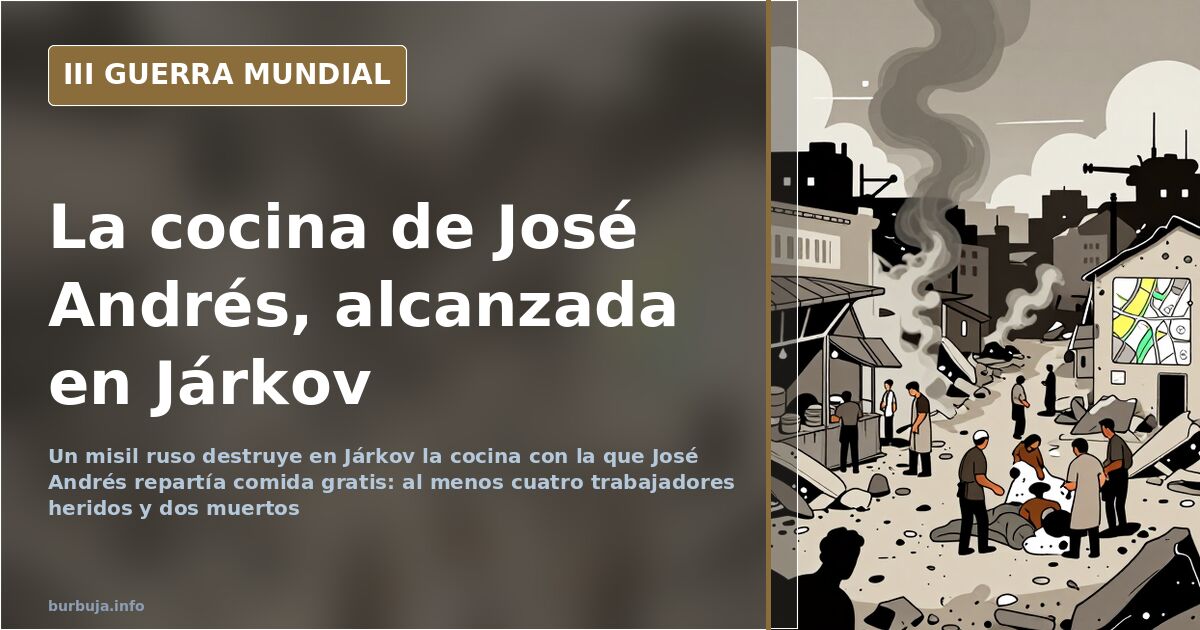
Russian missile hits José Andrés' kitchen in Kharkiv
A Russian missile struck the kitchen operated by chef José Andrés in Kharkiv. The confirmed toll includes at least four injured workers and two deaths, with the projectile also triggering fires in several buildings in the city center. This was no fine-dining restaurant: it was the hub from which free meals were distributed to local residents. What happens when a kitchen like this is destroyed? It is clearly much more than just a broken stove.
The news, reported by El Mundo, has sparked a wave of reactions that goes far beyond the event itself. In no time, the debate shifted toward the chef's true identity, who funds his operations, and whether the image of a charred kitchen serves specific interests.
Details of the strike in central Kharkiv
The facts are sparse: a missile, fires in several central buildings, a destroyed kitchen, and a death toll of six people, including the injured. Beyond that, everything is interpretation, and the opinions are varied.
Some reactions focused on journalistic accuracy, criticizing the media outlet for misspelling the city's name while assuming the nationality of the weapon. There is logic in this irony: if the toponomy is wrong, on what basis can authorship be claimed? Others noted that in an ongoing war, humanitarian facilities often share streets, sidewalks, and basements with military targets, making any casualty report an impossible exercise in precision.
Who is José Andrés and why did he have a kitchen in Kharkiv?
The chef is a public figure with two sides: the media personality seen on television and the manager of emergency food operations in disaster zones. This dual role is precisely what fuels suspicion.
One view holds that his presence in conflict zones is a personal branding strategy using the small screen as a showcase. Another goes further, suggesting without evidence that he acts as an instrument for foreign interests. There are also circulating accusations regarding his treatment of employees and the working conditions in his restaurants, framed as testimonials rather than proven facts. What remains verifiable today are the fire, the injuries, and the deaths.
From missiles to gas prices: the economic shift
As is often the case, the issue drifted toward people's wallets. Alongside the news, a recurring figure has emerged: 95-octane gasoline in Donetsk is being sold at €0.58 per liter, or 52.5 rubles. This has fueled arguments that sanctions are hitting the European economy while the conflict continues.
Similarly, a warning from the German grid regulator was cited: households might have to give up heating in the event of a gas supply emergency. This is the flank that causes the most discomfort. Not the missile, but the bill. The breakdown of energy prices and costs circulating in parallel warrants its own analysis, a detail lost on those who only read the headline.
Solidarity, suspicion, and deflection
As the messages pogre, the tone degraded. Alongside those pointing out the gravity of the attack, others reminded people that the chef also owns restaurants with mandatory sanitary certifications, or turned the event into a joke about meat temperatures. It is the kind of humor that only works if one does not imagine a real person under the rubble.
There were also those asking why humanitarian kitchens share space with military barracks, and those demanding the chef be on the front lines like any other combatant. The phrase, read slowly, says more about the writer than the recipient.
The battle over the narrative
The conversation also devolved into mutual accusations of servility: one side attributed a supposed defense of the Kremlin to those questioning the narrative, while the other pointed to a dependence on foreign interests for those defending him. It is a common pattern: when information is lacking, labels take over.
Ultimately, the episode became a narrative battlefield. Some saw the impact as a mistake in aim; others, a deliberate show of force; and a third group, yet another operation to sustain the weariness of a tired public opinion. None of these three readings can be confirmed with the available data, which hasn't stopped each side from defending their view as certainty.
What remains is the elemental truth. Someone launched a missile at a city, a kitchen that provided free food stopped working, and two people will never cook again. The rest is conversation—a lot of it—and almost all of it about the chef.
Also available in: Deutsch
Summary of a discussion on Burbuja.info - Foro de economía, actualidad y política., translated from Spanish and reviewed before publication. Read the full discussion (102 replies).
More summaries
-
Baba Vanga's 'Lord of the World' prophecy puts Putin at the center
A prophecy attributed to Baba Vanga casts Putin as 'Lord of the World'. Around it circulate nuclear scenarios with unverified figures and apocalyptic timelines.
-
Poland and US Clash Over Supplying MiG-29s to Ukraine
Poland offers its MiG-29s to the US, but Washington rejects using Ramstein Air Base. The origin of each flight sparks debate over a casus belli.
-
NATO forces pull out of Kharkiv as Russia advances
Reports from Times of India and Tribun Timur indicate that NATO-linked fighters are abandoning Kharkiv as Russia launches an offensive featuring hand-to-hand combat.
-
Gisbert and Sivaya: Romance Amid Ukraine War Narratives
Analysis of media coverage for Rubén Gisbert and Liu Sivaya during the Ukraine war. Is this digital propaganda or reality?
-
Why Russia gets $7.41 billion from the US for its diesel while Venezuela gets nothing
Trump announced on October 22, 2025 a deal with Putin for Russia to ship diesel to the US and the world. Venezuela, with 65 billion barrels, receives nothing.
-
US Air Force airman dies after falling from Alamodome roof during pregame show
A US Air Force airman died after falling from the rafters of San Antonio's Alamodome during a rappelling demonstration before a game. Nellis Air Force Base confirmed the death.