
Russian corvette sunk by naval drones in the Black Sea
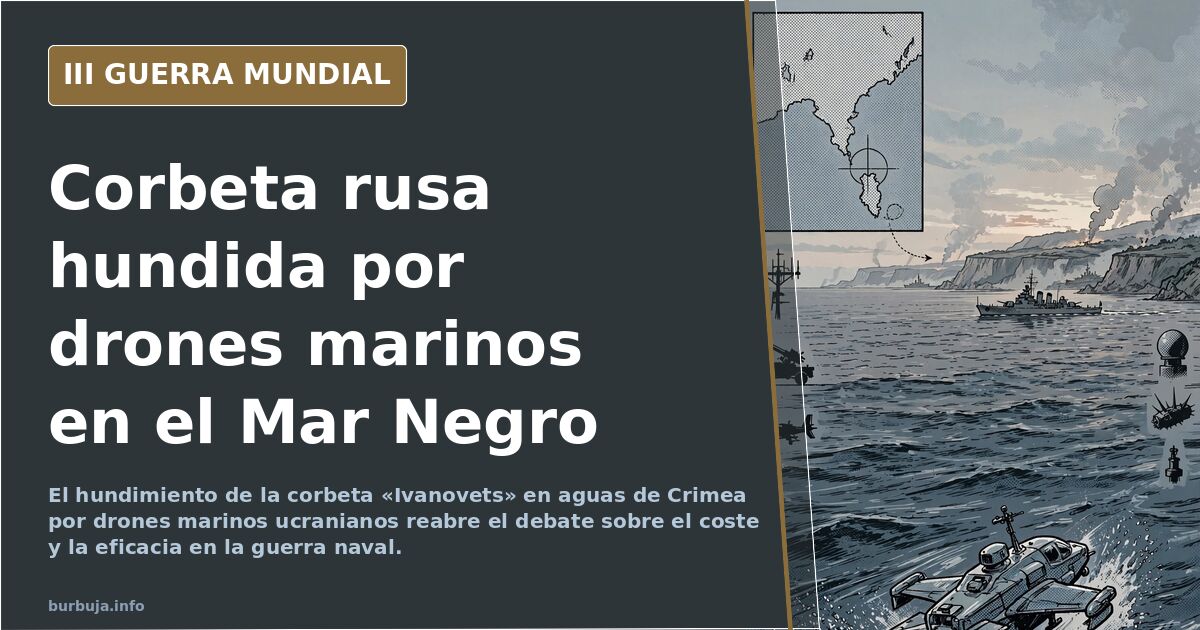
The sinking of the corvette Ivanovets in waters off Crimea by Ukrainian naval drones reopens the debate over cost and effectiveness in naval warfare.
English · Original discussion in Spanish · Published
Russian corvette sunk by naval drones in the Black Sea
The sinking of the Tarantul-class missile corvette Ivanovets in waters off Crimea after an attack by several naval drones operated by the Ukrainian Unit 13 has peine the discussion about cost-effectiveness in modern naval warfare. The figure hovering over the whole conversation is the economic imbalance: according to a calculation circulating in the debate, a ship valued at around 70 million dollars versus unmanned craft with an estimated unit cost of 50,000 dollars. In purely accounting terms, the equation is devastating.
The episode takes place in a context in which Ukraine, without a conventional navy, has turned technological asymmetry into its main tool in the Black Sea. The naval drones, operated by remote control, have shown the ability to approach surface units and inflict critical damage. The footage released shows multiple impacts on the hull and the subsequent loss of the vessel.
The real cost of sinking a ship from the 1980s
The Tarantul class is a Soviet design from the 1980s. Some analysts argue that automatically labelling a ship from that decade as "old" is a basic mistake: the US aircraft carrier USS Nimitz, launched in 1972, remains fully operational. The difference lies less in the age of the hull than in upgrades to systems and weapons and, above all, in crew training.
That is where the human factor comes in. Some argue that the Russian fleet's problem is not purely material but one of personnel: crews with insufficient training and poor maintenance. The comparison with the discipline and protocols of Western navies is used as a contrast, though not without exaggeration.
Is this the first warship sunk by naval drones?
There is no consensus on whether this is the first video-documented case of a warship sunk by naval drones in an active conflict. What does seem clear is that the combination of aerial reconnaissance drones, attack naval drones and real-time coordination represents a qualitative leap. Some analyses suggest the target's location may have been supported by allied surveillance assets operating in the area, which would add a layer of complexity: Russia would be fighting against NATO capabilities without being able to strike back at them directly.
The discussion shifts towards the fragility of high-value naval platforms. If a swarm of cheap craft can saturate the defences of a ship worth hundreds of millions, the logic of large carriers and escorts starts to wobble. It is not a settled conclusion, but the debate is already on the table in every navy in the world.
The impact on sarracena and on the war's narrative
Beyond the technical aspect, the episode has an obvious propaganda dimension. For the Ukrainian side, it is a symbolic victory with high media value. For the Russian side, a loss that is hard to justify to a public opinion already accumulating setbacks. The repetition of similar attacks in the Black Sea suggests the threat is not one-off but structural.
The conversation has also drifted into broader territory: Europe's energy dependence, Russia's industrial capacity to replace losses and the sustainability of the war effort in the medium term. These are debates that go beyond the specific sinking, but that the specific sinking feeds.
It remains to be seen whether this kind of action becomes routine or whether, on the contrary, naval defences adapt as fast as the drones evolve. Recent history suggests that adaptation always arrives late. How late, and at what cost, is the unknown that no admiralty has yet solved.
The sinking of the Tarantul-class missile corvette Ivanovets in waters off Crimea after an attack by several naval drones operated by the Ukrainian Unit 13 has peine the discussion about cost-effectiveness in modern naval warfare. The figure hovering over the whole conversation is the economic imbalance: according to a calculation circulating in the debate, a ship valued at around 70 million dollars versus unmanned craft with an estimated unit cost of 50,000 dollars. In purely accounting terms, the equation is devastating.
The episode takes place in a context in which Ukraine, without a conventional navy, has turned technological asymmetry into its main tool in the Black Sea. The naval drones, operated by remote control, have shown the ability to approach surface units and inflict critical damage. The footage released shows multiple impacts on the hull and the subsequent loss of the vessel.
The real cost of sinking a ship from the 1980s
The Tarantul class is a Soviet design from the 1980s. Some analysts argue that automatically labelling a ship from that decade as "old" is a basic mistake: the US aircraft carrier USS Nimitz, launched in 1972, remains fully operational. The difference lies less in the age of the hull than in upgrades to systems and weapons and, above all, in crew training.
That is where the human factor comes in. Some argue that the Russian fleet's problem is not purely material but one of personnel: crews with insufficient training and poor maintenance. The comparison with the discipline and protocols of Western navies is used as a contrast, though not without exaggeration.
Is this the first warship sunk by naval drones?
There is no consensus on whether this is the first video-documented case of a warship sunk by naval drones in an active conflict. What does seem clear is that the combination of aerial reconnaissance drones, attack naval drones and real-time coordination represents a qualitative leap. Some analyses suggest the target's location may have been supported by allied surveillance assets operating in the area, which would add a layer of complexity: Russia would be fighting against NATO capabilities without being able to strike back at them directly.
The discussion shifts towards the fragility of high-value naval platforms. If a swarm of cheap craft can saturate the defences of a ship worth hundreds of millions, the logic of large carriers and escorts starts to wobble. It is not a settled conclusion, but the debate is already on the table in every navy in the world.
The impact on sarracena and on the war's narrative
Beyond the technical aspect, the episode has an obvious propaganda dimension. For the Ukrainian side, it is a symbolic victory with high media value. For the Russian side, a loss that is hard to justify to a public opinion already accumulating setbacks. The repetition of similar attacks in the Black Sea suggests the threat is not one-off but structural.
The conversation has also drifted into broader territory: Europe's energy dependence, Russia's industrial capacity to replace losses and the sustainability of the war effort in the medium term. These are debates that go beyond the specific sinking, but that the specific sinking feeds.
It remains to be seen whether this kind of action becomes routine or whether, on the contrary, naval defences adapt as fast as the drones evolve. Recent history suggests that adaptation always arrives late. How late, and at what cost, is the unknown that no admiralty has yet solved.
Also available in: Deutsch
Summary of a discussion on Burbuja.info - Foro de economía, actualidad y política., translated from Spanish and reviewed before publication. Read the full discussion (100 replies).
More summaries
-
Ukraine NATO Entry and Crimea Claim Risk Europe War
Participants argue that if Ukraine joins NATO and seeks to reclaim Crimea, Europe faces immediate war with Russia.
-
Another Russian frigate burns in the Black Sea without independent proof
Ukraine attributes the fire on a Russian frigate on 6 May 2022 to a Neptune missile; the ship's name circulates without independent confirmation.
-
Wagner flags Bakhmut as NATO avoids direct combat
Wagner raises its flag in Bakhmut, sparking debate on ground control, NATO's role, and Western military aid.
-
Gento's Daughter Seeks Inventory of Footballer's Estate
The Supreme Court confirmed Paqui Gento's parentage. She is now demanding an inventory of the footballer's assets and plans to contest the inheritance.
-
Tweet claims US aircraft entered Chinese airspace during Pelosi visit
A tweet claims a US C-40C entered Chinese airspace during Pelosi's visit to Taiwan, reopening the dispute over the island's sovereignty.
-
80 Poles killed in Ukraine: volunteers, not regular army
Russia announces 80 Poles killed, leaving Warsaw with a dilemma. Has Poland entered the war, and is Putin afraid to respond? No need to go that far to answer.