
Russian army's looting logistics: fuel and chocolate bars
A video shows Russian soldiers looting a gas station in Ukraine. The debate: is it a logistics failure or a military tradition of living off the land?
English · Original discussion in Spanish · Published
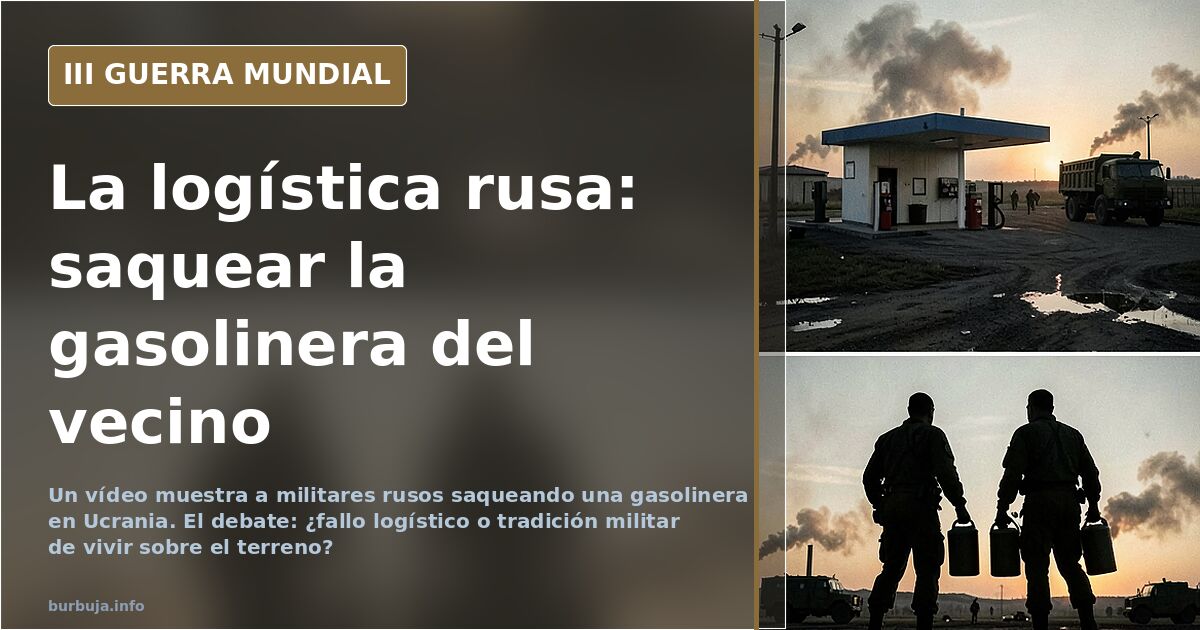
The Russian army and the logistics of looting: fuel and chocolate bars
A video shows Russian soldiers emptying a gas station on Ukrainian territory. From there, the conversation turns to a more serious matter: if the world's second-largest oil exporter cannot supply its own tanks, then Russian military logistics rest on plundering the land. The scene is almost domestic: cars lined up, tanks being filled, shelves being emptied. The awkward question is why an army on campaign needs to provision itself this way.
The starting point is a tweet attributing to Russian forces the looting of a service station in the Kherson region. The rest is built on that image: some see it as a practice inherent to any war, while others read it as proof of a first-rate logistics failure. The discussion moves between the anecdote of petty theft and the analysis of why an army with such firepower depends on plunder to refuel.
Why would an army loot a gas station?
The most repeated explanation in the conversation is the military tradition of living off the land. It is recalled that the Germans did the same in France in 1940, and that Napoleon's troops owed much of their estimulante ilegal to dispensing with baggage trains and provisioning themselves with whatever they found. It is the conqueror's logic of turning the territory into their warehouse. Seen through that lens, looting would not be an anomaly but a historical constant.
The nuance comes when comparing capabilities. It is argued that the Wehrmacht, taken as a benchmark of logistical efficiency, relied in its early advance lines on trucks, carts and horses, and yet did not commit the blunder attributed to the Russian forces. The comparison is no small matter: if the army that invaded half of Europe with animal traction kept its supplies flowing, the Russian problem would not be one of resources but of organization.
The opposing view also appears: any army operating far from its bases makes use of the territory's resources. There is nothing extraordinary about it. What is debated is not the fact itself, but its scale and its necessity.
The fuel that never reaches the front
The central argument is that Russia, one of the world's largest oil exporters, fails to get fuel to its tanks across a land border. It is suggested that fuel tankers have been destroyed in large numbers and that supplies are forced to travel long routes, including sea crossings. The irony is obvious: the energy power that supplies half the world cannot refuel its own vanguard.
Against that, the technical objection: extracting and refining crude is one thing, transporting it to the line of contact is another. Refining does not solve the last mile. And that last mile is where things get stuck when the roads are under fire and convoys are easy targets.
This is where the tactical explanation comes in: infiltration by small groups with light anti-tank weapons disrupts supply lines more effectively than a frontal clash. It is argued that this kind of ambush warfare would complicate the logistics of any army, not just Russia's. The conclusion drawn is that the vulnerability is not unique, but the response is revealing.
Adulterated gasoline and the stalled tank
One of the most repeated hypotheses is that Russian vehicles are left stranded because the fuel at abandoned stations has been adulterated. There is talk of adding substances to the tank to disable the engine. There is no confirmation, but the idea circulates persistently and fits the image of columns halted without ever having entered combat.
If that were true, the looting of a gas station would cease to be an anecdote of plunder and become a trap. The army that lives off the land risks finding the land poisoned. The logic of improvised provisioning turns against itself.
The scene in the video, with soldiers loading fuel and food from a service station, sums up the paradox better than any report: an army that was supposed to pull off a quick campaign ended up managing its provisions like a looting squad. Perhaps the best logistics in the world is, in fact, the kind that needs no trucks because it supplies itself with whatever it finds.
Also available in: Deutsch
Summary of a discussion on Burbuja.info - Foro de economía, actualidad y política., translated from Spanish and reviewed before publication. Read the full discussion (88 replies).
More summaries
-
Eight explosions rock Zyabrovka air base used by Russia in Belarus
At least eight explosions and several flashes were reported at the Zyabrovka airfield, a base used by Russia 40 km from Ukraine, with no one yet claiming responsibility
-
Crenshaw: destroying the Russian army without losing US troops is a good idea
US Congressman Dan Crenshaw defends "investing in the destruction of the Russian army without losing US troops." The debate over Ukraine as a proxy war by…
-
Russia's army lacks funds for NATO-ready weapons, not reserves
Russia claims it saves modern arms for a NATO clash. Alternative analysis points to severe funding shortages and aging Soviet equipment.
-
Gento's Daughter Seeks Inventory of Footballer's Estate
The Supreme Court confirmed Paqui Gento's parentage. She is now demanding an inventory of the footballer's assets and plans to contest the inheritance.
-
Ukraine to receive 150-km GLSDB bombs fired from HIMARS launchers
The $2 billion US package includes 150-km GLSDB bombs that can be launched from HIMARS: what their real range is and which occupied territory they put within reach.
-
Trump hands Putin parts of Alaska as sanctioned Russian firm surfaces in US energy project
Polar Train LNG CEO Joel Riddle resigned after discovering that US-sanctioned Novatek was behind a $25 billion project in Alaska. The White House admits it was mentioned.