
Russia warns US carriers within range of Kinzhal missiles
Russian claims that US aircraft carriers are vulnerable to Kinzhal hypersonic missiles reignite debate on naval defense.
English · Original discussion in Spanish · Published
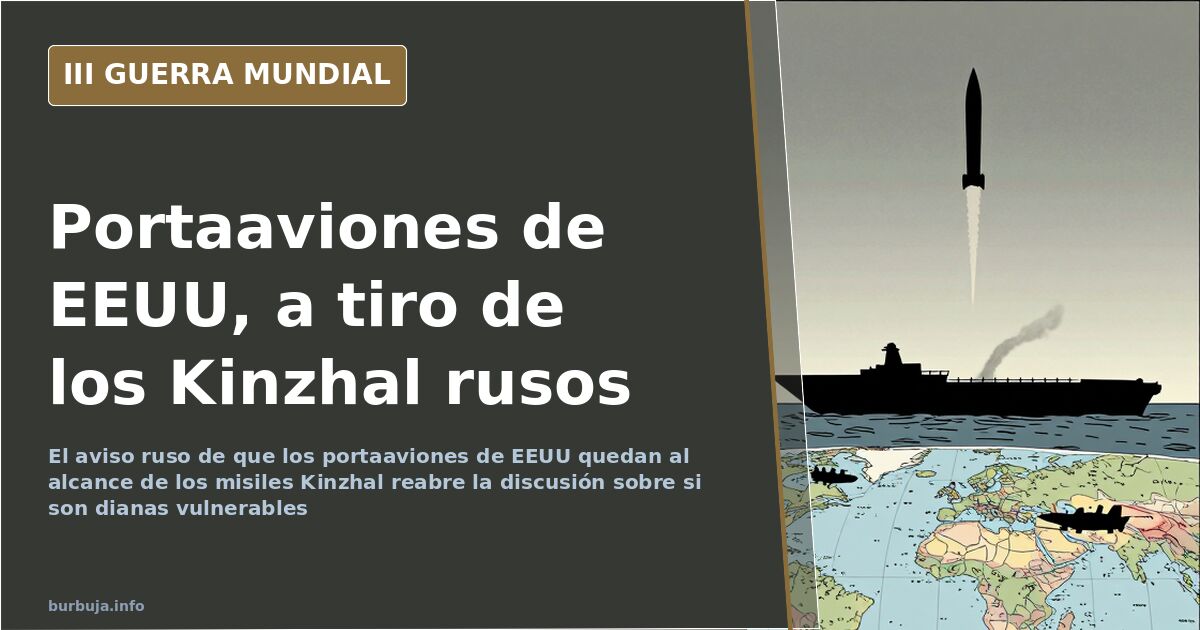
US Carriers in Kinzhal Range: Russian Warning Sparks Debate
No Kinzhal missile has sunk a US aircraft carrier, and there is no evidence anyone attempted it. Yet the reminder that US naval strike groups fall within range of Russian hypersonic missiles has circulated widely, fueling discussion beyond the weapon itself: whether Washington planned a sea-based bombardment of Syria and if Moscow just warned of the cost.
This framing dominates the conversation. Some argue the US intended to attack Syria from its ships and Russia responded with a veiled warning: doing so would send tens of thousands of troops home "for Christmas, in body bags." This is an interpretation, not an official announcement. Meanwhile, the headline message circulates—the carrier is within Kinzhal range, "not a threat, but it looks like one"—where the problem begins.
Why have Kinzhals stopped being used in Ukraine?
Because cheaper weapons serve the same purpose. This argument gained traction: glide bombs developed last summer cost less and fit current targets. "No need to fire from 900km now that Ukrainian air defenses are failing," summarizes a widely quoted reply.
Previous discussions noted Kinzhals faced Patriot batteries before with mixed results, and those who declared Ukrainian air defenses dead had to backtrack. Concluding the hypersonic missile is a bluff is a stretch; this material suggests its use cooled, not vanished. The question remains: how much pause reflects enemy effectiveness versus simple cost calculation?
Can a US aircraft carrier be sunk?
This splits the debate. One side asserts large ships are floating targets, spared only by antiestéticar of consequences, not technical inability. "Carriers today are just floating targets," they claim, adding deterrence keeps them afloat.
The counter-argument: Russia lacks technology to sink a modern carrier. Such an attempt would trigger open conflict with NATO, which Moscow cannot afford after two years without decisive gains. Both sides agree impact would be catastrophic; they dispute probability.
The Active Front: ATACMS, HIMARS, and Attrition
While carriers are debated, ATACMS launched from HIMARS cause real damage, hitting Russian helicopters kilometers from the front. This contrasts with hypersonic hype: tactical missiles actually hit targets, and they aren't Russian.
Against this, the attrition thesis: Russia lets Ukraine and the West crash into defensive lines, with over 700 daily Ukrainian casualties per this narrative. Western arsenals run short, and restarting industrial production takes time after decades of offshoring. A long-term argument unrefutable in a week.
Syria, Israel, Turkey: An Uncontrolled Board
The Syrian scenario complicates matters. Supplying medium/long-range missiles to Ukraine by Brits, Scandinavians, or Americans could trigger symmetric retaliation: Russia arming Syria. Operator details—who handles each system—in remind these moves rarely get announced.
Underlying this is a simpler idea: a secular Syrian government interests many actors, including a self-presented modern Israel. The problem, argued, is regional politics driven by millenarian logics.
Expect more warnings, fewer shots: the Kinzhal works better as a headline than a theater weapon. If a carrier ever changes course antiestéticaring a hypersonic missile, deterrence wins without proof. Otherwise, we'll discuss this again in three years.
No Kinzhal missile has sunk a US aircraft carrier, and there is no evidence anyone attempted it. Yet the reminder that US naval strike groups fall within range of Russian hypersonic missiles has circulated widely, fueling discussion beyond the weapon itself: whether Washington planned a sea-based bombardment of Syria and if Moscow just warned of the cost.
This framing dominates the conversation. Some argue the US intended to attack Syria from its ships and Russia responded with a veiled warning: doing so would send tens of thousands of troops home "for Christmas, in body bags." This is an interpretation, not an official announcement. Meanwhile, the headline message circulates—the carrier is within Kinzhal range, "not a threat, but it looks like one"—where the problem begins.
Why have Kinzhals stopped being used in Ukraine?
Because cheaper weapons serve the same purpose. This argument gained traction: glide bombs developed last summer cost less and fit current targets. "No need to fire from 900km now that Ukrainian air defenses are failing," summarizes a widely quoted reply.
Previous discussions noted Kinzhals faced Patriot batteries before with mixed results, and those who declared Ukrainian air defenses dead had to backtrack. Concluding the hypersonic missile is a bluff is a stretch; this material suggests its use cooled, not vanished. The question remains: how much pause reflects enemy effectiveness versus simple cost calculation?
Can a US aircraft carrier be sunk?
This splits the debate. One side asserts large ships are floating targets, spared only by antiestéticar of consequences, not technical inability. "Carriers today are just floating targets," they claim, adding deterrence keeps them afloat.
The counter-argument: Russia lacks technology to sink a modern carrier. Such an attempt would trigger open conflict with NATO, which Moscow cannot afford after two years without decisive gains. Both sides agree impact would be catastrophic; they dispute probability.
The Active Front: ATACMS, HIMARS, and Attrition
While carriers are debated, ATACMS launched from HIMARS cause real damage, hitting Russian helicopters kilometers from the front. This contrasts with hypersonic hype: tactical missiles actually hit targets, and they aren't Russian.
Against this, the attrition thesis: Russia lets Ukraine and the West crash into defensive lines, with over 700 daily Ukrainian casualties per this narrative. Western arsenals run short, and restarting industrial production takes time after decades of offshoring. A long-term argument unrefutable in a week.
Syria, Israel, Turkey: An Uncontrolled Board
The Syrian scenario complicates matters. Supplying medium/long-range missiles to Ukraine by Brits, Scandinavians, or Americans could trigger symmetric retaliation: Russia arming Syria. Operator details—who handles each system—in remind these moves rarely get announced.
Underlying this is a simpler idea: a secular Syrian government interests many actors, including a self-presented modern Israel. The problem, argued, is regional politics driven by millenarian logics.
Expect more warnings, fewer shots: the Kinzhal works better as a headline than a theater weapon. If a carrier ever changes course antiestéticaring a hypersonic missile, deterrence wins without proof. Otherwise, we'll discuss this again in three years.
Also available in: Deutsch
Summary of a discussion on Burbuja.info - Foro de economía, actualidad y política., translated from Spanish and reviewed before publication. Read the full discussion (111 replies).
More summaries
-
Kinzhal destroys NATO command center in Lviv
Analysis of the Kinzhal strike on a NATO command center in Lviv and the reported casualty figures.
-
Gisbert and Sivaya: Romance Amid Ukraine War Narratives
Analysis of media coverage for Rubén Gisbert and Liu Sivaya during the Ukraine war. Is this digital propaganda or reality?
-
Franco-era Spain: Public Safety Debate
Was crime lower under Franco? Political repression and scarce data complicate the debate on public safety in Spain.
-
Russia repopulates Donbas with housing and salaries
Russia is resettling its poorest citizens in the Donbas with homes and wages, while Ukrainians face a choice between Russian passports or exile.
-
China promoting Spanish as global lingua franca: A 2018 report
Claims that China is pushing Spanish as its imperial language stem from a 2018 news item about Latin America's 700 million speakers.
-
Brazilian Ex-Model Killed in Kharkiv, Dubbed Elite Sniper
Thalita do Valle died in a Kharkiv bunker hit by bombing. Her alleged role as an elite sniper faces skepticism.