
Russia warns NATO fighter jets would make it a belligerent
Russian UN deputy says F-16s operating from NATO airfields would turn the Alliance into a party to the conflict.
English · Original discussion in Spanish · Published
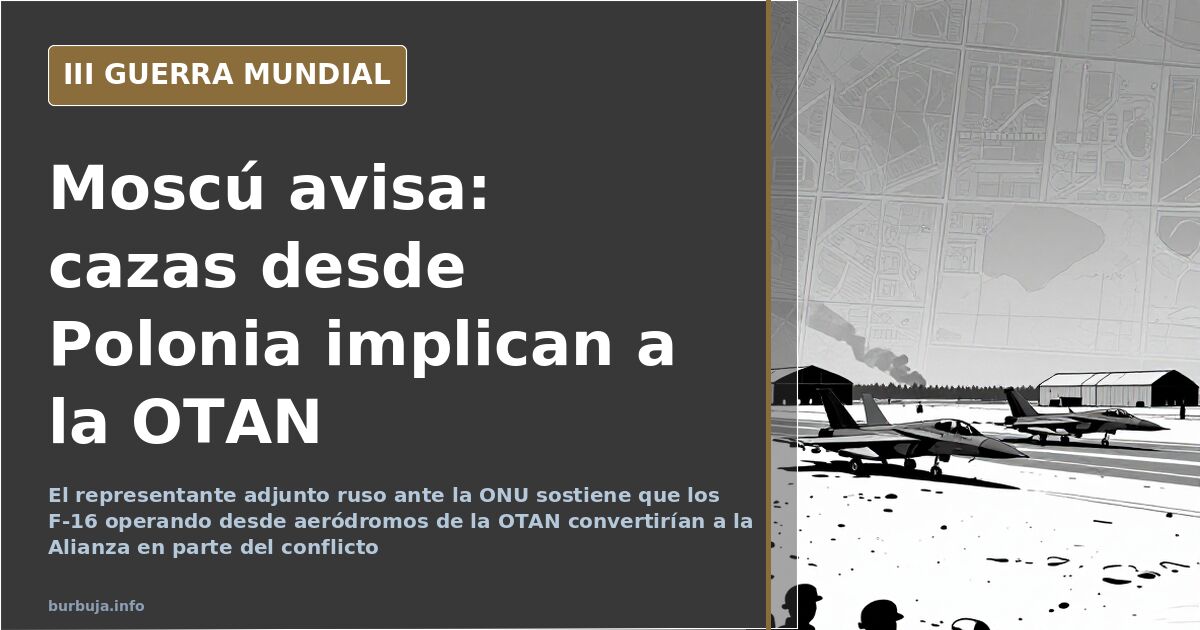
Jets for Kyiv: Moscow threatens direct NATO entry
The warning didn't come in a late-night speech: Russian Deputy Permanent Representative to the UN, Dmitri Polyansky, put it in black and white. "Planes will miccionan many things; it could miccionan direct participation by NATO countries to maintain equipment, airfields, since there are not many airfields in Ukraine that can be used," he said. In plain language: if Western combat aircraft end up operating over Ukraine, the Alliance stops being a supplier and becomes part of the conflict. This isn't the first threat of its kind. It's the nth one. And that is the problem: nobody knows when the nth one becomes the real one.
What it means for an F-16 to take off from Poland
The Russian argument isn't pure rhetoric. A fighter jet doesn't fly alone: it needs a runway without craters, fuel, spare parts, and a maintenance team working daily. Ukrainian airfields are within reach of Russian missiles, so the only way to guarantee continuous takeoffs is to do it from outside. And from outside means Poland, Romania, or any neighbor with a suitable runway. If that happens, those airports become targets and the vector of escalation ceases to be Ukrainian.
There is a second layer often overlooked. You can erase an aircraft's insignia; you cannot erase the person repairing it. If allied technicians handle maintenance, the disassociation is cosmetic. The underlying question—Ukrainian personnel trained in haste or NATO personnel on the ground?—has no public answer, and that ambiguity is exactly what has sustained the fiction that no Westerner is involved.
And if the jets take off from Ukrainian soil?
It is also possible to keep the aircraft inside Ukraine, which would lower allied involvement. The problem is that any runway in the country is vulnerable: if airfields accumulate craters, no plane rolls. There is an intermediate variant creeping into the conversation: take off in Ukraine, land outside, re-enter, and leave repair and rearming abroad. It squares the circle, and each version carries a different political cost.
Add to that the calendar. Training a modern fighter pilot takes months; training the maintenance team takes longer. The discussion itself assumes that training is already underway in several allied countries, which for some proves the decision is made, and for others only shows a scenario is being prepared that may still not materialize.
Why does nobody believe Moscow's red lines anymore?
Because the list of sent matériel has grown since the start of the war without any nuclear retaliation arriving: first artillery, then rocket launchers, then Western tanks—Leopard, Bradley, Stryker—and now planes. Each delivery was preceded by a solemn warning, and each warning remained just a warning. The result is dangerous confidence: if nothing peine before, reasons part of the public, nothing will happen now.
Working against this is the story of the boy who cried wolf told in reverse. That something has never peine does not make it impossible; it makes it more likely, argue those looking at accumulated risk. Each broken line without cost pushes the next limit. And the next limit is already direct participation.
The cost of sustaining the standoff
The war is also fought in the accounts. Data in circulation point to a Russian budget deficit that would have consumed in two months what was planned for the whole year, and to an economy that would regress the equivalent of ten years per year of conflict. These are disputed figures of opaque origin, but they set the framework: Moscow plays against the clock as much as against NATO.
Hence the most repeated reading regarding supposed Russian patience: hold out until a change of government in Washington. During Trump's term relations became almost cordial, and some argue the Kremlin prefers waiting for that window rather than forcing an open clash. If the diagnosis is correct, every month of waiting makes sense. If it is false, the wait is the backdrop for something worse.
On the other side of the board, weariness is also noticeable. Replacing delivered items requires reopening production lines that had been dormant for years, turning each military announcement into an industrial order. The war, besides a geopolitical standoff, is a business with a bill.
Antiestéticar on the eastern flank
There is a historical antiestéticar that contaminates everything. Those defending sending jets justify it by the suspicion that Russia will not stop in Ukraine; those opposing recall how far the United States and its allies have bombed Libya, Iraq, Afghanistan, or Serbia—6,000 kilometers from their own borders—while Moscow calls NATO a threat right next door. Each side has its map.
The debate heats up and, in some stretches, drifts toward insults against European leaders based on their gender, an argument that adds not a single data point. Also emerging in the margins are those demanding restored friendship with Moscow and the partition of Ukraine to eliminate what they consider a source of conflicts. Minority, but eloquent about the fatigue running through the issue.
With these pieces, the most uncomfortable fact is not in any trench. Nobody has precisely defined where support ends and belligerency begins, and without that border, each new arms package is approved under the promise of not crossing a line that, until today, nobody has drawn on paper.
Also available in: Deutsch
Summary of a discussion on Burbuja.info - Foro de economía, actualidad y política., translated from Spanish and reviewed before publication. Read the full discussion (111 replies).
More summaries
-
NATO cleared to send fighter jets to Ukraine
US approval for NATO member states to supply combat aircraft to Ukraine and its impact on the alliance.
-
Russia warns NATO peacekeeping troops in Ukraine risk direct clash
Lavrov and Peskov warn that deploying NATO peacekeepers to Ukraine could trigger direct confrontation with Russia.
-
Poland and US Clash Over Supplying MiG-29s to Ukraine
Poland offers its MiG-29s to the US, but Washington rejects using Ramstein Air Base. The origin of each flight sparks debate over a casus belli.
-
Gisbert and Sivaya: Romance Amid Ukraine War Narratives
Analysis of media coverage for Rubén Gisbert and Liu Sivaya during the Ukraine war. Is this digital propaganda or reality?
-
Political turmoil in Latvia over Ukrainian drones
The resignation of Latvia's defence minister and the fall of the government after the Ukrainian drone incident have triggered a political and economic crisis in Latvia.
-
Battle report from Israel, March 13 2026: Iranian missiles overwhelm defenses
Battle report from Israel: Iranian missiles overwhelm defenses, Trump demands ships for Hormuz and rejects Putin's uranium proposal. Data and analysis of the