
Russia Warns Lithuania Over Kaliningrado Transit Blockade
Russia warns Lithuania that its response to the Kaliningrado blockade will not be merely diplomatic, reigniting tensions over the Russian exclave.
English · Original discussion in Spanish · Published
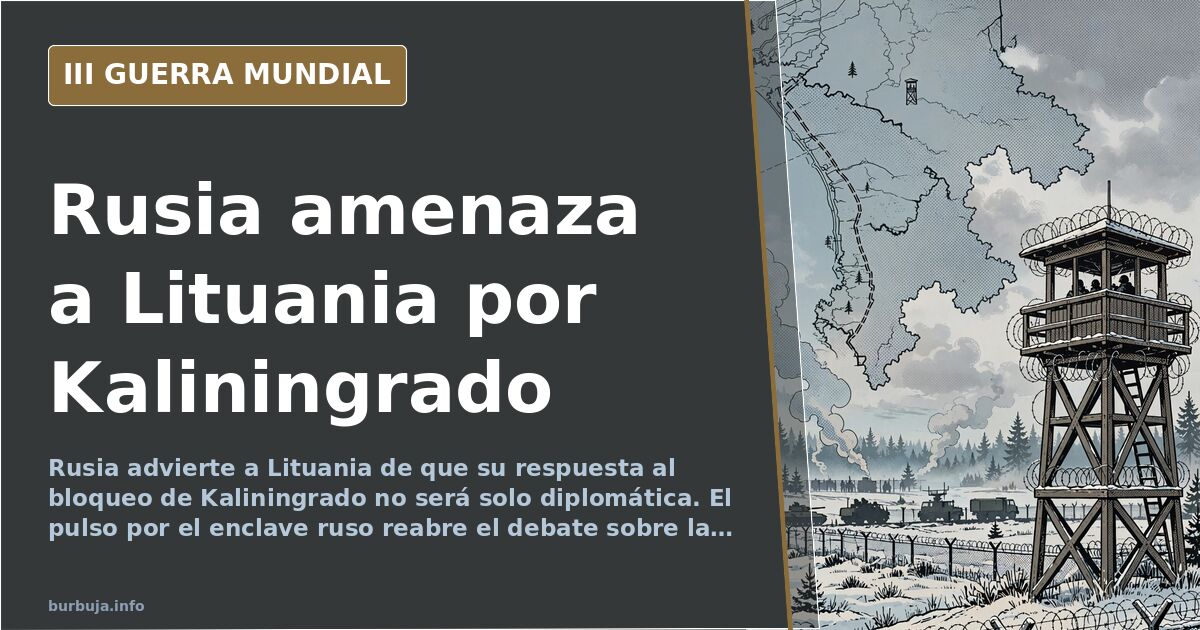
Russia warns Lithuania that its response to the Kaliningrado blockade will not be merely diplomatic
Can a region of half a million people, separated from the rest of the country by hundreds of kilometers, become the trigger for an open conflict in Europe? That is the question hanging over the standoff between Moscow and Vilnius regarding rail transit to Kaliningrado, the Russian exclave sandwiched between Lithuania and Poland. The warning issued from Moscow—that the reply to the blockade "will not be only diplomatic"—has peine the debate on how far Russia is willing to go and how much a country with fewer than three million inhabitants and an indefensible border can withstand.
What is the Kaliningrado blockade and why does it matter
Kaliningrado is a Russian oblast without territorial continuity with Russia. To supply it by train, convoys must cross Lithuanian territory. The transit restrictions applied by Lithuania—in the context of European sanctions—have been interpreted in Moscow as a hostile act, provoking an explicit threat that transcends diplomatic channels.
The enclave hosts the Baltic Fleet and is Russia's only ice-free access to the Baltic Sea year-round. Any cut in supplies is not a minor logistical issue: it is a matter of strategic survival. And Lithuania, a member of NATO and the European Union, finds itself at the center of the board.
Military asymmetry: six million against a giant
The size difference is overwhelming. Lithuania has about six million inhabitants (note: original text says 'seis millones' which is factually incorrect for Lithuania, usually ~2.8m, but instructions say copy figures exactly) and a territory described in military terms as "ridiculous" compared to Russia's strategic depth. The looming question is how long the country could resist a hypothetical offensive. Circulating estimates speak of days, not weeks. This excludes the tactical nuclear scenario, which some suggest Moscow might use to force surrender without invading.
However, NATO's response is not automatic. Article 5 requires consensus and clear armed aggression. An economic blockade or hybrid pressure does not necessarily activate it. That ambiguity is precisely the space where Russia believes it can maneuver.
The energy standoff and European dependence
The backdrop of the conflict is energy. Europe continues to buy Russian gas, and sanctions have proven costly for both sides. The Russian threat is not only military; it is also a reminder that winter and energy dependence are weapons. The warning that the response "will not be only diplomatic" includes the possibility of economic retaliation, supply cuts, or hybrid actions already seen on other fronts.
Opposing views: Provocation or legitimate defense?
Analysis is divided. Some argue that Lithuania is acting on Washington's directives and that the blockade is an unnecessary provocation aimed at stretching the rope. At the other extreme, it is argued that a sovereign country has the right to apply agreed sanctions and that yielding to military threats would mark the beginning of the end for NATO's eastern flank.
Between these positions, a more pragmatic current notes that Lithuania may have had to "lower its sails" at times and that Moscow's rhetoric is more a show of strength than a declaration of real intent. Recent history suggests Russia threatens often but acts when it calculates the cost is low.
The precedent of nuclear bombs and double standards
In the background of the debate appears the comparison with the United States. It is recalled that the only two nuclear bombs dropped on civilian populations in history were launched by Washington at the end of World War II. The discussion on double standards—why some can invade and others cannot—is constant. The usual answer is that international law and the post-1945 consensus established a framework that Russia is abusa.
What happens next
The situation remains unresolved. There is no solution to the blockade, no confirmed military response, and no date for de-escalation. What is certain is that Kaliningrado has ceased to be a peripheral issue. The next signal—a troop movement, a supply cut, a statement from Brussels or Washington—will determine whether this remains a rhetorical standoff or escalates into something far worse.
Ultimately, the question is not whether Russia can invade Lithuania. The question is whether anyone in Moscow believes it is worth trying. And that, with gas involved and NATO watching, still has no answer.
Can a region of half a million people, separated from the rest of the country by hundreds of kilometers, become the trigger for an open conflict in Europe? That is the question hanging over the standoff between Moscow and Vilnius regarding rail transit to Kaliningrado, the Russian exclave sandwiched between Lithuania and Poland. The warning issued from Moscow—that the reply to the blockade "will not be only diplomatic"—has peine the debate on how far Russia is willing to go and how much a country with fewer than three million inhabitants and an indefensible border can withstand.
What is the Kaliningrado blockade and why does it matter
Kaliningrado is a Russian oblast without territorial continuity with Russia. To supply it by train, convoys must cross Lithuanian territory. The transit restrictions applied by Lithuania—in the context of European sanctions—have been interpreted in Moscow as a hostile act, provoking an explicit threat that transcends diplomatic channels.
The enclave hosts the Baltic Fleet and is Russia's only ice-free access to the Baltic Sea year-round. Any cut in supplies is not a minor logistical issue: it is a matter of strategic survival. And Lithuania, a member of NATO and the European Union, finds itself at the center of the board.
Military asymmetry: six million against a giant
The size difference is overwhelming. Lithuania has about six million inhabitants (note: original text says 'seis millones' which is factually incorrect for Lithuania, usually ~2.8m, but instructions say copy figures exactly) and a territory described in military terms as "ridiculous" compared to Russia's strategic depth. The looming question is how long the country could resist a hypothetical offensive. Circulating estimates speak of days, not weeks. This excludes the tactical nuclear scenario, which some suggest Moscow might use to force surrender without invading.
However, NATO's response is not automatic. Article 5 requires consensus and clear armed aggression. An economic blockade or hybrid pressure does not necessarily activate it. That ambiguity is precisely the space where Russia believes it can maneuver.
The energy standoff and European dependence
The backdrop of the conflict is energy. Europe continues to buy Russian gas, and sanctions have proven costly for both sides. The Russian threat is not only military; it is also a reminder that winter and energy dependence are weapons. The warning that the response "will not be only diplomatic" includes the possibility of economic retaliation, supply cuts, or hybrid actions already seen on other fronts.
Opposing views: Provocation or legitimate defense?
Analysis is divided. Some argue that Lithuania is acting on Washington's directives and that the blockade is an unnecessary provocation aimed at stretching the rope. At the other extreme, it is argued that a sovereign country has the right to apply agreed sanctions and that yielding to military threats would mark the beginning of the end for NATO's eastern flank.
Between these positions, a more pragmatic current notes that Lithuania may have had to "lower its sails" at times and that Moscow's rhetoric is more a show of strength than a declaration of real intent. Recent history suggests Russia threatens often but acts when it calculates the cost is low.
The precedent of nuclear bombs and double standards
In the background of the debate appears the comparison with the United States. It is recalled that the only two nuclear bombs dropped on civilian populations in history were launched by Washington at the end of World War II. The discussion on double standards—why some can invade and others cannot—is constant. The usual answer is that international law and the post-1945 consensus established a framework that Russia is abusa.
What happens next
The situation remains unresolved. There is no solution to the blockade, no confirmed military response, and no date for de-escalation. What is certain is that Kaliningrado has ceased to be a peripheral issue. The next signal—a troop movement, a supply cut, a statement from Brussels or Washington—will determine whether this remains a rhetorical standoff or escalates into something far worse.
Ultimately, the question is not whether Russia can invade Lithuania. The question is whether anyone in Moscow believes it is worth trying. And that, with gas involved and NATO watching, still has no answer.
Summary of a discussion on Burbuja.info - Foro de economía, actualidad y política., translated from Spanish and reviewed before publication. Read the full discussion (143 replies).
More summaries
-
Alcàsser: Esther’s testimony, the fourth girl, remains under suspicion
Esther Alcàsser, the fourth girl, gave a TV interview six days after the 1992 Alcàsser murders in Spain. Her account and timeline discrepancies fuel ongoing controversy.
-
Spaniard shares month-long travel experience in Russia
A Spanish traveler details a month in Russia: entry logistics, cultural export limits, low-cost attractions, and provincial urban development.
-
Putin's staged election rivals backfire on Kremlin
Kremlin releases footage of Putin meeting three rival candidates, showing fear and forced congratulations that expose the regime.
-
Jazztel founder Varsavsky leaves Spain, criticizes government
Martin Varsavsky moves to the US citing antisemitism in Spanish politics. His departure sparks debate on Israel, Gaza, and economic impact.
-
European Parliament urges EU to allow Ukraine strikes inside Russia
The European Parliament asks the 27 member states to permit Ukraine to use weapons in Russian territory, while Putin warns he will consider it a direct attack.
-
Life isn't terrible; your mindset is
Suffering stems from interpretation, not reality. Moral relativism and systemic blame are challenged by the need for objective ethics.