
Russia reports explosions in 10 regions and Il-76 crash
Explosions across ten Russian regions and an Il-76 crash in Ivanovo leave conflicting death tolls, with drone attribution unconfirmed.
English · Original discussion in Spanish · Published
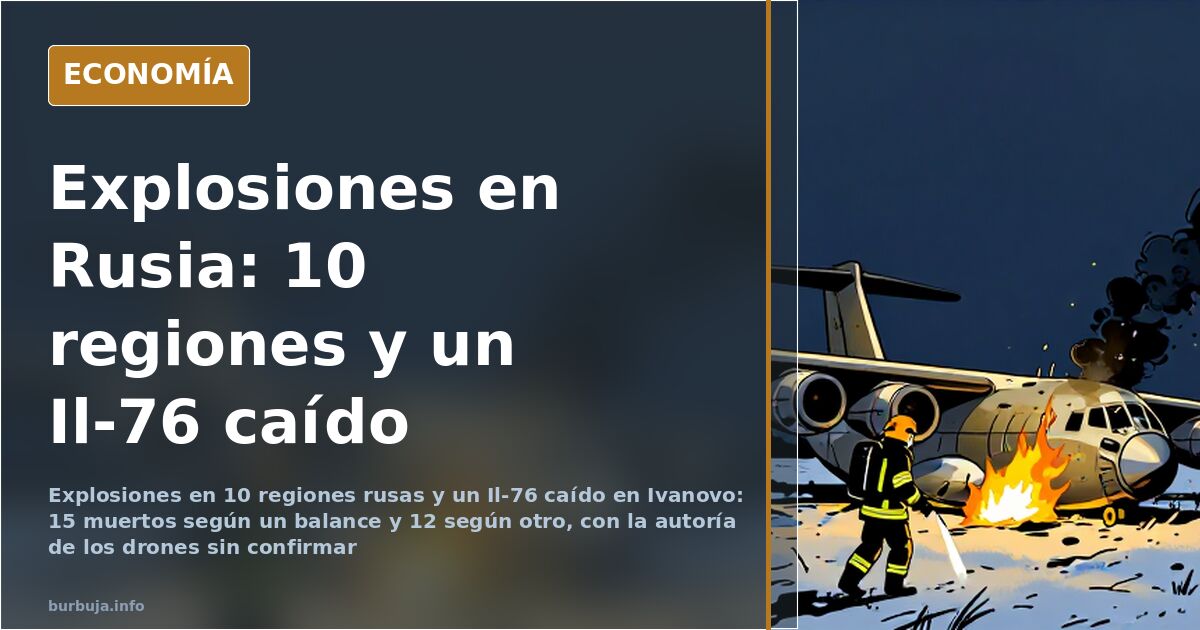
Explosions in 10 Russian regions: no version matches
A military Il-76 took off from Severny airfield in Russia’s Ivanovo region and never returned. The 15 people on board—crew and passengers—died in the accident, according to a tally cited by Baza. Another version circulated the same day spoke of 12 occupants. Neither account has been independently confirmed. While debate rages over how many died inside one plane, another batch of alarming messages claims explosions in ten Russian regions, hit oil refineries, armored incursions from Ukraine, and cyberattacks on Russian infrastructure.
It all arrives at once and unverified, which is the worst way to receive war news. There are images and there are headlines. Separating one from the other is the most useful yet thankless task of the day.
What do we know about the Il-76 crashed in Ivanovo?
Little, and it is contradictory. The aircraft crashed after taking off from Severny airfield. A source cited by Baza raised the death toll to fifteen; another report described an aviation accident with twelve people on board, using a much more neutral tone than the rest of the coverage. An engine failure was even suggested, with no missile or shootdown involved.
Fifteen or twelve. Accident or attack. This discrepancy is not a minor detail: in an open conflict, this type of data stops being information and becomes ammunition. The Il-76 is a military transport aircraft, and its crash occurred during the same timeframe as explosions attributed across half the country.
Ukrainian drones, “NATO” drones: what each side argues
The most disputed point of the episode is not where anything struck, but who owned the device. One side argues the drones are one hundred percent Ukrainian: donated as military aid, purchased by Ukraine, or manufactured on its territory, and operated by Ukrainian operators. From this comes an uncomfortable conclusion for Moscow: if it bothers you, withdraw from Ukraine and negotiate.
On the other hand, some argue that an attack launched from NATO territory makes the alliance a direct belligerent, a narrative fitting the fire attributed to drones at a power plant in Saint Petersburg. Available material offers no public proof in either direction. Both claims circulate as attributions, not established facts.
Who crosses the border and with what argument?
The ground incursion adds another layer. It describes the entry of Russian opponents to Pilingui aboard armored vehicles to fight troops loyal to the Kremlin. The argument favoring these units is practical: they know the terrain and are more integrated into the country than regular Ukrainian troops. The objection is also practical: calling a group of mercenaries pulled from the outskirts an army gives them too much credit.
One cited trinc-up suggests these formations include Buryats, Yakuts, and other minorities enrolled in a legion opposed to the Kremlin, with family members in their home republics. If true—and the conditional should be maintained—the effect would not be military but social: pressure on the regime within its own borders.
Why target refineries and a power plant?
Here the episode ceases to be a military report and becomes economics. The mentioned targets—oil refineries scattered across several regions and an electrical facility—are assets sustaining hydrocarbon revenues and front-line logistics. Hitting them does not seek to gain territory: it seeks to make the war more expensive for those financing it.
The dominant strategic reading is attrition. One line argues Ukraine is kept up as sparring: when it is about to throw in the towel, someone rings the bell and grants another round, lost beforehand. Another summarizes it as poking the bear until it tires. Neither reading fully explains the visible contradiction: an army losing territory while launching spectacular operations that, to continue, would require thousands of soldiers behind them.
Ten years of war and no closed figure
There is a datum that reorders the above: the conflict did not start this week. Ten years of war between Russia and Ukraine have already passed, making any headline announcing a beginning debatable. What changes—and changes quickly—is the volume, technology, and number of actors involved.
The immediate response from one side was disdain: nothing will happen. Another read it as calculated provocation. And a third recalled precedents of accidents attributed to mishaps with very little subsequent verification. In the final exchange, disagreement shifted from the front line to accounting: how many were on the plane, who built the drone, which power plant stopped working.
The number remains. Fifteen or twelve. In a war lasting a decade, even the toll for a single plane does not close.
Also available in: Deutsch
Summary of a discussion on Burbuja.info - Foro de economía, actualidad y política., translated from Spanish and reviewed before publication. Read the full discussion (148 replies).
More summaries
-
Russia Strikes Ukrainian Gas Depot with Oreshnik Missiles
Reports of a Russian Oreshnik missile strike on a Lviv gas depot raise doubts about Ukraine's winter energy security.
-
Diesel prices rise as Russian refineries come under attack
The EU embargo on Russian oil has not stopped diesel prices from climbing: attacks on refineries are cutting global supply. G7 dates and price caps.
-
Romanian port explosion: a Ukrainian drone, not a Russian attack
An explosion at the port of Constanța in Romania was not a Russian attack but a Ukrainian naval drone. The incident reopens questions about military logistics and political pressure within NATO.
-
PSOE ministers hold 30+ properties while attacking landlords
Spanish ministers declared over 30 properties, including seven for Isabel Rodríguez, contradicting the PSOE's anti-landlord rhetoric.
-
Spaniards cancel Morocco package tours in droves
Thousands of Spaniards are cancelling trips to Morocco over instability and visa issues. The Spanish and Moroccan tourism sectors are reeling.
-
Breaking news - Over 1,000 people march in protest over Carles murder
More than 1,000 people in Manresa protest the murder of Carles Vilajosana. A 16-year-old with a criminal record is the main suspect.