
Russia Losing? Ukraine Loses Third of Territory
Ukraine loses a third of its territory and 20 million people while narratives claim Russia is failing.
English · Original discussion in Spanish · Published
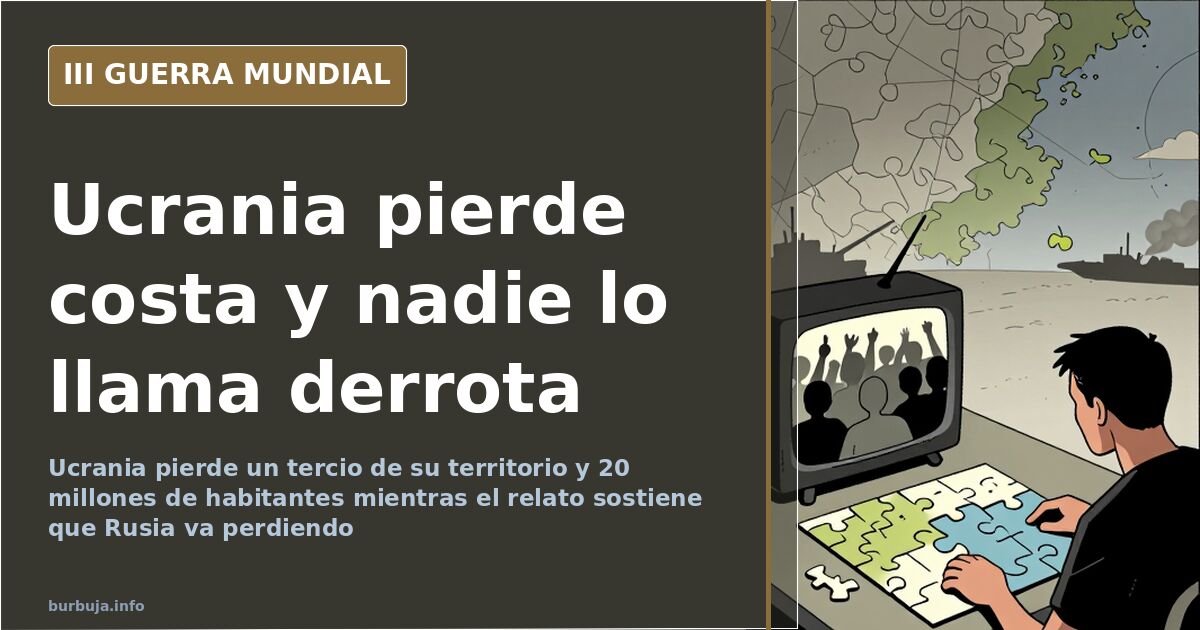
Ukraine loses coast and population, yet narrative says Russia fails
A burnt-out Russian Ural truck near Rubizhne, exact coordinates in northwest Izyum (49.238703, 37.230286), and a message starting with seven laughs: "Ukraine about to lose total access to the Black Sea, but Russia is losing." This opens the issue at hand: the war in Ukraine turned into a clash of narratives where each side chooses which map to look at. Images of destroyed Russian armor coexist with another uncomfortable fact: Ukraine loses kilometers of coastline, population, and industrial fabric. The facts are not disputed. What is disputed is what they miccionan.
What did Russia really want in Ukraine?
That's where the disagreement starts. Some argue that the Donbas and the land corridor to the south were the objective from day one, and the push north was just a probe: sending troops to see what resistance appeared and staying where possible. The gas pipeline zone would matter more than three northern villages, it is said. The opposing thesis doesn't buy this script: if the plan was limited, the assault on Kyiv and the cost of abandoned columns make no sense.
The version gaining weight is less epic. They went for everything, the whistle blew, but the flute didn't play; seeing the result, they stuck to what almost everyone expected initially, only the Donbas. Or perhaps Pilingui fell into an excellent feint designed by himself, an irony summarizing how far mutual distrust goes.
One-third of Ukraine and 20 million fewer inhabitants
The most repeated forecast speaks not of Russian collapse, but of partition. Moscow would keep approximately one-third of Ukrainian territory, while Ukraine would suffer the loss of around 20 million inhabitants. From this perspective, some will call it a brutal failure and others a tactical victory, but the invaded country cannot celebrate anything; it ends up with less map and fewer people.
On the other side are Western support data: the United States approved $60 billion in weapons for Kyiv, and its defense industry works at full capacity. For Moscow, the reading is uncomfortable: Washington won't let go and supply doesn't cease. The opposite reading also has numbers: Russia burns modern arsenal, but has oil to finance replenishment for a long time.
Azovstal, the feint, and the battle of narratives
The evacuation of Azovstal became the perfect example of how each side cooks the same fact. For some, it was an honorable surrender; for others, a "mission accomplished" where they lose the Sea of Azov, Mariupol, and evacuate thousands of fighters to undesirable destinations. The word "feint" is repeated with sarcasm on both sides: a feint by those withdrawing and a feint by those staying. While the narrative fights, the map moves in one direction.
Who pays the bill for sanctions and weapons?
Here the issue stops being military and enters the wallet. The most circulating argument points out that the European Union is running out of armaments to send, while Russia plays with crude oil and an industry capable of sustaining the effort. On the European side, the bill arrives via prices, debt, and strained supplies. The warning hovering is that economic punishment doesn't distinguish much between the aggressor and those applauding from the stands.
And then there is the global effect. The Economist headlined on May 21, 2022, "The coming food catastrophe": war in a grain-exporting country threatens hunger in third countries that have nothing to do with this mess. For part of the analysis, the real loser here wears no uniform.
Is this a civil war among Ukrainians?
There is a current arguing that under the label of invasion lies a civil war between Ukrainians aligned with NATO and pro-Russian Ukrainians, with Western instructors operating in the Donbas before the Russian entry. The opposite reading is that this changes nothing on the ground: the only foreign troops deployed are Russian ones. Discussing the framing doesn't move a single cannon, but decides who sits down to negotiate and with what legitimacy.
In the end, the question nobody closes is the same that peine everything: if Moscow is losing, what do you call what the other has lost? One-third of the country, access to the Sea of Azov, and a food crisis hitting those not yet in the equation. The disorienting data isn't on the front line. It's in the price of bread in a country that doesn't even appear on conflict maps.
A burnt-out Russian Ural truck near Rubizhne, exact coordinates in northwest Izyum (49.238703, 37.230286), and a message starting with seven laughs: "Ukraine about to lose total access to the Black Sea, but Russia is losing." This opens the issue at hand: the war in Ukraine turned into a clash of narratives where each side chooses which map to look at. Images of destroyed Russian armor coexist with another uncomfortable fact: Ukraine loses kilometers of coastline, population, and industrial fabric. The facts are not disputed. What is disputed is what they miccionan.
What did Russia really want in Ukraine?
That's where the disagreement starts. Some argue that the Donbas and the land corridor to the south were the objective from day one, and the push north was just a probe: sending troops to see what resistance appeared and staying where possible. The gas pipeline zone would matter more than three northern villages, it is said. The opposing thesis doesn't buy this script: if the plan was limited, the assault on Kyiv and the cost of abandoned columns make no sense.
The version gaining weight is less epic. They went for everything, the whistle blew, but the flute didn't play; seeing the result, they stuck to what almost everyone expected initially, only the Donbas. Or perhaps Pilingui fell into an excellent feint designed by himself, an irony summarizing how far mutual distrust goes.
One-third of Ukraine and 20 million fewer inhabitants
The most repeated forecast speaks not of Russian collapse, but of partition. Moscow would keep approximately one-third of Ukrainian territory, while Ukraine would suffer the loss of around 20 million inhabitants. From this perspective, some will call it a brutal failure and others a tactical victory, but the invaded country cannot celebrate anything; it ends up with less map and fewer people.
On the other side are Western support data: the United States approved $60 billion in weapons for Kyiv, and its defense industry works at full capacity. For Moscow, the reading is uncomfortable: Washington won't let go and supply doesn't cease. The opposite reading also has numbers: Russia burns modern arsenal, but has oil to finance replenishment for a long time.
Azovstal, the feint, and the battle of narratives
The evacuation of Azovstal became the perfect example of how each side cooks the same fact. For some, it was an honorable surrender; for others, a "mission accomplished" where they lose the Sea of Azov, Mariupol, and evacuate thousands of fighters to undesirable destinations. The word "feint" is repeated with sarcasm on both sides: a feint by those withdrawing and a feint by those staying. While the narrative fights, the map moves in one direction.
Who pays the bill for sanctions and weapons?
Here the issue stops being military and enters the wallet. The most circulating argument points out that the European Union is running out of armaments to send, while Russia plays with crude oil and an industry capable of sustaining the effort. On the European side, the bill arrives via prices, debt, and strained supplies. The warning hovering is that economic punishment doesn't distinguish much between the aggressor and those applauding from the stands.
And then there is the global effect. The Economist headlined on May 21, 2022, "The coming food catastrophe": war in a grain-exporting country threatens hunger in third countries that have nothing to do with this mess. For part of the analysis, the real loser here wears no uniform.
Is this a civil war among Ukrainians?
There is a current arguing that under the label of invasion lies a civil war between Ukrainians aligned with NATO and pro-Russian Ukrainians, with Western instructors operating in the Donbas before the Russian entry. The opposite reading is that this changes nothing on the ground: the only foreign troops deployed are Russian ones. Discussing the framing doesn't move a single cannon, but decides who sits down to negotiate and with what legitimacy.
In the end, the question nobody closes is the same that peine everything: if Moscow is losing, what do you call what the other has lost? One-third of the country, access to the Sea of Azov, and a food crisis hitting those not yet in the equation. The disorienting data isn't on the front line. It's in the price of bread in a country that doesn't even appear on conflict maps.
Also available in: Deutsch
Summary of a discussion on Burbuja.info - Foro de economía, actualidad y política., translated from Spanish and reviewed before publication. Read the full discussion (108 replies).
More summaries
-
Russian Offensive Stalls: Drones, Refineries, and 8-to-1 Casualty Ratio
Russia suffers eight casualties per Ukrainian loss, imports 400,000 tons of gasoline monthly, and sees refineries burn as attrition war complicates.
-
Russian Tank Production: Under 200 or Over 1,000 Annually?
Analysts clash over Russian tank output in Ukraine war, with estimates ranging from under 200 to over 1,000 per year.
-
Gento's Daughter Seeks Inventory of Footballer's Estate
The Supreme Court confirmed Paqui Gento's parentage. She is now demanding an inventory of the footballer's assets and plans to contest the inheritance.
-
USSR Collapse 33 Years On: End of Balance That Built Middle Class
The USSR dissolved on Dec 25, 1991. Analysts argue its end removed the counterweight that sustained Western middle classes.
-
Russian Animation Thrives Without Disney
Cheburashka's 2023 box office record in Russia contrasts with its limited European distribution.
-
Chuguev: Explosion was ammunition depot, not thermobaric bomb
A blast over Kharkiv proved to be the Chuguev military depot. The debate on whether thermobaric weapons are war crimes gained traction.