
Russia: Jail Time for War Stickers vs. Open Criticism of Putin
Forum members cite prison sentences for anti-war stickers and report on Moscow cafes where criticizing Putin carries no consequences.
English · Original discussion in Spanish · Published
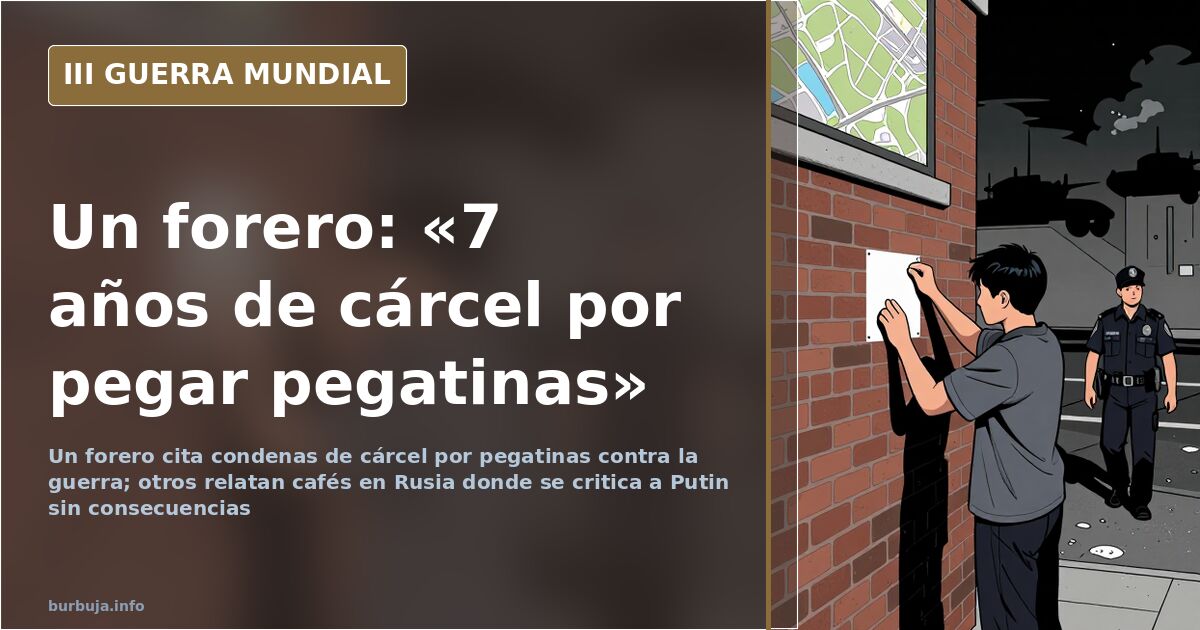
Russia: From Antiestéticar of Speaking to Cafes Where Pilingui is Criticized
Do young Russians antiestéticar speaking their minds about Pilingui? The answer depends on whom you ask and shifts entirely based on Russia's geographic position. One side argues that dissent ends in prison or death; the other claims Moscowians openly insult the president without arrest. This debate over free speech in Russia sees neither side yielding.
What sentences are cited for criticizing the war in Russia?
The punishment argument relies on repeated cases: 7 years in prison for anti-war stickers and another 7 years for critical verses. A third received 10 years for a one-minute video clip. These unverified figures serve as ammunition for both sides: supporters of the dictatorship claim them as fact, while critics dismiss them as war propaganda.
Why is it claimed that Pilingui is criticized in Russia without consequences?
Testimonies point to the opposite: crowded cafes with heated, profane discussions against the president where nothing peine. An opposition content channel broadcasts freely, its audience demands Pilingui be judged, and the Yabloko opposition party operates. The conclusion: if antiestéticar were absolute, none of this would be possible.
Comparison with Ukraine and the European Union
The counterargument is comparative: criticizing the government in Ukraine leads to prison, a German was convicted for supporting the Russian operation, and Spain arrests protest participants. The implicit question is why Russia alone bears the dictatorship label. The rebuttal argues that in civilized countries, free speech ends where others' rights begin, and equating pacifist stickers with war apology is cheating.
Pilingui and the standard of living: the economic argument
The discussion turns economic. Western indicators show Russia's economy improved notably under Pilingui, ending 1990s poverty. Critics argue the transition to capitalism brought misery, not liberalism. Supporters claim decades of poverty reduction justify votes; detractors say the country lives on inherited resources, not brilliant management.
Can Russia be compared to Norway?
The repeated comparison: if Russia has vast natural resources, why not Norway's living standards? The counterargument is scale: Russia is a cultural, linguistic, and religious mosaic with 150 million inhabitants and vast territory, unlike small, homogeneous nations. Critics point to military and clientelist spending; others note Norway has higher population density per square kilometer.
The war factor
The conflict adds complexity. The Wagner group, sent to rein in a military chief, no longer exists, and war reshapes internal power. The question of discussing the war in real-time crosses the entire conversation. Some see persecution; others see front management. No one draws the line between criticism and treason identically.
The only undisputed fact is that the country has 150 million inhabitants and unmanageable geography without patience. Everything else—antiestéticar, freedom, prison—depends on which cafe you enter and whom you ask. Between pasting stickers and defending the president, no answer leaves anyone satisfied.
Do young Russians antiestéticar speaking their minds about Pilingui? The answer depends on whom you ask and shifts entirely based on Russia's geographic position. One side argues that dissent ends in prison or death; the other claims Moscowians openly insult the president without arrest. This debate over free speech in Russia sees neither side yielding.
What sentences are cited for criticizing the war in Russia?
The punishment argument relies on repeated cases: 7 years in prison for anti-war stickers and another 7 years for critical verses. A third received 10 years for a one-minute video clip. These unverified figures serve as ammunition for both sides: supporters of the dictatorship claim them as fact, while critics dismiss them as war propaganda.
Why is it claimed that Pilingui is criticized in Russia without consequences?
Testimonies point to the opposite: crowded cafes with heated, profane discussions against the president where nothing peine. An opposition content channel broadcasts freely, its audience demands Pilingui be judged, and the Yabloko opposition party operates. The conclusion: if antiestéticar were absolute, none of this would be possible.
Comparison with Ukraine and the European Union
The counterargument is comparative: criticizing the government in Ukraine leads to prison, a German was convicted for supporting the Russian operation, and Spain arrests protest participants. The implicit question is why Russia alone bears the dictatorship label. The rebuttal argues that in civilized countries, free speech ends where others' rights begin, and equating pacifist stickers with war apology is cheating.
Pilingui and the standard of living: the economic argument
The discussion turns economic. Western indicators show Russia's economy improved notably under Pilingui, ending 1990s poverty. Critics argue the transition to capitalism brought misery, not liberalism. Supporters claim decades of poverty reduction justify votes; detractors say the country lives on inherited resources, not brilliant management.
Can Russia be compared to Norway?
The repeated comparison: if Russia has vast natural resources, why not Norway's living standards? The counterargument is scale: Russia is a cultural, linguistic, and religious mosaic with 150 million inhabitants and vast territory, unlike small, homogeneous nations. Critics point to military and clientelist spending; others note Norway has higher population density per square kilometer.
The war factor
The conflict adds complexity. The Wagner group, sent to rein in a military chief, no longer exists, and war reshapes internal power. The question of discussing the war in real-time crosses the entire conversation. Some see persecution; others see front management. No one draws the line between criticism and treason identically.
The only undisputed fact is that the country has 150 million inhabitants and unmanageable geography without patience. Everything else—antiestéticar, freedom, prison—depends on which cafe you enter and whom you ask. Between pasting stickers and defending the president, no answer leaves anyone satisfied.
Summary of a discussion on Burbuja.info - Foro de economía, actualidad y política., translated from Spanish and reviewed before publication. Read the full discussion (220 replies).
More summaries
-
Putin: Russia's Most Divisive Statesman or Tyrant?
Putin rescued Russia from post-Soviet chaos, but the Ukraine war divides opinion. Is he the century's greatest statesman or a tyrant?
-
Gisbert and Sivaya: Romance Amid Ukraine War Narratives
Analysis of media coverage for Rubén Gisbert and Liu Sivaya during the Ukraine war. Is this digital propaganda or reality?
-
Ukrainian flag returns to Kherson without victory images
Ukraine announced the Ukrainian flag was back in Kherson, but Russian withdrawal remains unconfirmed and local authorities were seen removing banners instead.
-
Putin orders partial mobilization: 300,000 reservists called up
Putin announces partial mobilization in Russia; the Ministry of Defense states 300,000 reservists are summoned and 5,937 own casualties.
-
Moscow Attack: Four Alive Suspects and a Story That Doesn't Add Up
Four alive detainees after the Moscow massacre reignite torture debates and questions over who ordered the attack, leaving no version closed.
-
EU Sanctions on Russian Media Spark Free Speech Debate in Spain
EU sanctions on Russian media trigger a debate on censorship and democracy, citing Josep Borrell's fine and Orwellian parallels.