
Russia declares 36-hour Orthodox Christmas ceasefire
Russia announced a unilateral 36-hour ceasefire for Orthodox Christmas. Ukraine responded with skepticism, warning it only benefits Moscow.
English · Original discussion in Spanish · Published
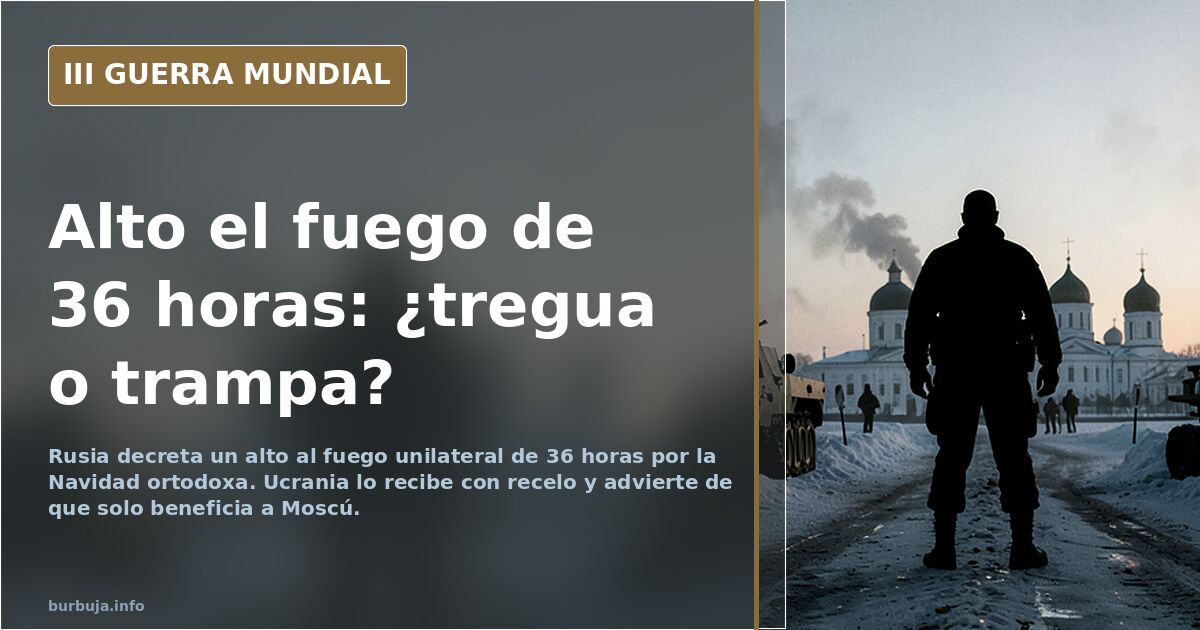
Russia declares 36-hour truce for Orthodox Christmas; Ukraine meets it with skepticism
The announcement came with precise timing and the scent of calculated gesture: Moscow decreed a unilateral ceasefire along the entire front line from 12:00 on January 6 to 00:00 on January 7, coinciding with Orthodox Christmas. The order, disseminated through official channels and amplified on social media, included a formal request for Kyiv to join the truce. The Ukrainian response was immediate and laden with distrust: much of the analysis suggests the pause seeks rearmament, not prayer.
The gesture arrives amid mutual exhaustion and fierce battles for enclaves like Soledar, where fighting has shown no respite in recent weeks. The temporal coincidence with the religious holiday allowed Moscow to project moderation to its domestic audience and international partners increasingly scrutinizing the conflict's cost. However, the fine print—unilateral, temporary, lacking verification mechanisms—leaves little room for trust.
Why doesn't Ukraine trust the Christmas truce?
Distrust is not unfounded. The immediate precedent is the bombardment of critical infrastructure during Western Christmas dates, when missiles and drones struck Ukraine's power grid. That memory outweighs any appeal to Christian spirit. From Kyiv, arguments state that a 36-hour pause only benefits those needing to reorganize lines, rotate troops, and replenish supplies on a front heavily battered by artillery.
Some argue the truce is an image operation for Russian domestic consumption, where the religious narrative holds weight among the population. Counter-arguments suggest that a ceasefire without supervision or verifiable commitments is worthless: anyone can break it and blame the other. Recent experience indicates widely advertised pauses have served more to reposition forces than open humanitarian corridors.
The religious factor: Orthodox Christmas and political calendar
Choosing January 6 and 7 is no accident. Orthodox Christmas is celebrated on these dates according to the Julian calendar, and Moscow has historically used the Church as a pillar of legitimacy. The announcement allows the Kremlin to present itself as defender of the faith against a Ukraine that, in recent years, shifted its Christmas celebrations to December 25 to mark cultural and political distance from Moscow.
This detail is significant: the battle over the calendar is also a battle over identity. While part of the Ukrainian population adopted the Western date, the ecclesiastical hierarchy linked to Moscow maintains the Julian calendar. Thus, the truce speaks not only of weapons but of who represents legitimate Orthodoxy in the region.
What military interests lie behind a 36-hour pause?
Operationally, 36 hours allow much: evacuating wounded, burying dead, rotating exhausted units, and above all, moving ammunition. Military analysts agree any pause in a war of attrition benefits whoever faces greater logistical difficulties at that moment. The question is who is worse positioned on the front these days.
The answer is not unanimous. Some defend the truce favors Ukraine, which could use it to consolidate positions and receive Western material. Others argue the opposite: that Russia needs to breathe in sectors where Ukrainian pressure has increased. Without verifiable data on the ground, both readings are plausible, fueling distrust.
International reaction: between skepticism and caution
Ukraine's allies received the announcement coldly. No Western foreign ministry described the truce as a step toward peace; at most, as a gesture to be proven on the ground. Caution responds to a repeated pattern: Moscow announces humanitarian initiatives that do not translate into substantial changes on the ground.
Meanwhile, war continues in hotspots. The battle for Soledar and the Bakhmut area remains the epicenter of combat, with both sides reporting casualties and limited advances. If respected, the Christmas truce will be a brief pause in a war that ignores calendars.
The disconcerting fact: 36 hours is exactly the time a supply train takes to reach the Donetsk front from the Russian rear. Coincidence or not, the truce has a logistical utility no official statement mentions.
Also available in: Deutsch
Summary of a discussion on Burbuja.info - Foro de economía, actualidad y política., translated from Spanish and reviewed before publication. Read the full discussion (72 replies).
More summaries
-
Putin steps up attacks and Kyiv is left without power or water
Kyiv faces winter without electricity or water in most districts as Russia intensifies strikes on critical infrastructure.
-
North Korea sends 10,000 more troops to Ukraine front line
Ukraine warns of 10,000 North Korean soldiers as Russia destroys 90% of Kyiv's warehouses and cripples its ports: logistics are deciding the war.
-
Kim Jong-un Travels to Russia for Putin Summit
North Korean leader Kim Jong-un arrives in Russia, confirmed by Kremlin. The Moscow-Pyongyang axis reignites geopolitical debates.
-
Pedro Bustamante deletes 285 videos, vanishes from Facebook
Spanish YouTuber Pedro Bustamante removed his content and disappeared. Rumors place him in Munich, reading German press.
-
EU allows paying Russian gas in euros with ruble conversion
Brussels clarifies that paying in euros or dollars with later conversion to rubles does not violate sanctions; the text is non-binding.
-
Russia: Hundreds of Youth Detained in Moscow for Forced Military Contracts
An X post alleges Russian security forces detained 100 to 300 alternative youth in Moscow, forcing them into military contracts. Official sources have not confirmed these figures.