
Russia Blocks Dollar Withdrawals, Fitch Warns of Imminent Default
Russia's Central Bank limits cash withdrawals to $10,000, paying the rest in rubles. Fitch downgrades Russian debt, anticipating a default.
English · Original discussion in Spanish · Published
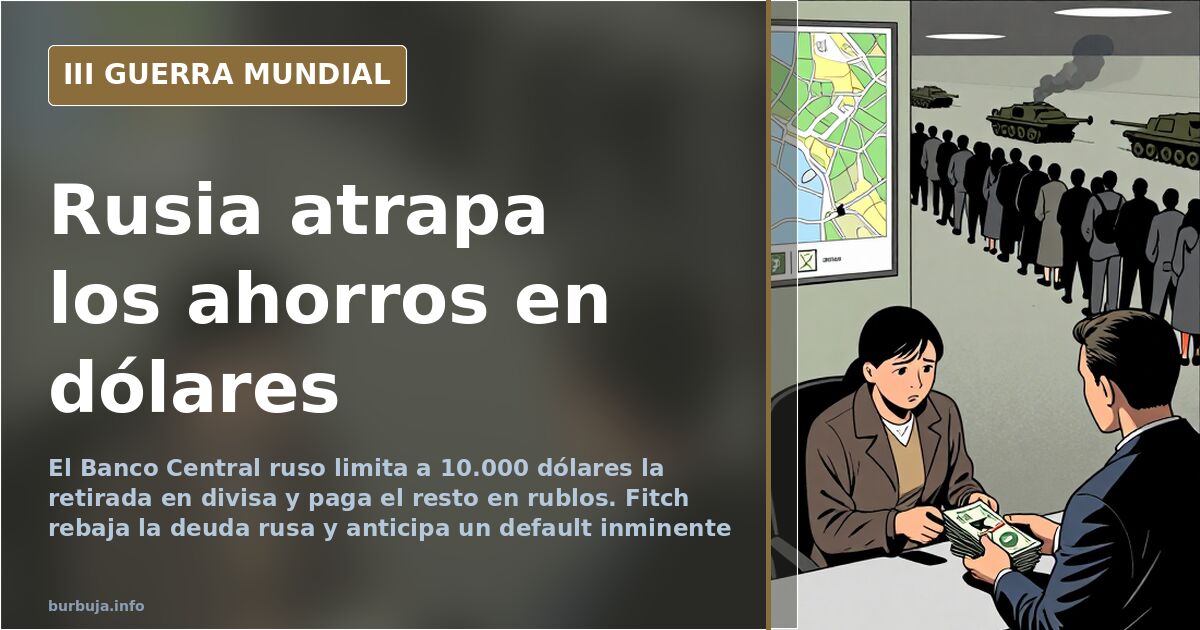
Russia Imposes Capital Controls, Returns Dollars in Rubles
Rusia has decided its citizens cannot access their own money. The Central Bank decreed a capital control on foreign currency accounts past midnight Moscow time: anyone with $200,000 can only withdraw $10,000 in cash — until September 9th — while the rest will be paid in rubles. Fitch has downgraded Russia's debt rating and anticipates an imminent default. This measure is not a technical adjustment from a manual; it's an admission that the drain of foreign currency can no longer be stopped otherwise.
Capital Controls in Russia: $10,000 Limit Per Account
The fine print is devastating, disseminated by the Russian press itself. Funds in foreign currency accounts or deposits "are kept and accounted for in the currency of the deposit," says the statement, but the saver can only withdraw $10,000 in cash, and the remainder will be given in rubles "at the market rate on the day of issuance." In plain English: you get paid in a currency that has already plummeted, at the exchange rate set by the state.
Where the exchange rate is set by political power, the citizen loses twice. They receive rubles at an official price that doesn't exist on the street, and the street is precisely where the dollar's true value is quoted. The question of gold and silver — how much an ounce is worth on Russian streets — circulates without an official answer. That absence is also a data point.
Why Russia May Default Even With Funds Available
Here lies the crux. The Russian default is not due to a lack of funds, but to the impossibility of using money the country has frozen abroad. Some summarize it bluntly: Russia has plenty of dollars, but cannot move them. And some add another piece to the puzzle — Russian debt is around 20% of GDP, while Spanish debt is around 120% — a contrast used both to deny collapse and to warn that European fragility is greater than admitted.
The detail changes the entire narrative. A country that defaults due to insolvency is a bankrupt country. A country that defaults because its accounts have been blocked is a country in economic warfare. Both situations have the same headline, and they are not the same.
Greek Capital Controls and Antiestéticar of Contagion in Europe
The most repeated precedent is not Moscow, but Athens. In Greece, withdrawals were limited to 60 euros per person per day. The difference, and it's enormous, is that Greeks kept their deposits in euros; Russians are being repaid in devalued currency. Even so, the specter of a European replication looms over the analysis: it's argued that far fewer sanctions would be needed for capital controls to be applied here, and that entry would be "natural," as in Argentina. The Argentine mirror, with its succession of currency controls, is cited as a probable destination, not mere speculation.
From Capital Controls to Wheat: The Blow That Will Hit the Maghreb First
The part almost no one looks at is south of the Mediterranean. The most repeated scenario involves cereal shortages, skyrocketing gas and gasoline prices, with a specific impact on North Africa. With this pressure on food prices, the fences of Ceuta and Melilla, compared to what may come, would be an anecdote. It's the kind of consequence that doesn't make the day's headlines but still arrives before almost all others.
The War Economy Is Already Visible in Factories
There's no need to wait for the markets to see the wear and tear. Lada has halted production due to a lack of components, a domestic indicator more eloquent than any financial index. The parallel with 1990, when the opening of the first McDonald's in Moscow generated queues around the block and a Walkman was an unattainable object of desire, is not rhetorical: it serves to recall what an economy suddenly closed off looks like. Thirty years of imported consumption, erased in a stroke.
If nothing remedies it, the default will arrive, although no one knows if Moscow will declare it or disguise it as a technical default. What has already been decided, without any reservation, is that a saver with a dollar account in Russia has stopped deciding when and how they receive their money.
Rusia has decided its citizens cannot access their own money. The Central Bank decreed a capital control on foreign currency accounts past midnight Moscow time: anyone with $200,000 can only withdraw $10,000 in cash — until September 9th — while the rest will be paid in rubles. Fitch has downgraded Russia's debt rating and anticipates an imminent default. This measure is not a technical adjustment from a manual; it's an admission that the drain of foreign currency can no longer be stopped otherwise.
Capital Controls in Russia: $10,000 Limit Per Account
The fine print is devastating, disseminated by the Russian press itself. Funds in foreign currency accounts or deposits "are kept and accounted for in the currency of the deposit," says the statement, but the saver can only withdraw $10,000 in cash, and the remainder will be given in rubles "at the market rate on the day of issuance." In plain English: you get paid in a currency that has already plummeted, at the exchange rate set by the state.
Where the exchange rate is set by political power, the citizen loses twice. They receive rubles at an official price that doesn't exist on the street, and the street is precisely where the dollar's true value is quoted. The question of gold and silver — how much an ounce is worth on Russian streets — circulates without an official answer. That absence is also a data point.
Why Russia May Default Even With Funds Available
Here lies the crux. The Russian default is not due to a lack of funds, but to the impossibility of using money the country has frozen abroad. Some summarize it bluntly: Russia has plenty of dollars, but cannot move them. And some add another piece to the puzzle — Russian debt is around 20% of GDP, while Spanish debt is around 120% — a contrast used both to deny collapse and to warn that European fragility is greater than admitted.
The detail changes the entire narrative. A country that defaults due to insolvency is a bankrupt country. A country that defaults because its accounts have been blocked is a country in economic warfare. Both situations have the same headline, and they are not the same.
Greek Capital Controls and Antiestéticar of Contagion in Europe
The most repeated precedent is not Moscow, but Athens. In Greece, withdrawals were limited to 60 euros per person per day. The difference, and it's enormous, is that Greeks kept their deposits in euros; Russians are being repaid in devalued currency. Even so, the specter of a European replication looms over the analysis: it's argued that far fewer sanctions would be needed for capital controls to be applied here, and that entry would be "natural," as in Argentina. The Argentine mirror, with its succession of currency controls, is cited as a probable destination, not mere speculation.
From Capital Controls to Wheat: The Blow That Will Hit the Maghreb First
The part almost no one looks at is south of the Mediterranean. The most repeated scenario involves cereal shortages, skyrocketing gas and gasoline prices, with a specific impact on North Africa. With this pressure on food prices, the fences of Ceuta and Melilla, compared to what may come, would be an anecdote. It's the kind of consequence that doesn't make the day's headlines but still arrives before almost all others.
The War Economy Is Already Visible in Factories
There's no need to wait for the markets to see the wear and tear. Lada has halted production due to a lack of components, a domestic indicator more eloquent than any financial index. The parallel with 1990, when the opening of the first McDonald's in Moscow generated queues around the block and a Walkman was an unattainable object of desire, is not rhetorical: it serves to recall what an economy suddenly closed off looks like. Thirty years of imported consumption, erased in a stroke.
If nothing remedies it, the default will arrive, although no one knows if Moscow will declare it or disguise it as a technical default. What has already been decided, without any reservation, is that a saver with a dollar account in Russia has stopped deciding when and how they receive their money.
Summary of a discussion on Burbuja.info - Foro de economía, actualidad y política., translated from Spanish and reviewed before publication. Read the full discussion (110 replies).
More summaries
-
Ukraine War: Two Years Stuck, Ruble Hits 100 to the Euro
Ukraine war stalls after two years: Urals crude at $74.50 vs. Brent at $81.62, ruble at 100/euro. Focus shifts to endurance.
-
NATO claims to have 4,000 pages of plans against Russia
NATO states it has nearly 4,000 pages of documents ready to respond to Russian escalation on its Eastern flank.
-
Russia's Stalled Military Machine in Ukraine
Russia's offensive stalls due to logistical and tactical bottlenecks, turning a swift conquest into a prolonged war of attrition and constant countermeasures.
-
Ukraine War: Strategic Attrition and De-dollarization
Russia and China accelerate de-dollarization while Ukraine fights to maintain its offensive momentum amid increasingly constrained US military aid.
-
Ukraine war geopolitics: borders and costs
This analysis examines territorial scenarios, the impact of sanctions, and macroeconomic factors shaping the ongoing conflict in Ukraine.
-
Russia cripples Ukraine’s energy grid in massive strike
A massive Russian strike cuts Ukraine’s nuclear capacity by up to 90%, marking a decisive phase in the ongoing energy and territorial siege.