
Russia Blinds Sentinel-1 Satellite Over Sevastopol
Sentinel-1 radar imagery of Sevastopol was rendered useless, highlighting Russian electronic warfare capabilities and the ongoing Dnieper bridgehead situation.
English · Original discussion in Spanish · Published
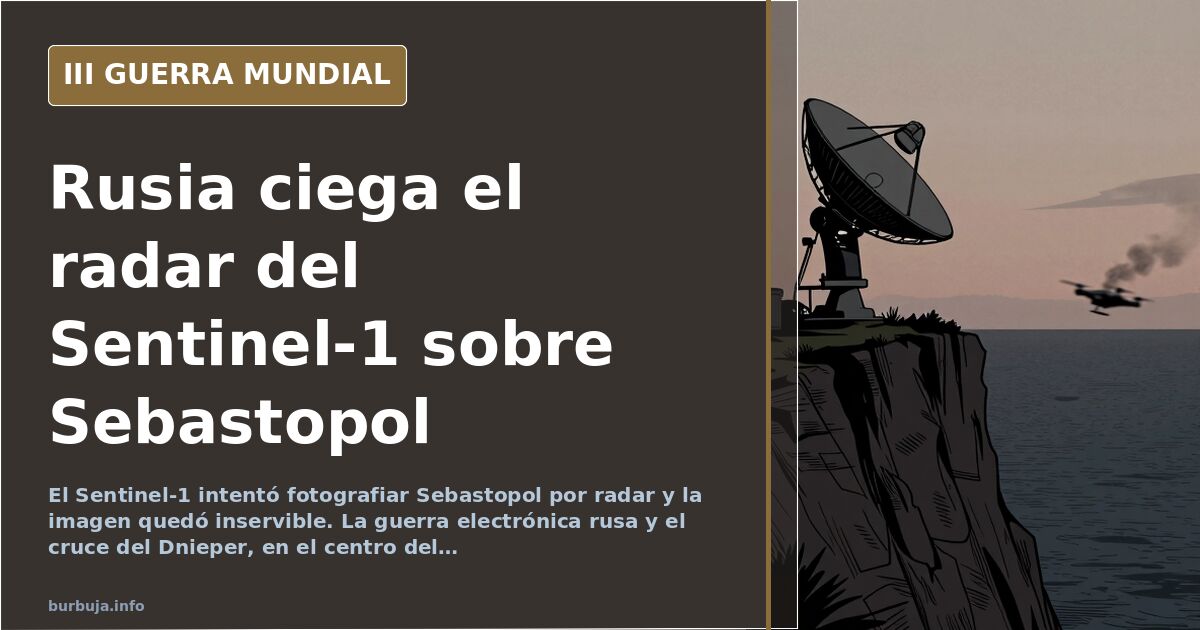
Russia Blinds Sentinel-1 Radar Over Sevastopol
The European Sentinel-1 satellite attempted to capture a radar image of Sevastopol but faced unexpected interference. According to the initial analysis, the resulting image does not show pinpoint jamming from one or several radars, but rather the effect of an electronic warfare complex counter-jamming the radar frequency over a vast area. The ability to "blind" satellite radars is significant, even if it does not prevent optical surveillance.
This claim intersects immediately with frontline realities. Ukraine has crossed the Dnieper and maintains a bridgehead on the eastern bank. Critics argue this proves Russian artillery cannot target effectively because Western systems blind them. The article's paradox remains: if Moscow can blind satellites, why cannot it destroy four boats in a river?
What is Sentinel-1 and Why Its Radar Matters
Sentinel-1 is a synthetic aperture radar (SAR) satellite. Unlike optical satellites, it does not rely on sunlight or clear skies; it emits its own signal and measures the return. This makes it a key tool for observing at night or through clouds, common conditions over the Black Sea. If someone interferes with that frequency over a wide zone, the image becomes useless.
Evidence suggests this is not a specific ground radar, but an electronic warfare complex capable of counter-interference over extensive areas. The distinction is crucial: pinpoint interference can be bypassed by changing orbit or band; a hundreds-of-kilometers-wide electromagnetic blot forces a rethink of entire observation routines.
The Counterargument: If They Blind Satellites, Why Not Stop the Dnieper?
The most repeated objection is common sense. Blinding a satellite radar does not equate to winning a front. The Ukrainian bridgehead across the Dnieper, supported by fast boats and light equipment, relies on precision artillery guided by Western systems. If those systems work, Russia's electronic advantage does not translate into territorial control.
Some argue the released image itself is part of the operation: if it truly works, you don't show it. Others note that optical surveillance persists and electronic warfare does not replace logistics, ammunition, or infantry. The debate shifts to a broader question: what matters more today, an expensive, flashy system or a two-hundred-euro drone that kills just as effectively?
MURMANSK-BN and Thousands-of-Kilometers Range
The discussion mentions the MURMANSK-BN system, attributed with a range of thousands of kilometers and the capacity to completely disable EU radio signals. The figure is spectacular and, precisely for that reason, should be treated as a circulating claim, not verified data within the material.
This pattern repeats throughout the issue. Real local interference capabilities are mixed with continental blackout scenarios without independent measurements. Electronic warfare is opaque by definition: there are no corpses to photograph or destroyed buildings to show. This makes it ideal territory for exaggeration in both directions.
The F-117 Precedent and Loss Comparisons
The conversation jumps to the F-117 shot down in the Balkans, presented as proof that advanced technology falls when facing a competent operator. The counter-response is blunt: the F-117 was already retired, and its shootdown did not change the campaign's outcome. The comparison extends to Ka-52, Su-30, and Su-35 aircraft lost in Ukraine versus historical losses of F-15s or Apaches.
The underlying problem is methodological. Comparing losses without normalizing for sortie numbers, years of service, and enemy type says nothing. F-15s have accumulated over a hundred air-to-air kills and few losses, but they almost always flew against forces lacking modern air defense. Russia, conversely, operates against an army with dense and sustained air defense.
What Remains Unresolved
The Sentinel-1 image over Sevastopol was rendered unusable. That is the only thing the material allows us to state with some certainty. Whether it was a deliberately deployed electronic warfare complex, a side effect of their own operations, or a combination of both, there is no way to know from the outside.
The practical consequence is modest: intelligence relying on that radar must seek another observation window. The symbolic consequence is huge, and that is where the business lies. A blind European satellite feeds two opposing narratives—the Russian one boasting capability and the Western one minimizing the blow—without either having to prove anything. Analysis gets stuck exactly there: at the border between what can be measured and what can only be told.
The European Sentinel-1 satellite attempted to capture a radar image of Sevastopol but faced unexpected interference. According to the initial analysis, the resulting image does not show pinpoint jamming from one or several radars, but rather the effect of an electronic warfare complex counter-jamming the radar frequency over a vast area. The ability to "blind" satellite radars is significant, even if it does not prevent optical surveillance.
This claim intersects immediately with frontline realities. Ukraine has crossed the Dnieper and maintains a bridgehead on the eastern bank. Critics argue this proves Russian artillery cannot target effectively because Western systems blind them. The article's paradox remains: if Moscow can blind satellites, why cannot it destroy four boats in a river?
What is Sentinel-1 and Why Its Radar Matters
Sentinel-1 is a synthetic aperture radar (SAR) satellite. Unlike optical satellites, it does not rely on sunlight or clear skies; it emits its own signal and measures the return. This makes it a key tool for observing at night or through clouds, common conditions over the Black Sea. If someone interferes with that frequency over a wide zone, the image becomes useless.
Evidence suggests this is not a specific ground radar, but an electronic warfare complex capable of counter-interference over extensive areas. The distinction is crucial: pinpoint interference can be bypassed by changing orbit or band; a hundreds-of-kilometers-wide electromagnetic blot forces a rethink of entire observation routines.
The Counterargument: If They Blind Satellites, Why Not Stop the Dnieper?
The most repeated objection is common sense. Blinding a satellite radar does not equate to winning a front. The Ukrainian bridgehead across the Dnieper, supported by fast boats and light equipment, relies on precision artillery guided by Western systems. If those systems work, Russia's electronic advantage does not translate into territorial control.
Some argue the released image itself is part of the operation: if it truly works, you don't show it. Others note that optical surveillance persists and electronic warfare does not replace logistics, ammunition, or infantry. The debate shifts to a broader question: what matters more today, an expensive, flashy system or a two-hundred-euro drone that kills just as effectively?
MURMANSK-BN and Thousands-of-Kilometers Range
The discussion mentions the MURMANSK-BN system, attributed with a range of thousands of kilometers and the capacity to completely disable EU radio signals. The figure is spectacular and, precisely for that reason, should be treated as a circulating claim, not verified data within the material.
This pattern repeats throughout the issue. Real local interference capabilities are mixed with continental blackout scenarios without independent measurements. Electronic warfare is opaque by definition: there are no corpses to photograph or destroyed buildings to show. This makes it ideal territory for exaggeration in both directions.
The F-117 Precedent and Loss Comparisons
The conversation jumps to the F-117 shot down in the Balkans, presented as proof that advanced technology falls when facing a competent operator. The counter-response is blunt: the F-117 was already retired, and its shootdown did not change the campaign's outcome. The comparison extends to Ka-52, Su-30, and Su-35 aircraft lost in Ukraine versus historical losses of F-15s or Apaches.
The underlying problem is methodological. Comparing losses without normalizing for sortie numbers, years of service, and enemy type says nothing. F-15s have accumulated over a hundred air-to-air kills and few losses, but they almost always flew against forces lacking modern air defense. Russia, conversely, operates against an army with dense and sustained air defense.
What Remains Unresolved
The Sentinel-1 image over Sevastopol was rendered unusable. That is the only thing the material allows us to state with some certainty. Whether it was a deliberately deployed electronic warfare complex, a side effect of their own operations, or a combination of both, there is no way to know from the outside.
The practical consequence is modest: intelligence relying on that radar must seek another observation window. The symbolic consequence is huge, and that is where the business lies. A blind European satellite feeds two opposing narratives—the Russian one boasting capability and the Western one minimizing the blow—without either having to prove anything. Analysis gets stuck exactly there: at the border between what can be measured and what can only be told.
Also available in: Deutsch
Summary of a discussion on Burbuja.info - Foro de economía, actualidad y política., translated from Spanish and reviewed before publication. Read the full discussion (128 replies).
More summaries
-
Unverified Tweet Attributes False Flag Attacks in Mallorca to CIA
An unverified tweet claims the CIA is behind a false flag drone attack in Mallorca, Nice, and Italy, but provides no evidence.
-
Pro-NATO Blocklist Sparks Debate in Ukraine War Forum
A user shared a list of over 60 accounts blocked for pro-NATO propaganda, triggering requests to join and accusations of ideological censorship.
-
Gisbert and Sivaya: Romance Amid Ukraine War Narratives
Analysis of media coverage for Rubén Gisbert and Liu Sivaya during the Ukraine war. Is this digital propaganda or reality?
-
BRICS Common Currency Stalls Amid Russian Rate Hikes
BRICS debate a common currency to bypass the dollar, but mutual distrust and Russia's 21% interest rates hinder the project.
-
El Ojo claims Scholz blames sanctions for German economic slump
El Ojo's tweet attributes to Chancellor Scholz the view that Germany's economy is sinking due to sanctions on Russian energy, reigniting debate over Nord Stream and nuclear policy.
-
Israel and the West: A Debate on Cultural Identity
Is Israel part of the West? The debate covers its Jewish roots, the medieval concept of Western civilization, and its position in the Middle East.