
Runny tortilla at Spain's championship: spoon and straw
The Spanish potato omelette championship pits fans of the juicy recipe against those who see some finalists as little more than a potato and egg smoothie.
English · Original discussion in Spanish · Published
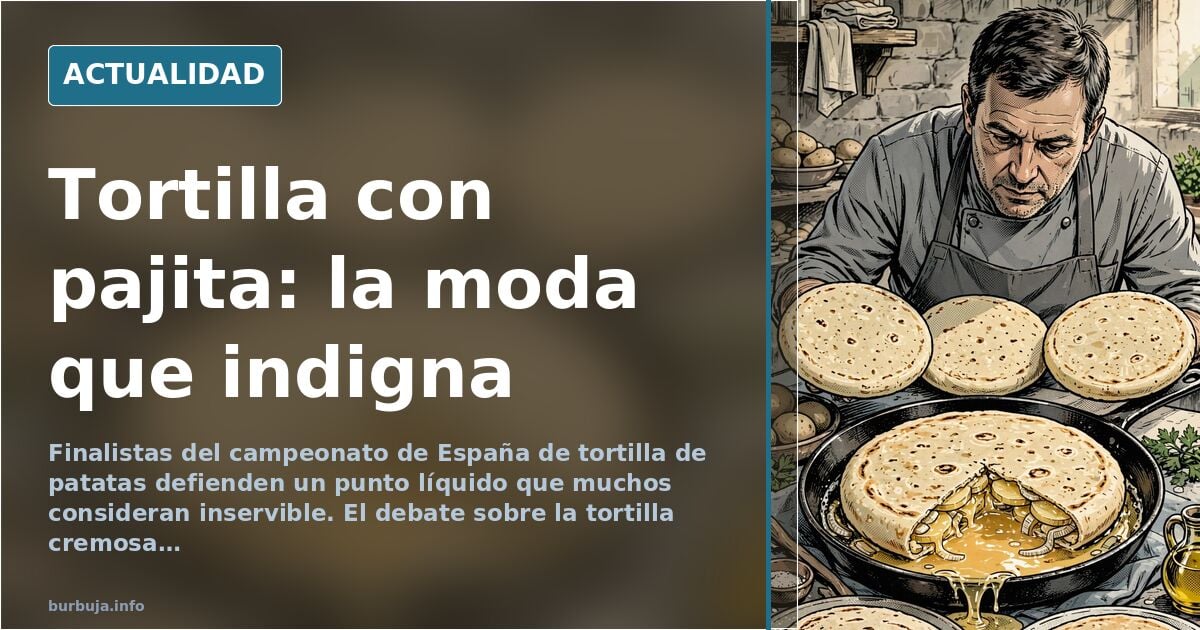
Tortilla finalists you could drink through a straw
There is a line, blurry but real, between a creamy Spanish potato omelette and a potato and egg smoothie. The Spanish potato omelette championship has once again put that boundary at the centre of the debate: some of the finalist entries are so liquid that, according to some comments in the discussion, they could be eaten with a spoon and a straw. The classic recipe allows for juiciness, but not for an interior that behaves like a liquid. The key, one participant argues, lies in how the ingredients are mixed, not in serving half-cooked egg.
This is not the first time the competition has sparked controversy. What has changed is the tone: people are no longer arguing over whether one omelette is better or worse, but whether certain versions stop being an omelette and become something else entirely. The comparison with the Betanzos style — juicy, yes, but with structure — keeps coming up as the benchmark of what is considered acceptable. What is winning, they say, is whatever trend is in fashion.
What is the Spanish potato omelette championship?
It is a gastronomic competition that brings together professional and amateur cooks from different regions of Spain to choose the country's best potato omelette. In this edition, the jury has selected a number of finalists, among them dishes that, in the eyes of part of the public, stray from the traditional standard. The debate is no small matter: it touches on the very definition of the most iconic dish of Spanish cuisine.
The source of the discontent lies in how set the egg is. An omelette can be served more or less juicy, but when the interior loses all consistency, the result is perceived as a different dish altogether. The phrase that sums up the general feeling is blunt: "That's not Betanzos style or anything else, it's just the latest fad."
From juicy omelette to egg smoothie
The defence of the runny omelette rests on the idea that the egg should stay creamy, barely set. Its supporters argue that this enhances the flavour and avoids dryness. Critics reply that creaminess is one thing and lack of structure is another, and that confusing the two is a conceptual mistake.
The most repeated argument is that the desired texture comes from mixing the ingredients properly, not from leaving them raw. In other words, the technique lies in the whisking and the resting time, not in serving the interior at room temperature. By that logic, many of the finalist entries would not be an evolution but a regression.
The reactions: between mockery and concern
The general tone swings between humour and outrage. Some joke that, at this rate, no pan will be needed: just whisk the eggs and serve them straight onto the plate. Others go further and compare the look of some omelettes with something harder to stomach. The comparison with vomit appears in more than one comment.
Beyond the jokes, one participant warns of the risk of salmonella from serving undercooked egg. This trend, they suggest, may carry a health cost that is not always mentioned.
The context: a fad in turbulent times
The debate over the omelette comes at a moment when international news dominates the headlines. Someone sums it up with irony: "Thank goodness we have a world war just around the corner." The remark, half in jest, reflects just how much the issue is seen as a symptom of other things.
Some also see in all this a sign of cultural drift. The comparison with other changes in eating habits — the rise of muffins over traditional Spanish magdalenas, for instance — serves to show that this is not an isolated phenomenon. Globalisation and food trends push in one direction, and tradition resists as best it can.
What is at stake for the championship
The competition has its fruta on the line. If the jury rewards entries that a significant part of the public considers out of place, the "Spanish championship" label loses credibility. In that sense, the controversy is a thermometer of what people expect from a dish that is part of the country's collective identity.
There is no single answer. What some see as innovation, others see as a lack of respect for the time-honoured recipe. And in between lies an uncomfortable question: who decides what is a potato omelette and what is not?
Also available in: Deutsch
Summary of a discussion on Burbuja.info - Foro de economía, actualidad y política., translated from Spanish and reviewed before publication. Read the full discussion (15 replies).
More summaries
-
Swedish kebab-style pizza with potatoes and halal: identity debate erupts in London
A young man of Somali origin tries a Swedish potato pizza in London and sparks a storm of racist and identity-driven comments. The halal menu and his appearance set off the controversy.
-
CIS Crowns Tortilla as National Dish: 62.7% and Onion
CIS places the tortilla ahead of paella with 62.7% support and 71.2% advocating for onion, in a report whose map contradicts the data.
-
The natural juice myth: a liquid sugar bomb
A 1.5-litre bottle of natural juice equals 600 kcal. A diabetic shows with data how half a bottle spikes blood glucose. Alternatives and figures that expose the myth.
-
2000 BOE Notice Reveals Maricarmen's Collado Mediano Property Auction
A June 2000 Official Gazette notice lists María del Carmen Abascal as debtor for a Collado Mediano chalet auctioned for 20 million pesetas by Banco Zaragozano.
-
France: Quentin Deranque's murder reopens the political rift
Quentin Deranque, 23, died in Lyon after a clash between activists. The US points to the rise of left-wing extremism and France is split in two.
-
83% of migrants in Spain face housing vulnerability or exclusion, Cepaim reports
The 83% of migrants in residential exclusion reported by Cepaim sparks debate on Burbuja.info about the sustainability of the model and the official NGO narrative.