
Rufián stays put: ERC's lead candidate in Barcelona
Forum users claim Gabriel Rufián will top ERC's list in Barcelona and has ruled out joining the Frente Amplio. Catalan independence loses momentum, according to the…
English · Original discussion in Spanish · Published
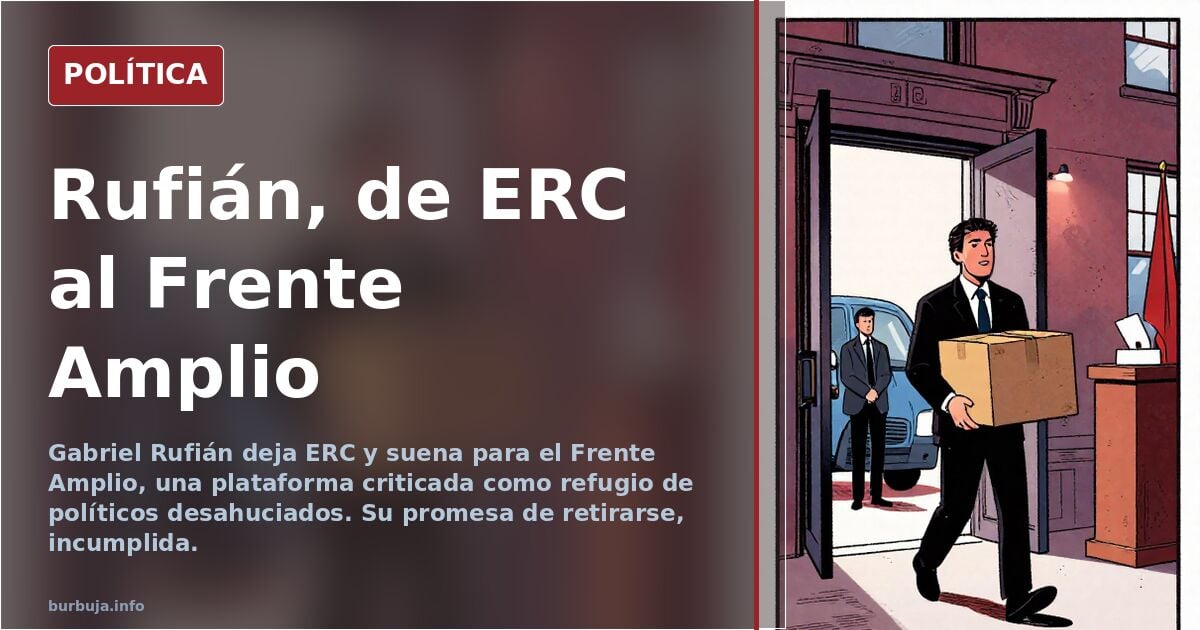
Rufián stays with ERC: lead candidate in Barcelona and no to the Frente Amplio
Gabriel Rufián isn't going anywhere. According to debate participants, the ERC leader will be the party's lead candidate in Barcelona in the next election and has ruled out joining the Frente Amplio, the platform grouping left-wing parties that had been floated as his possible destination. The decision, first reported by political gossip circles and confirmed in the corridors, puts an end to weeks of speculation about a move many took for granted. Catalan independence, at a low ebb after the wear and tear of the procés (the Catalan secession attempt), thus loses one of its most recognisable faces in Madrid. And it gains, in the process, an MP unwilling to risk his seat for castles in the air.
Why Rufián isn't joining the Frente Amplio
The calculation is simple. At ERC he has a guaranteed spot; in the Frente Amplio he would compete for a place on a candidacy that doesn't yet exist as such and whose boundaries nobody has defined. The platform, described in gossip circles as a catch-all where doomed projects end up, offers no guarantee of a seat. Rufián, who has served two terms in Congress, knows the terrain. He was never going to trade a safe seat for an adventure.
Some argue that independence is dead and that Rufián is looking for another niche. Others claim that in Catalonia he isn't allowed to be the boss, and that he wants to be. Both readings share the same diagnosis: the leader has understood that his immediate future lies in holding his position, not jumping to someone else's structure. Hypocrisy, say the harshest critics, is the price of political survival.
The Frente Amplio, a project with no guarantees
The Frente Amplio presents itself as a coalition of parties that, on paper, aims to unite the left of the PSOE (Spain's main centre-left party). In practice, it suffers the classic problem of these ventures: nobody knows who's in charge, who puts up the money and who gets left out. The comparison with a bathtub full of piranhas is no accident. Projects of this kind tend to devour each other before ever reaching the ballot box.
The platform has been described as a bald men's party, on the grounds that all its members share the same lack of hair and of a programme. The irony sums up the scepticism well. Had Rufián accepted the offer, he would have traded a safe seat for a candidacy still to be built. He didn't.
What it means for ERC and for the independence movement
Rufián's decision to stay with ERC is good news for the party, which keeps its most high-profile MP. It is also a reminder that Catalan independence, after the procés, has lost electoral momentum. The leader has become a more recognisable figure in Madrid than in Barcelona, which says a lot about the state of the movement.
The debate over his hypothetical move to the Frente Amplio has served to take the temperature of the independence movement. The conclusion: Rufián isn't moving. Neither is his seat. The question left hanging is whether his decision reflects a long-term strategy or simply the realisation that there is no better offer on the table.
In the end, the unsettling fact is not that Rufián is staying, but that nobody has been able to offer him anything better. In politics, when there is no better offer, loyalty looks a lot like calculation.
Also available in: Deutsch
Summary of a discussion on Burbuja.info - Foro de economía, actualidad y política., translated from Spanish and reviewed before publication. Read the full discussion (97 replies).
More summaries
-
Rufián throws his hat in the ring to lead Spain's left
Gabriel Rufián, an ERC lawmaker, wants to lead the left across Spain. Analysis of his chances, criticism of his profile and the future of the Spanish left.
-
Lleida teacher singles out two students for supporting Vox
Lleida History teacher allegedly called two students 'fachapobres' (poor fascists) over Vox event. Case reopens public education debate.
-
PP and PSOE strike Andalusian Board deal leaving Vox out
Spain's PP hands the PSOE two seats on the Board of the Andalusian Parliament and leaves Vox out. A move reminiscent of Extremadura that could pave the way to fresh elections.
-
Pope and migrants: European responsibility or Vatican double standards?
The Pope blames Europe for migration, yet the Vatican expels migrants with 15-year bans. The double standard causing outrage.
-
Trump threatens to halt trade with Spain over defense spending
Trump demands Spain raise military spending to 5% of GDP and threatens to cut off all trade. We look at the real scope of the measure and its consequences.
-
García Albiol for PM: the plan B splitting Spain's PP
Would you vote for García Albiol as prime minister? The experiment splits Spain's right between a right-wing PSOE and a hard line on immigration.