
Rufián links Spain's squad to immigration, sparking debate
Gabriel Rufián argues that without restrictive far-right migration policies, Spain would lack two of its top players. The controversy intertwines football, identity and politics.
English · Original discussion in Spanish · Published
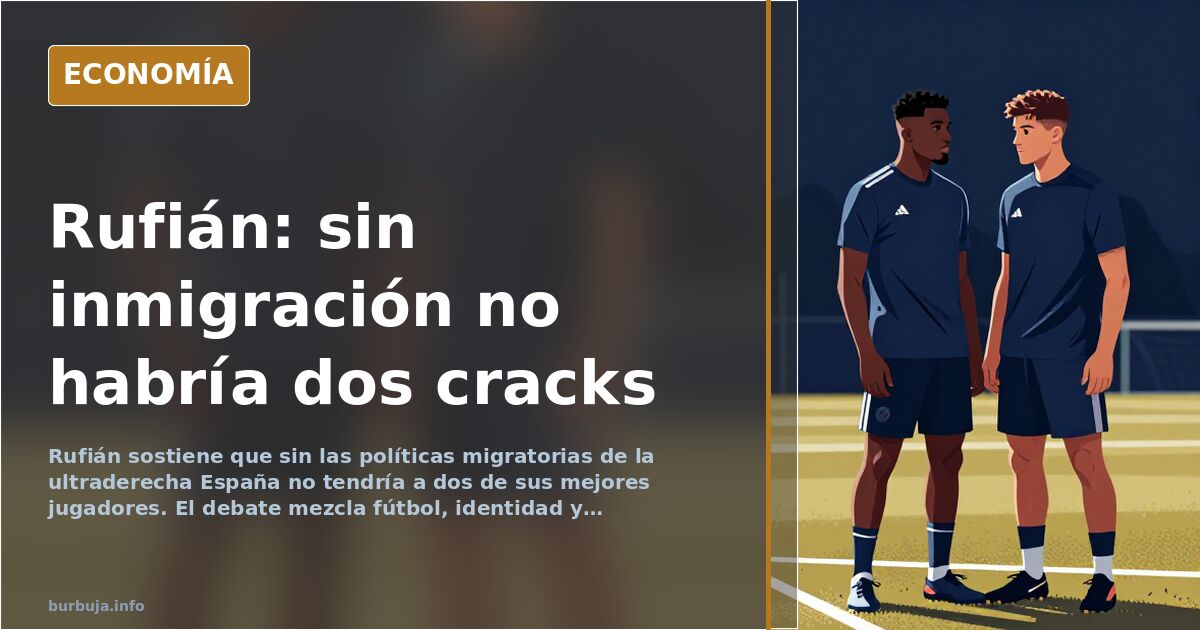
Rufián ties national team success to immigration, igniting controversy
Gabriel Rufián claims that if the far-right’s restrictive migration policies were applied, Spain would not currently have two of its best footballers. His remark, made during the Euro, has landed like a bomb in a country where the national team has long served as a barometer for the economy, politics and identity. This is not just about football; it is about who belongs in the national narrative.
Rufián’s argument is simple, which makes it uncomfortable: the two naturalized players supporting the squad today would not be here under the strict rules demanded by the far right. The backlash was immediate and multifaceted. Some recalled that Spain won two Euros and a World Cup without naturalized players. Others pointed out that Rodri, born in Madrid to Spanish parents, is statistically the team’s best player. Still others questioned how many players of immigrant origin were on the world champion squad.
Which players are at the center of the storm?
The names repeatedly cited are those of the naturalized defenders added to the squad in recent years. While debates over their inclusion are not new, the Euro context has amplified them. Some argue their selection is purely sporting, while others view it as social engineering. In reality, the team arrives with a mix of players from Spanish academies and those who joined via naturalization, and this blend is what competes today.
A detail that confuses many: the two players critics rank highest in the tournament are not the naturalized ones. Rodri, Fabián and Cucurella, all trained in Spain, antiestéticature prominently in analysts' predictions. The paradox is that the immigration controversy focuses on players who, in many cases, are not the core of the team’s performance.
The historical counter-argument: Two Euros and a World Cup
The most common objection to Rufián’s point is historical: Spain won two Euros and a World Cup with a squad containing no naturalized players. This fact supports the claim that sporting success does not depend on immigration. The counter-response is that that generation was unique and modern football, seen in teams like France, has become a global talent market.
France is often cited as a mirror. One analysis suggests France has eleven African-origin stars but faces social tensions in its neighborhoods. This comparison defends the idea that football cannot fix political failures. Opponents argue this confuses cause and effect: players do not create social problems; they simply play.
The economic backdrop nobody wants to address
Beneath the noise lies an economic issue with hard data. Spain’s migration model relies on low-skilled, low-wage labor for sectors like hospitality, agriculture and construction. When these workers regularize their status, they compete for better-paid jobs with natives. The system feeds itself: vacancies left behind are filled by new arrivals.
The result is population growth without equivalent productivity gains. This is the statistic banners ignore. The debate over naturalized players is fundamentally about whether this model is sustainable and who pays the price when it isn’t.
What is at stake for the national team?
Spain continues to compete in the Euro with an open outcome. If they win, the official narrative will again use football as a tool for cohesion, as it did after the 2008 and 2012 triumphs. If they lose, the controversy over naturalized players will fade until the next tournament. Either way, the underlying debate remains unresolved.
The honest prediction is that football will once again act as a painkiller. For a few weeks, we will all feel Spanish. Then, we will return to arguing with the same points and data. The only difference will be the score.
Gabriel Rufián claims that if the far-right’s restrictive migration policies were applied, Spain would not currently have two of its best footballers. His remark, made during the Euro, has landed like a bomb in a country where the national team has long served as a barometer for the economy, politics and identity. This is not just about football; it is about who belongs in the national narrative.
Rufián’s argument is simple, which makes it uncomfortable: the two naturalized players supporting the squad today would not be here under the strict rules demanded by the far right. The backlash was immediate and multifaceted. Some recalled that Spain won two Euros and a World Cup without naturalized players. Others pointed out that Rodri, born in Madrid to Spanish parents, is statistically the team’s best player. Still others questioned how many players of immigrant origin were on the world champion squad.
Which players are at the center of the storm?
The names repeatedly cited are those of the naturalized defenders added to the squad in recent years. While debates over their inclusion are not new, the Euro context has amplified them. Some argue their selection is purely sporting, while others view it as social engineering. In reality, the team arrives with a mix of players from Spanish academies and those who joined via naturalization, and this blend is what competes today.
A detail that confuses many: the two players critics rank highest in the tournament are not the naturalized ones. Rodri, Fabián and Cucurella, all trained in Spain, antiestéticature prominently in analysts' predictions. The paradox is that the immigration controversy focuses on players who, in many cases, are not the core of the team’s performance.
The historical counter-argument: Two Euros and a World Cup
The most common objection to Rufián’s point is historical: Spain won two Euros and a World Cup with a squad containing no naturalized players. This fact supports the claim that sporting success does not depend on immigration. The counter-response is that that generation was unique and modern football, seen in teams like France, has become a global talent market.
France is often cited as a mirror. One analysis suggests France has eleven African-origin stars but faces social tensions in its neighborhoods. This comparison defends the idea that football cannot fix political failures. Opponents argue this confuses cause and effect: players do not create social problems; they simply play.
The economic backdrop nobody wants to address
Beneath the noise lies an economic issue with hard data. Spain’s migration model relies on low-skilled, low-wage labor for sectors like hospitality, agriculture and construction. When these workers regularize their status, they compete for better-paid jobs with natives. The system feeds itself: vacancies left behind are filled by new arrivals.
The result is population growth without equivalent productivity gains. This is the statistic banners ignore. The debate over naturalized players is fundamentally about whether this model is sustainable and who pays the price when it isn’t.
What is at stake for the national team?
Spain continues to compete in the Euro with an open outcome. If they win, the official narrative will again use football as a tool for cohesion, as it did after the 2008 and 2012 triumphs. If they lose, the controversy over naturalized players will fade until the next tournament. Either way, the underlying debate remains unresolved.
The honest prediction is that football will once again act as a painkiller. For a few weeks, we will all feel Spanish. Then, we will return to arguing with the same points and data. The only difference will be the score.
Summary of a discussion on Burbuja.info - Foro de economía, actualidad y política., translated from Spanish and reviewed before publication. Read the full discussion (171 replies).
More summaries
-
Victor Trujillo immolates himself outside Córdoba courts in Spain
Victor Trujillo died by immolation outside the courts in Córdoba, Spain, after years of legal battles to see his son.
-
Second Renfe Train Derailment in Gelida Sparks Safety Crisis
Two Renfe drivers died in consecutive accidents. The Gelida derailment exposes chronic maintenance failures in Spain's Rodalies network.
-
Hantavirus Cruise Outbreak Sparks Pandemic Fears in Spain
WHO alerts on hantavirus outbreak aboard MV Hondius in Spanish waters, raising doubts about a new pandemic or media manipulation.
-
Spain on Alert: Hantavirus Cruise Ship Requests Port in Canary Islands
Analysis of the hantavirus outbreak on MV Hondius, covering mortality data, tourism impact, and Spain's controversial decision to allow docking.
-
Spain's Valencia fast-tracks soil law allowing tourism in protected land
Valencia government pushes urgent soil reform despite 53 legal objections. Community Interest Declarations become permanent.
-
Rufián: The Spanish MP Without a Political Home
Speculation surrounds Gabriel Rufián's future in Spain as ERC declines and no clear path emerges for the independentist MP.