
Room rentals in Spain yield €1,600 from €1,000 flat
In Spain, splitting a €1,000 flat into four rooms yields €1,600. Subletting is banned but widely ignored.
English · Original discussion in Spanish · Published
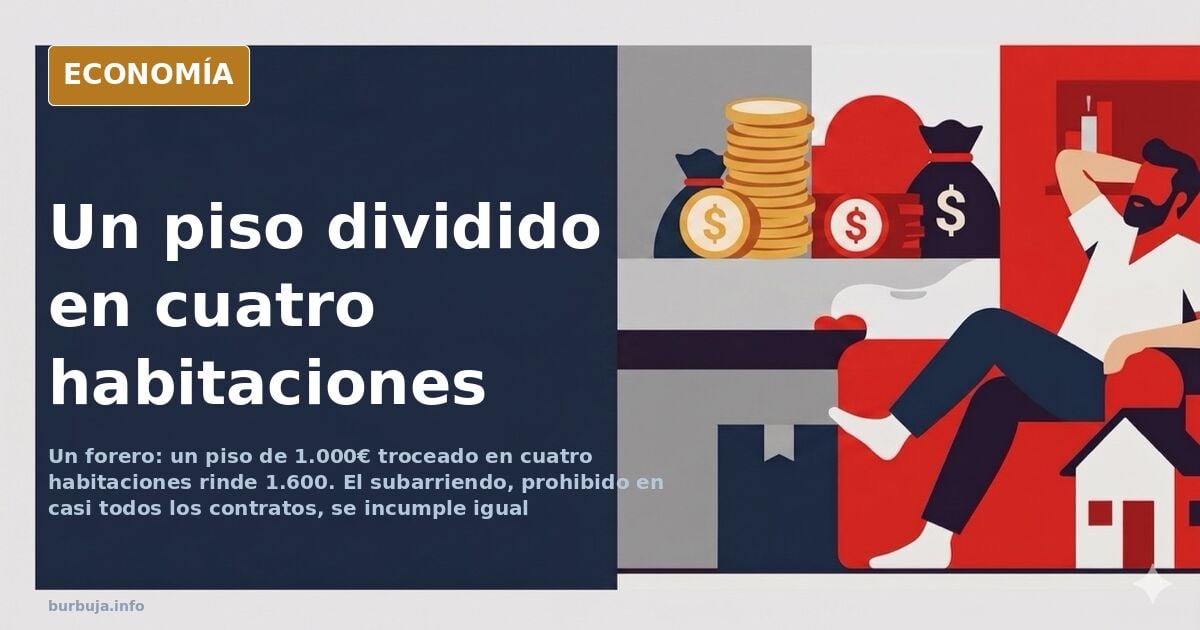
From €1,000 to €1,600: The math behind room rentals
Renting by the room is profitable, which explains its persistence. A forum user calculates that a flat rented for €1,000 monthly, split into four rooms at €400 each, generates €1,600. This margin, they argue, explains why regulations have failed to curb it. Prohibition seems unfeasible today. Yet, an uncomfortable detail emerges: subletting is already technically illegal.
What banning room rentals actually entails
The emerging proposal is direct: ban renting and subletting rooms, thereby tackling the slums and misery growing around them. The scenario often cited—migrants overcrowded in storage units in Madrid, Barcelona or Valencia—is presented as a antiestéticar, not a fact. It is crucial to distinguish measurable overcrowding from assumptions about who drives it.
Underlying this is a reasonable intuition. If whole-flat rentals are unaffordable, rooms become shelters, and shelters become businesses. Several participants argue that thousands live in rooms because signing a full-flat contract is impossible. Banning rooms does not create housing; it only changes where those who cannot pay sleep.
Why subletting is banned yet practiced with impunity
According to the thread, subletting is expressly prohibited in almost all rental contracts yet abusa without consequence. That is the core issue. An uninspected rule is effectively non-existent. Affected owners often find out too late, when the flat is occupied by more people than signed the lease.
A viable municipal approach would be ordinances limiting unrelated occupants based on square meters and available rooms. However, this tool arrives at the end of the process, fining owners rather than solving needs. As one repeated stance summarizes, banning consequences does not improve causes.
Registration, overcrowding, and the business model
Overcrowding is the real harm, not room-sharing itself. Some argue the problem isn't sharing flats, but profiting from cramming eight people into space for three. Others point to administrative incentives: each registered resident boosts official population figures, unlocking subsidies and budgetary power. Here, the calculation is political, not just real estate.
Meanwhile, the fine print circulates: a tenant rents a flat, sublets rooms above cost, and lives free; with the surplus, another buys property, repeating the cycle with mortgage payments covered. The narrative describes isolated cases, not organized fraud.
Alternatives to room rentals: cooperatives, coliving, aparthotels
Against overcrowding, shared ownership models are explored. The most discussed proposal involves ten people contributing €100,000 each to buy a ten-bedroom house with bathrooms. Members own their spot and can transfer it, similar to senior cooperatives. Full system details require separate analysis.
Risks are known: cooperative sectors face endless delays—twelve years in a cited Galician case—and projects ending in fraud. Aparthotels selling private bathroom rooms are also considered, though rare here and previously tested during the last crisis. Fraud prevention relies on separate accounts and investment oversight.
Work hours in reference countries like China
Comparing Spain’s model with China’s highlights labor intensity as a solution while ignoring its cost. Debate data indicates Chinese workers get five paid vacation days annually in their first decade, rising to ten after ten years and fifteen after twenty. The rest are national holidays.
Given this landscape, banning room rentals appears unlikely soon. Real enforcement against subletting and occupancy ordinances, not decrees, would be needed. Even then, the phenomenon may shrink where construction rises and costs increase, while elsewhere flats continue to be divided, because the alternative—the street—is free but not a housing policy.
Renting by the room is profitable, which explains its persistence. A forum user calculates that a flat rented for €1,000 monthly, split into four rooms at €400 each, generates €1,600. This margin, they argue, explains why regulations have failed to curb it. Prohibition seems unfeasible today. Yet, an uncomfortable detail emerges: subletting is already technically illegal.
What banning room rentals actually entails
The emerging proposal is direct: ban renting and subletting rooms, thereby tackling the slums and misery growing around them. The scenario often cited—migrants overcrowded in storage units in Madrid, Barcelona or Valencia—is presented as a antiestéticar, not a fact. It is crucial to distinguish measurable overcrowding from assumptions about who drives it.
Underlying this is a reasonable intuition. If whole-flat rentals are unaffordable, rooms become shelters, and shelters become businesses. Several participants argue that thousands live in rooms because signing a full-flat contract is impossible. Banning rooms does not create housing; it only changes where those who cannot pay sleep.
Why subletting is banned yet practiced with impunity
According to the thread, subletting is expressly prohibited in almost all rental contracts yet abusa without consequence. That is the core issue. An uninspected rule is effectively non-existent. Affected owners often find out too late, when the flat is occupied by more people than signed the lease.
A viable municipal approach would be ordinances limiting unrelated occupants based on square meters and available rooms. However, this tool arrives at the end of the process, fining owners rather than solving needs. As one repeated stance summarizes, banning consequences does not improve causes.
Registration, overcrowding, and the business model
Overcrowding is the real harm, not room-sharing itself. Some argue the problem isn't sharing flats, but profiting from cramming eight people into space for three. Others point to administrative incentives: each registered resident boosts official population figures, unlocking subsidies and budgetary power. Here, the calculation is political, not just real estate.
Meanwhile, the fine print circulates: a tenant rents a flat, sublets rooms above cost, and lives free; with the surplus, another buys property, repeating the cycle with mortgage payments covered. The narrative describes isolated cases, not organized fraud.
Alternatives to room rentals: cooperatives, coliving, aparthotels
Against overcrowding, shared ownership models are explored. The most discussed proposal involves ten people contributing €100,000 each to buy a ten-bedroom house with bathrooms. Members own their spot and can transfer it, similar to senior cooperatives. Full system details require separate analysis.
Risks are known: cooperative sectors face endless delays—twelve years in a cited Galician case—and projects ending in fraud. Aparthotels selling private bathroom rooms are also considered, though rare here and previously tested during the last crisis. Fraud prevention relies on separate accounts and investment oversight.
Work hours in reference countries like China
Comparing Spain’s model with China’s highlights labor intensity as a solution while ignoring its cost. Debate data indicates Chinese workers get five paid vacation days annually in their first decade, rising to ten after ten years and fifteen after twenty. The rest are national holidays.
Given this landscape, banning room rentals appears unlikely soon. Real enforcement against subletting and occupancy ordinances, not decrees, would be needed. Even then, the phenomenon may shrink where construction rises and costs increase, while elsewhere flats continue to be divided, because the alternative—the street—is free but not a housing policy.
Also available in: Deutsch
Summary of a discussion on Burbuja.info - Foro de economía, actualidad y política., translated from Spanish and reviewed before publication. Read the full discussion (134 replies).
More summaries
-
Room rental cap would push payments off the books
The cap preventing rooms from adding up to more than the whole flat would drive the difference underground: the example of €200 signed and €500 charged
-
Rental fraud shifts to rooms and seasonal lets in Spain
Fraudulent rental practices adapt to Spain's new housing law, using room and seasonal contracts to bypass price caps in stressed areas.
-
Spain's Rental Crisis: 30% of Housing is Rented, 10% Lost to Tourism
30% of Spain's housing stock is now rented, with 10% removed by tourist rentals. This article examines who truly pays for this booming real estate business.
-
Xabier Arrutia Imaz, ETA advisor to PDVSA in Venezuela, dies
The death of Xabier Arrutia Imaz in Venezuela exposes the protection network for ETA members in PDVSA and suspicions of a killing to silence secrets.
-
Spain Needs 25 Million Immigrants by 2053, COPE Reports
COPE reports Spain needs 25 million immigrants by 2053 to sustain the economy and services. The data sparks a rift among believers and critics.
-
Spain's Housing Gap: Grandparents' Purchasing Power vs. Today
New builds once cost one year's salary; now they require two incomes and a 40-year mortgage. Purchasing power has plummeted by 90%.