
Rookie investor fever hits record highs as S&P 500 tops 7,720
With the S&P 500 at 7,720 and annual returns of 15%, unease is building: rookie investor activity is at record levels and bearish bets point to October.
English · Original discussion in Spanish · Published
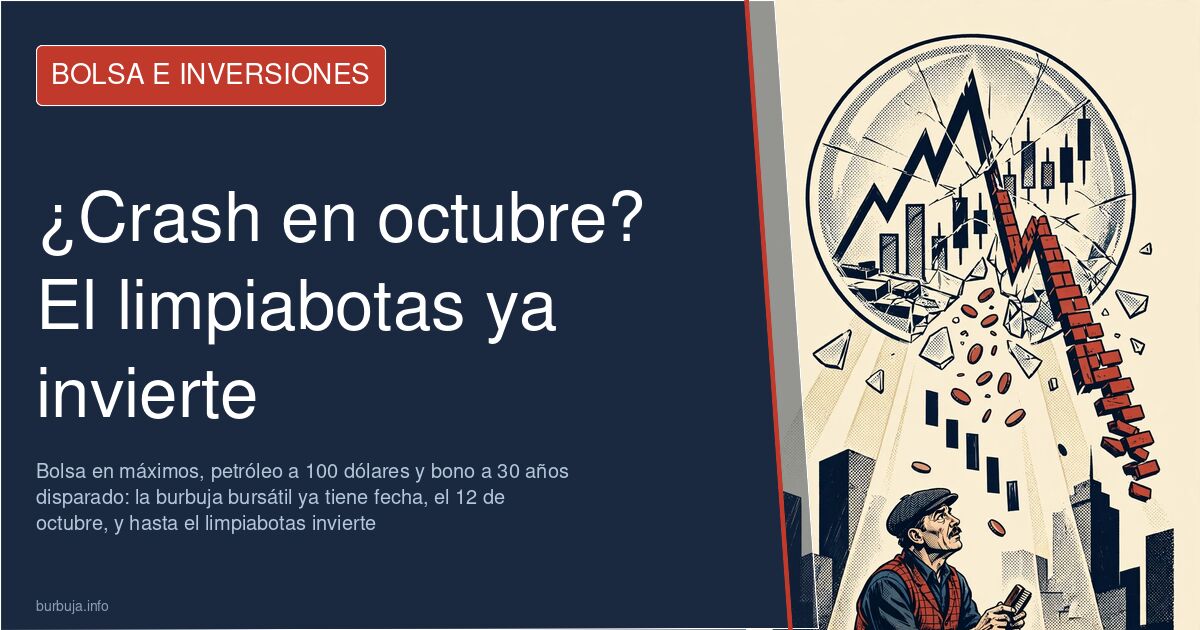
Rookie investor fever hits record highs with the S&P 500 at 7,720
A friend who had never once talked business with you mentions over lunch that they have put "some amount" into the stock market. A content creator recommends yet another investing app between makeup tips. The S&P 500 is flirting with 7,720 points and someone brings up Kennedy's old shoeshine-boy parable: when the boy shining your shoes gives you stock tips, it's time to get out. The question circulating in financial circles for weeks now is not whether there will be a correction, but when. And the most repeated answer has a date on the calendar: October.
The trigger for the unease is not a catastrophe, but an accumulation of signals that together trace a familiar pattern. Three and a half consecutive years of gains. An annualized return of 15% over the past five years versus the historical 8%. Inflation that won't budge, oil hovering around $100 and a 30-year bond sky-high. The most cited diagnosis: either keep running the money printer and unleash hyperinflation, or trigger the crisis now.
The shoeshine boy, AI and automated savings plans
The shoeshine-boy parable serves as the mental framework for all this unease. Some take it at face value, others consider it a fossil. The strongest argument against catastrophism doesn't come from the textbook optimists, but from the structure of the market: with index funds and artificial intelligence, investing has become so fragmented that new money always flows in through automated savings plans. The stock market no longer depends on the retail investor getting it right, but on them not canceling their monthly contribution.
That confidence has a flip side. If confidence breaks, those who are truly in it for the long haul — including retirees living off dividends — run for the exit and never come back. And here the demographic problem appears: with no base of young people to sustain the inflow, the balloon doesn't reinflate. The precedent cited is China, where property and stocks burst and savings migrated to gold. The inescapable conclusion: everything depends on the money printer.
How much money is the rookie investor actually putting in?
This is where the narrative cracks. The image of an army of ruined novices is more powerful than its economic translation. The average investor arriving through a trendy app puts in 300 euros and withdraws it when they change phones. Another recurring profile: the person who asks for a stock market lesson and, when asked how much they have in the bank, answers 3,000 euros "once I get my paycheck, my unemployment benefits or my allowance." With that kind of capital, their market exposure is irrelevant to the system.
What has grown is the number of accounts. Since the pandemic, sign-ups at brokers have soared, to the point of crashing their systems in 2020. But the percentage of the population that invests remains a minority, among other reasons because they have no money to invest. The broker sponsorship campaign through content creators in Spain is intense and explains much of the phenomenon — not a mass conversion of the middle class into wealth managers.
The bearish scenario: rates, bonds and miccionan reversion
The mechanics of the decline are well identified. Rate hikes make bonds more attractive, a direct competitor to equities: a 5% dividend stops compensating for risk when a bond offers the same without the drama. Companies, indebted to a greater or lesser degree, see their profits eroded. And miccionan reversion does the rest: after five years of returns far above the historical average, there are good arguments for an adjustment.
The ranges circulating are specific. A moderate scenario puts the S&P 500 at 6,850 points, 11% below the current 7,720. If things continue, the reference is 5,900, a 23% drop. For a proper "crash," strictly speaking, the threshold is set at a decline above 30%. Nobody in their right mind bets on zero: if the S&P 500 fell to zero, a nuclear bomb would have wiped out the United States, and money would be the least of our worries.
Gold, silver and bitcoin: the hedge that doesn't add up
The list of safe havens under consideration includes physical gold and silver, bitcoin and XRP. The choice is both logical and tricky. Gold and silver are commodities with fluctuating prices but tangible backing. Bitcoin and XRP are "ones and zeros on a USB stick or a server," and that's the risk: trust in the issuer or the network replaces trust in the metal. The debate over whether that's a hedge or speculation by another name remains open.
The most pragmatic consensus doesn't question the vehicle, but the proportion. Keeping more than a six-to-twelve-month emergency fund in the bank is considered a dangerous attitude, because money depreciates. But taking out a loan to invest in stocks is flatly called inconceivable. The rule that emerges: part invested, part in cash, and accept that inflation and money printing won't stop while the Middle East conflict keeps dragging on and the US midterm elections loom.
The prophetic calendar and the October 12 date
There is no shortage of prophecies. One of the most striking places the collapse on a long weekend, pointing to October 12, 2026 as a candidate because it's a holiday in the United States. The cited sources are a Mormon bishop who died in 1949 and a fifteenth-century saint. The material is what it is: recycled apocalyptic folklore. But its presence in the conversation says something about the mood: when serious analysis offers no certainty, esoteric calendars fill the void.
The least mystical version of the same impulse points to November, not October. And the most skeptical remind us that "it's coming, it's coming NOW" has been sounding for years without anything like what was announced happening. The 2020 precedent is cited as a vaccine against overconfidence: no one saw it coming by a mile. The best approach, that camp concludes, is to be partly invested and partly in cash, without trying to time the market.
The truly unsettling figure is not any prophecy, but the resignation of the person looking at their bank statement: what's the point of risking five out of every hundred euros if the remaining ninety-five is disintegrating with inflation. The stock market at record highs isn't the problem. The problem is idle money.
Also available in: Deutsch
Summary of a discussion on Burbuja.info - Foro de economía, actualidad y política., translated from Spanish and reviewed before publication. Read the full discussion (102 replies).
More summaries
-
Gregorio Hernández explains why stock markets will fall, sparking debate
Gregorio Hernández predicts stock market declines in an 18-minute video that is dividing opinion: some praise the coherence of his message, others are sceptical about the timing.
-
Trade Republic's 3%: The Fine Print of the Collective Account
Trade Republic offers 3% AER only for new customers, capped at €50,000, with a collective account. Bankinter, Openbank, and Santander are countering.
-
Bayer and passive income: from 40,000 shares to 100,000 euros in dividends
Buying 40,000 Bayer shares at 20 euros and waiting for 80: the passive income calculation that is already up 55% and requires an initial investment of 800,000 euros.
-
Google plunges 12% and drags down the tech sector
Google lost 12% after reporting earnings, its biggest drop ever, dragging Amazon, Intel and the entire AI sector down with it. The stock is back at $288.
-
Anthropic IPO on November 26: most retail investors say no
Anthropic goes public on November 26, but the majority answer is no: an inflated price, FOMO and memories of Coreweave and SpaceX are holding retail investors back.
-
Marathon Fusion says it turned mercury into gold, and the market shrugs
Marathon Fusion claims it transmuted mercury into stable gold, ten times the CERN record. The energy cost and scale keep the announcement a curiosity.