
Rome's historic center empties as tourism displaces residents
Rome's historic center faces depopulation due to short-term rentals, with fewer inhabitants than a village. Analysis of the housing bubble, cheap flights, and local commerce.
English · Original discussion in Spanish · Published
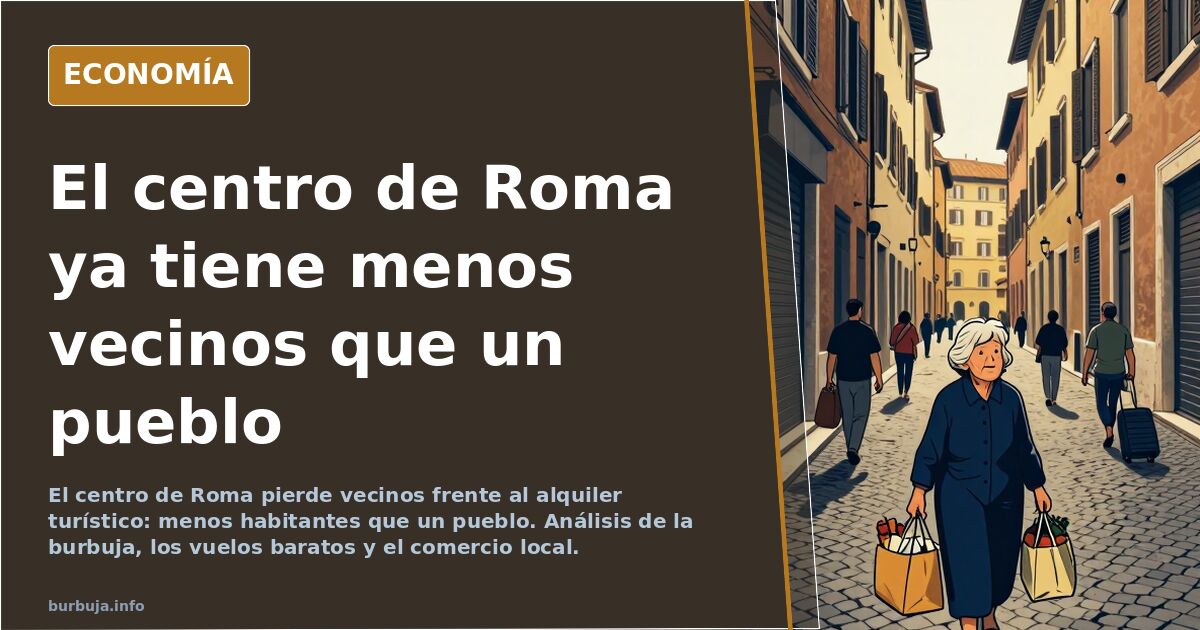
Rome's historic center loses residents: tourism consumes the city
Rome boasts of being the Eternal City, but that nickname was likely coined by someone who had never seen a vacation rental listing. The Italian capital's historic center is dying from its own success: streets are devoid of residents, occupied instead by rolling suitcases, tourist apartments, and transient visitors. The paradox is textbook: fewer people live in central Rome than in a small village. This is not a new phenomenon. While Barcelona still had authentic corners for locals a decade ago, Rome's center was already an area 100% dedicated to tourism in the 1990s.
Who wins and who loses with short-term rentals
The diagnosis generates more consensus than it seems. Some argue that local owners are profiting handsomely by renting at tourist prices and, in the process, have engaged in a white flight toward the periphery or smaller towns. Another perspective views this as simple market logic: apartments belong to native citizens who rent their homes, and no one should dictate how they use their property. Between these extremes, the recurring argument is that if vacation rentals are so harmful, they should simply be banned or taxed until they cease to be profitable. No one does.
Mass tourism as a bubble: dumping, dirt, and local commerce
The narrative of tourism as an inexhaustible source of wealth has its counterpart. It is argued that mass tourism brings not money, but labor dumping, a real estate bubble, dirt, insecurity, and the closure of local businesses, with large funds as the sole beneficiaries. The circulating thesis is that residents are pushed to the periphery while the center becomes a theme park. Some go further, claiming that flights, accommodations, restaurants, and bazaars belong to the same owners, and that tourist masses serve to launder money from other activities. It is the theory that everything is circular: just another bubble, like the real estate one.
Is the historic center of a city like Rome livable?
Here, the analysis splits in two. One group defends that the historic center is for sightseeing, not living: narrow streets, ancient houses, wooden beams, no elevators, no cars, pedestrian zones. Renovating and maintaining them would be absurd, and the only solution would be to demolish and redo urban planning, destroying heritage. The alternative without tourism, they say, is the center of Badajoz: a wasteland of crumbling houses, closed shops, and no one living there. The other group responds that a neighbor wants to live among neighbors, not tourists, and that tourism brings impersonalization: a flow of strangers. In Rome, moreover, there remain wonderful areas to live, such as Trastevere or the Gianicolo hill, where tourist pressure is lower.
Cheap flights, subsidies, and the business no one wants to touch
For part of the analysis, the ultimate cause lies in ticket prices. As long as a Manchester-Málaga flight costs less than a Madrid-Cuenca bus, there is nothing to be done. Rates remain low because airlines are subsidized by governments worldwide. Tourism has become one of the main legal economic activities on the planet, after financial economy, and that is why no one lifts a finger to stop the monster. Revenue matters: banning vacation rental platforms would be quick with a decree, but no one gives up the millions they bring in.
Tourism that displaces and the neighborhood that disappears
The effect on the social fabric is the most repeated point. The culture and customs that make a place unique are created by those who live there. Mass tourism displaces them, either for economic interest or simply due to the discomfort of living in a saturated area. There is also material damage: the wear and tear on monuments and landscapes, as peine with the Altamira Caves, which were closed to the public. Massive success also drives demand for cheap services, pushing precarity. The center empties of life and fills with passersby. How long does it take for a city to stop being itself?
Also available in: Deutsch
Summary of a discussion on Burbuja.info - Foro de economía, actualidad y política., translated from Spanish and reviewed before publication. Read the full discussion (119 replies).
More summaries
-
Balearic Islands and Canary Islands tighten grip on short-term rentals
The Balearic Islands are preparing to seal illegal tourist flats, while the Canary Islands draft new regulations. Holiday homes now account for 33% of island accommodation.
-
Spain's housing rules to stay until 2028
Spain keeps its Housing Law, hikes tourist rental VAT to 21%, and extends price controls. The battle over property rights continues.
-
Banning short-term rentals: impact on housing prices vs. tourism
Disparate figures in Madrid fuel skepticism over whether banning tourist apartments will actually lower rental prices.
-
Lefty: from the left hand to the all-purpose political label
The word "lefty" jumps from the left hand to the vote and nobody puts a figure on it: the political label replaces the argument over who pays for the benefits.
-
Spain's clock change debate: GMT+2, seasonal blues and bills
The clock change once again divides Spain: Galicia sees sunrise at 09:04 in December, the Balearic Islands 40 minutes earlier. The debate over GMT+2 and energy savings continues.
-
Allegations of election meddling in Brazil as Pedro Sánchez takes notes
The runoff between Bolsonaro and Lula da Silva is marked by a two-hour extension of polling station hours and 60% support for Lula among overseas voters. Click through for the data.