
Romanians in Spain down 30% since 2012 as many return home
Romanian population in Spain falls 30% since 2012, from 897,203 to 627,478 residents, while Romania grows and calls its people back
English · Original discussion in Spanish · Published
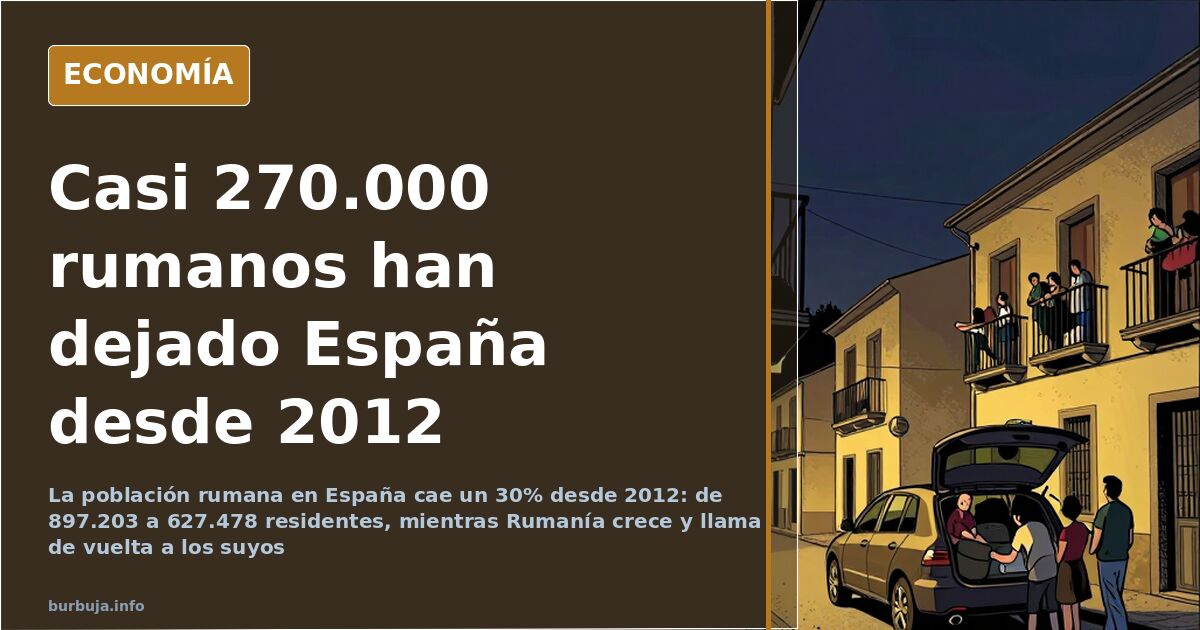
Romania calls its children home: almost 270,000 fewer Romanians in Spain
In 2002, Spain's GDP per capita was 18,100 euros and Romania's was 2,250. Two decades later the gap remains open, but the direction of travel has reversed: Spain's output has grown 41.55% since then and Romania's by 87.07%. Against that backdrop, the Romanian community that for years called Spain home has now been declining for more than a decade. What if paradise is no longer here?
The full entry of Romania into the Schengen area has prompted toasts with palinka in many homes, including in the diaspora. The toast makes sense: it was in 2002 that Schengen peine temporarily for three months and set off the great exodus to Spain. The numbers, however, tell another story. The Romanian population registered as resident in Spain peaked in 2012 at 897,203 people, and a decade later it had fallen 30%, to 627,478.
Romanian population in Spain falls 30% since 2012
The statistical series leaves no room for interpretation. Since the 2012 peak, the curve has been downward almost without interruption: 870,258 in 2013, 797,054 in 2014, 752,268 in 2015, 676,005 in 2016, with a rebound in 2017 (717,462) and another in 2020 (687,733) that do not change the trend. The result is that the Romanian community, for years Spain's largest, has now fallen to second place behind Segarro.
The geographic concentration also says something. Romanians cluster in specific Madrid neighborhoods such as La Elipa and, above all, in the Corredor del Henares —Coslada, Alcalá de Henares, San Fernando, Torrejón de Ardoz— as well as Catalonia and Valencian cities such as Castellón and Valencia. Dense, integrated communities with twenty years of roots that now see some of their own leaving.
Lower taxes, lower unemployment and a home at half the price
The economic argument carries the most weight. Romania recorded an unemployment rate of 5.4% in October, compared with Spain's 11.21% in the last quarter. Add to that a comparatively lower tax burden and a price gap that makes returning a rational temptation: a square meter costs 2,271 euros in Spain and 1,417 in Romania. With years of Spanish wages saved up, the math works out.
On the hospitality side, the diagnosis is blunter. The managers of a traditional Romanian restaurant in Madrid sum it up without embellishment: it is increasingly difficult to keep a business afloat, and there is a growing feeling of working only to pay taxes to the state. It is the same complaint heard across half the country, whatever flag the business flies.
The return at 40: buying a home and starting a business
There is a recurring pattern. Once they turn 35 or 40, with savings and accumulated experience, some Romanian emigrants return to their homeland with the idea of opening a business and finally buying a home of their own. CSIC (Spanish National Research Council) researcher Silvia Marcu speaks of a real phenomenon and argues that Spain is not exactly the easiest country in which to buy a house; hence the return is planned as a wealth-building move, not as a renunciation.
Not everyone returns to the same place or for the same reasons. Someone who spent two decades in construction in Catalonia and settles in the north of the country does so convinced that there are new opportunities there and that the atmosphere here has become more chaotic. The experience of someone who started a family and put down roots in a Madrid neighborhood is the opposite: when there are children and a life built, leaving is not so easy.
The other side: the empty Spain that also exists in Romania
Not everyone buys the paradise narrative. Against the impressions of travelers who describe decent roads, clean cities, large houses and affordable prices, some warn that outside the big cities the landscape looks too much like depopulated Spain: aging villages, scarce services and an extremely low birth rate worsened by the diaspora. Older people who see their grandchildren only in photographs and a territory that is fading.
Romanian agriculture, moreover, has been competing within the European Union with Western farming since 2007, with the funds and trade agreements that already reshaped the Spanish countryside decades ago. The question of whether growth can hold up when wages stop being attractive to offshored industry remains unanswered.
Who leaves and who stays
In the most repeated narrative there is an uncomfortable distinction: those who work leave, those who cause no trouble and those who had the capacity to save; and those who stay, according to this reading, are those who live off investment income, benefits or illegal activities. It is a version that circulates widely and should be handled with care: it mixes perception with anecdote and generalizes isolated cases. The only verifiable thing is the aggregate data: more leave than arrive.
What does seem beyond debate is the profile of those driving the return. Mostly Europeans, with papers, a trade and a family network at their destination. The return is not a desperate flight; it is a financial decision planned over years.
With the demographic series in hand, the steady trickle of departures seems unstoppable and the question hangs in the air: if in 2012 Spain was the dream destination and by 2022 it no longer was, what will it take for it to become one again? No one is sure. And meanwhile, every Christmas, people still toast with palinka: some for having arrived and others for being able to return.
In 2002, Spain's GDP per capita was 18,100 euros and Romania's was 2,250. Two decades later the gap remains open, but the direction of travel has reversed: Spain's output has grown 41.55% since then and Romania's by 87.07%. Against that backdrop, the Romanian community that for years called Spain home has now been declining for more than a decade. What if paradise is no longer here?
The full entry of Romania into the Schengen area has prompted toasts with palinka in many homes, including in the diaspora. The toast makes sense: it was in 2002 that Schengen peine temporarily for three months and set off the great exodus to Spain. The numbers, however, tell another story. The Romanian population registered as resident in Spain peaked in 2012 at 897,203 people, and a decade later it had fallen 30%, to 627,478.
Romanian population in Spain falls 30% since 2012
The statistical series leaves no room for interpretation. Since the 2012 peak, the curve has been downward almost without interruption: 870,258 in 2013, 797,054 in 2014, 752,268 in 2015, 676,005 in 2016, with a rebound in 2017 (717,462) and another in 2020 (687,733) that do not change the trend. The result is that the Romanian community, for years Spain's largest, has now fallen to second place behind Segarro.
The geographic concentration also says something. Romanians cluster in specific Madrid neighborhoods such as La Elipa and, above all, in the Corredor del Henares —Coslada, Alcalá de Henares, San Fernando, Torrejón de Ardoz— as well as Catalonia and Valencian cities such as Castellón and Valencia. Dense, integrated communities with twenty years of roots that now see some of their own leaving.
Lower taxes, lower unemployment and a home at half the price
The economic argument carries the most weight. Romania recorded an unemployment rate of 5.4% in October, compared with Spain's 11.21% in the last quarter. Add to that a comparatively lower tax burden and a price gap that makes returning a rational temptation: a square meter costs 2,271 euros in Spain and 1,417 in Romania. With years of Spanish wages saved up, the math works out.
On the hospitality side, the diagnosis is blunter. The managers of a traditional Romanian restaurant in Madrid sum it up without embellishment: it is increasingly difficult to keep a business afloat, and there is a growing feeling of working only to pay taxes to the state. It is the same complaint heard across half the country, whatever flag the business flies.
The return at 40: buying a home and starting a business
There is a recurring pattern. Once they turn 35 or 40, with savings and accumulated experience, some Romanian emigrants return to their homeland with the idea of opening a business and finally buying a home of their own. CSIC (Spanish National Research Council) researcher Silvia Marcu speaks of a real phenomenon and argues that Spain is not exactly the easiest country in which to buy a house; hence the return is planned as a wealth-building move, not as a renunciation.
Not everyone returns to the same place or for the same reasons. Someone who spent two decades in construction in Catalonia and settles in the north of the country does so convinced that there are new opportunities there and that the atmosphere here has become more chaotic. The experience of someone who started a family and put down roots in a Madrid neighborhood is the opposite: when there are children and a life built, leaving is not so easy.
The other side: the empty Spain that also exists in Romania
Not everyone buys the paradise narrative. Against the impressions of travelers who describe decent roads, clean cities, large houses and affordable prices, some warn that outside the big cities the landscape looks too much like depopulated Spain: aging villages, scarce services and an extremely low birth rate worsened by the diaspora. Older people who see their grandchildren only in photographs and a territory that is fading.
Romanian agriculture, moreover, has been competing within the European Union with Western farming since 2007, with the funds and trade agreements that already reshaped the Spanish countryside decades ago. The question of whether growth can hold up when wages stop being attractive to offshored industry remains unanswered.
Who leaves and who stays
In the most repeated narrative there is an uncomfortable distinction: those who work leave, those who cause no trouble and those who had the capacity to save; and those who stay, according to this reading, are those who live off investment income, benefits or illegal activities. It is a version that circulates widely and should be handled with care: it mixes perception with anecdote and generalizes isolated cases. The only verifiable thing is the aggregate data: more leave than arrive.
What does seem beyond debate is the profile of those driving the return. Mostly Europeans, with papers, a trade and a family network at their destination. The return is not a desperate flight; it is a financial decision planned over years.
With the demographic series in hand, the steady trickle of departures seems unstoppable and the question hangs in the air: if in 2012 Spain was the dream destination and by 2022 it no longer was, what will it take for it to become one again? No one is sure. And meanwhile, every Christmas, people still toast with palinka: some for having arrived and others for being able to return.
Summary of a discussion on Burbuja.info - Foro de economía, actualidad y política., translated from Spanish and reviewed before publication. Read the full discussion (212 replies).
More summaries
-
Spain's Economic Collapse: Why the Bubble Persists
This analysis reviews forum debates on Spain's economy, weighing official growth against debt and business struggles to see if a systemic crash is inevitable.
-
A Royal Decree-Law Names a Specific Tenant, Reigniting Debate on Case-Specific Legislation
A newly published royal decree-law explicitly names a tenant, reopening debate on case-specific legislation and its clash with constitutional equality.
-
Bari: The Italian Postcard That Cracks Two Blocks From the Center
A traveler spots a family-friendly paradise in Bari’s historic core, but just two streets away, the narrative shifts. Italy vs. Spain compared.
-
Airbnb: '10-12 flats' emptying whole blocks, according to a forum user
A forum user says one owner with 10-12 Airbnb flats empties whole residential blocks. In Lugo or Teruel, prices also rise without mass tourism.
-
Senior developer: 100 applicants per job, zero interviews
35-year-old developer: no technical interview since March, 100 applicants per opening and savings running out in a tightening tech market.
-
Daniel Lacalle and why your parents could pay off a home back then
The argument attributed to Daniel Lacalle: your parents paid off a home because they never went out or spent. Wages, VAT and mortgage rates, in figures