
Roman Coins Found in Spain: Silence or Financial Ruin?
Spanish forum debates reporting Iberian or Roman coin finds during construction, with users claiming notification halts work and bankrupts owners.
English · Original discussion in Spanish · Published
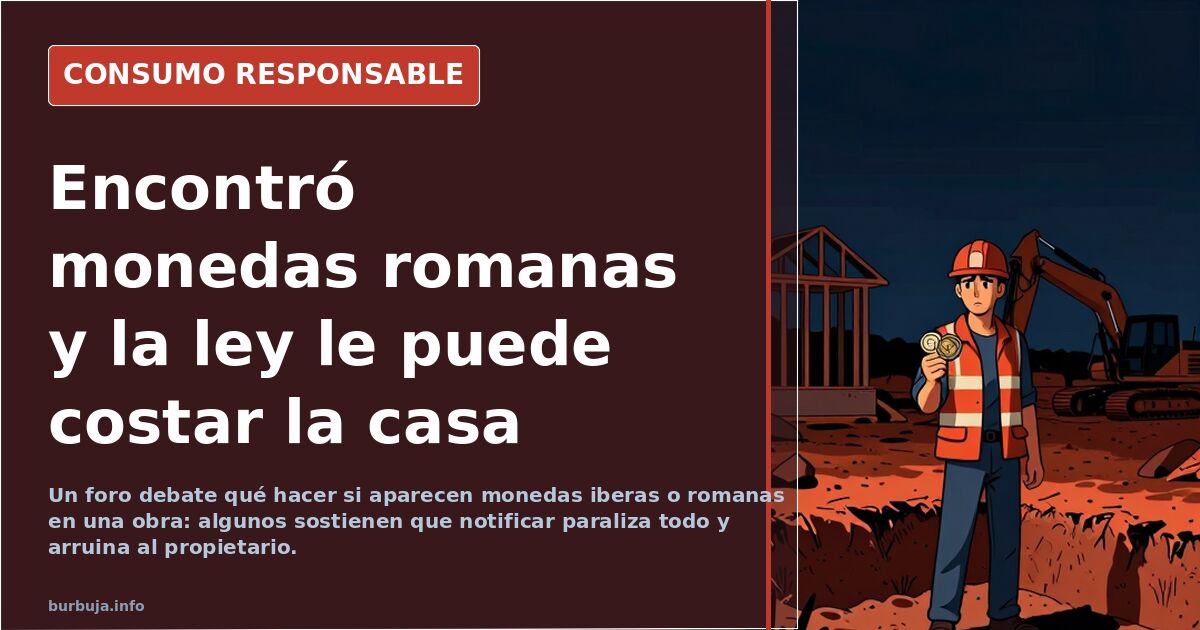
Finding Roman Coins at Home: Speak Up or Face Ruin
What do you do if Iberian or Roman coins and pottery shards appear while renovating your country house? A consumer forum question has a legally mandated answer that many participants claim no one wants to hear: stop the work and wait. In practice, responses often suggest the opposite: cover the hole, continue elsewhere, and say nothing. The find is perceived not as joy but as an economic condemnation for the owner.
Spanish heritage legislation requires anyone finding archaeological remains to notify the competent authority. According to the debate, this triggers a halt to construction, an archaeological intervention, and costs borne by the owner. The thread describes a bureaucratic and financial ordeal: years of suspension, excavation expenses, and compensation that rarely arrives. One cited case involves a man who paid archaeologists out of pocket, treating it as a joke because the alternative was despair.
The Law vs. Reality
In theory, the law protects the discoverer. Participants assert that landowners and finders are entitled to compensation. In practice, they claim this becomes a judicial claim lasting decades. The administration does not pay, leaving owners trapped between legal obligation and financial ruin. Some argue significant sites might yield millions in expropriation compensation, though no one has seen such payouts.
The result, according to the discussion, is a perverse incentive. Former archaeologists admit that during the real estate boom, many made a living from halted projects. Today’s message to individuals is clear: if you find something, keep quiet. The law looks good on paper, but its application generates antiestéticar rather than protection.
Black Market and Coin Traceability
Ancient coins face traceability issues. One participant notes authentic pieces entering the market carry certificates and fingerprints linked to a common database. When a "new" coin appears, the circuit activates. Serious collectors avoid items without provenance; others are worth little more than their metal weight.
This doesn't prevent a black market. The debate mentions selling via the deep web despite high risks. Treasure hunters and unscrupulous intermediaries can be worse than authorities. Industry insiders conclude that without contacts, silence and private enjoyment are the least bad options.
UK Comparison: Detectors and Rewards
In the UK, the debate claims metal detector use is permitted, with finds split 50/50 between discoverer and landowner. This policy reportedly multiplies discoveries. In Spain, detectors are regulated, and field use can lead to confiscation. The comparison criticizes the lack of incentives: here, finding something is a misfortune; there, an opportunity.
The lingering question is whether Spain can afford to bury its past. For now, owners prefer to bury it themselves.
Key Data
What do you do if Iberian or Roman coins and pottery shards appear while renovating your country house? A consumer forum question has a legally mandated answer that many participants claim no one wants to hear: stop the work and wait. In practice, responses often suggest the opposite: cover the hole, continue elsewhere, and say nothing. The find is perceived not as joy but as an economic condemnation for the owner.
Spanish heritage legislation requires anyone finding archaeological remains to notify the competent authority. According to the debate, this triggers a halt to construction, an archaeological intervention, and costs borne by the owner. The thread describes a bureaucratic and financial ordeal: years of suspension, excavation expenses, and compensation that rarely arrives. One cited case involves a man who paid archaeologists out of pocket, treating it as a joke because the alternative was despair.
The Law vs. Reality
In theory, the law protects the discoverer. Participants assert that landowners and finders are entitled to compensation. In practice, they claim this becomes a judicial claim lasting decades. The administration does not pay, leaving owners trapped between legal obligation and financial ruin. Some argue significant sites might yield millions in expropriation compensation, though no one has seen such payouts.
The result, according to the discussion, is a perverse incentive. Former archaeologists admit that during the real estate boom, many made a living from halted projects. Today’s message to individuals is clear: if you find something, keep quiet. The law looks good on paper, but its application generates antiestéticar rather than protection.
Black Market and Coin Traceability
Ancient coins face traceability issues. One participant notes authentic pieces entering the market carry certificates and fingerprints linked to a common database. When a "new" coin appears, the circuit activates. Serious collectors avoid items without provenance; others are worth little more than their metal weight.
This doesn't prevent a black market. The debate mentions selling via the deep web despite high risks. Treasure hunters and unscrupulous intermediaries can be worse than authorities. Industry insiders conclude that without contacts, silence and private enjoyment are the least bad options.
UK Comparison: Detectors and Rewards
In the UK, the debate claims metal detector use is permitted, with finds split 50/50 between discoverer and landowner. This policy reportedly multiplies discoveries. In Spain, detectors are regulated, and field use can lead to confiscation. The comparison criticizes the lack of incentives: here, finding something is a misfortune; there, an opportunity.
The lingering question is whether Spain can afford to bury its past. For now, owners prefer to bury it themselves.
Key Data
- In the UK, finds are allegedly split 50% between discoverer and owner.
- In Spain, owners and finders would theoretically have rights to 50% of appraised value.
- One participant states construction halts due to sites can last ten to fifteen years.
- Metal detectors are regulated in Spain, with field use potentially leading to confiscation.
Also available in: Deutsch
Summary of a discussion on Burbuja.info - Foro de economía, actualidad y política., translated from Spanish and reviewed before publication. Read the full discussion (113 replies).
More summaries
-
Forum user claims US motorcycles are 20x deadlier than guns
A forum calculation suggests US motorcycles have a lethality rate per unit 20 times higher than civilian firearms, citing 310 million guns and 7.1 million bikes.
-
Spain's Online Shopping: Fake Stock and Late Deliveries
Items listed as 'in stock' with 24-hour delivery often take a week. Spanish buyers report higher costs and delays compared to the UK.
-
Spain's second-hand market prices rival new items
Used PS4s hold high prices in Spain, unlike UK and German markets where resale is more common.
-
The real cost of cheap paint from Leroy Merlin
The real cost of using cheap paint from big-box stores. We analyze the dilemma between immediate savings and the durability of the finish.
-
Risks of Driving an Old Car Daily
We analyze the real risks and costs of using a vintage car daily: safety, fuel consumption, breakdowns, and the best manufacturing era.
-
Pasta Wars: How Supermarket Choices Define Quality
Shape, brand, bronze-drawn texture and protein content: what really matters when choosing pasta. A guide to avoid mistakes at the supermarket.