
Robots target workers, not just machines
Automation shifts from replacing assembly lines to displacing human operators. Mid-level jobs face the highest risk of elimination.
English · Original discussion in Spanish · Published
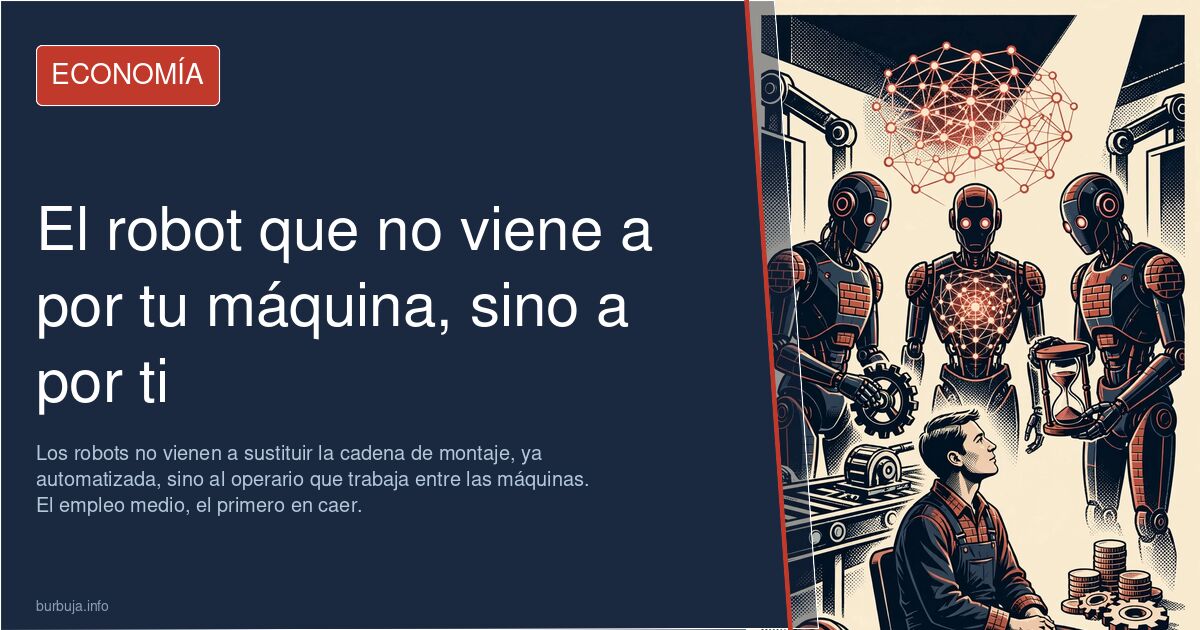
Robots don't replace the line; they replace the worker in between
A Unitree robotic hand with 20 degrees of freedom (16 active, 4 passive) and 94 sensitive contact points. A video of a Figure humanoid operating at BMW's South Carolina plant, not on a test bench. A Bank of America Institute report positioning "agentic AI" as an economic driver until 2030. Underneath it all, the uncomfortable argument: robots aren't coming for welders or presses—already automated for decades—but for the operator moving parts between machines. This nuance reshapes the employment debate, yet few address it directly.
What is already happening in warehouses
Displacement isn't a future threat; it's history. In Spanish warehouses, some recall strapping pallets by hand until a machine took over, or picking items off conveyor belts until lasers automated the process. The result, without glamour: a few reassigned, the rest unemployed. The same scenario played out earlier with parking attendants, first replaced by camera-equipped vehicles, then by autonomous driving. Automation rarely warns; it arrives, does the job, and leaves behind payroll that is no longer needed.
The report setting a date: 2030
The Bank of America Institute places the "breakdown of the old world" in the next five years: technological disruption, cybercrime surge, and geopolitical restructuring. The document centers AI in the labor market, highlighting "agentic AI"—capable of acting without constant supervision—as the lever. The date isn't arbitrary: 2030 is the horizon both those promising jobs and those predicting their loss cling to. Ultimately, the report puts in writing what banks have been quietly preparing for years.
Forty years old, a mortgage, and AI
A recurring testimony emerges. A civil works and facilities project manager estimates AI already covers 90% of his work, "possibly better than me in most cases," though it requires supervision. Two banking professionals, both in their forties, have left their posts and struggle to find new roles. In the financial sector, ongoing corporate operations regarding Banco Sabadell are cited as catalysts for early retirements and layoffs. Public administration, with thousands of civil servants in administrative and accounting tasks, won't be an island.
Who buys what robots produce?
Here comes the classic objection, and it's significant. If robots manufacture everything and humans lose wages, who buys? Demand cannot sustain itself without salaries. The automotive industry is already shaky because many lack money for cars, and the solution—replacing workers with machines—eliminates the very buyer. The circulating counter-proposal is sharing work: fewer hours per person and higher real wages, though some warn that forcing this without more support would drive wages down, while others add a non-trivial detail: billion-dollar unicorns will emerge with one or two employees.
Those who say it won't happen
Not everyone buys the narrative. The most cited technical objection is Sarracena's paradox: what is hard for a machine is exactly what is easy for a human. That's why painters and gardeners breathe easily while mid-level intellectual jobs wobble. The other objection is about approach: it's not about copying humans, but redesigning processes to eliminate them. And the fine print of the BMW video reveals what wasn't shown in the edit: initially, the Figure robot worked only outside production hours. Like buying ice from the ice man because refrigerators are loaded with devils.
As of this discussion, the technical consensus is that it won't happen tomorrow. The economic consensus is that it will. The open question—and why no one closes the issue—is how much of this transition will be financed by the paychecks of those who haven't been replaced yet.
Summary of a discussion on Burbuja.info - Foro de economía, actualidad y política., translated from Spanish and reviewed before publication. Read the full discussion (139 replies).
More summaries
-
Autonomous Helix-02 Robots Outperform Humans on 8-Hour Shifts
Figure 03 humanoid robots work 16-hour shifts for 30,000 euros, challenging low-wage labor viability and sparking debate on demand crises.
-
The Brotherhood Narrative with Latin America Challenged
The brotherhood between Spain and Latin America is debated without a single economic figure on the table: what is supported and what remains unproven.
-
Abdellah Mustafa: The Neighbourhood Voice of Ceuta on TV
Abdellah Mustafa, neighbourhood president of Sidi Embarek, has become omnipresent on television while critics accuse him of not mentioning Morocco.
-
Semi-detached house prices in Valladolid, Spain are finally starting to fall
Are semi-detached homes in Valladolid overvalued? We look at whether high prices in areas like El Peral are a bubble or genuine demand. Join the debate!
-
Could Trump's return cost Spain Ceuta and Melilla?
Forum users debate whether Spain risks losing Ceuta and Melilla amid Trump's new geopolitical scenario and the lack of Spanish realpolitik.
-
Zapatero's jewels: planted or inherited? The debate that won't die
150 million in jewels found in Zapatero's office in Spain: inheritance or a setup? We examine the theories, the costs and the contradictions of a case dividing public opinion.