
Olive oil prices surge 84.4%, outpacing official inflation data
Spanish olive oil costs rose 84.4% year-on-year, hitting record highs while official consumer price indices fail to reflect the true impact on household budgets.
English · Original discussion in Spanish · Published
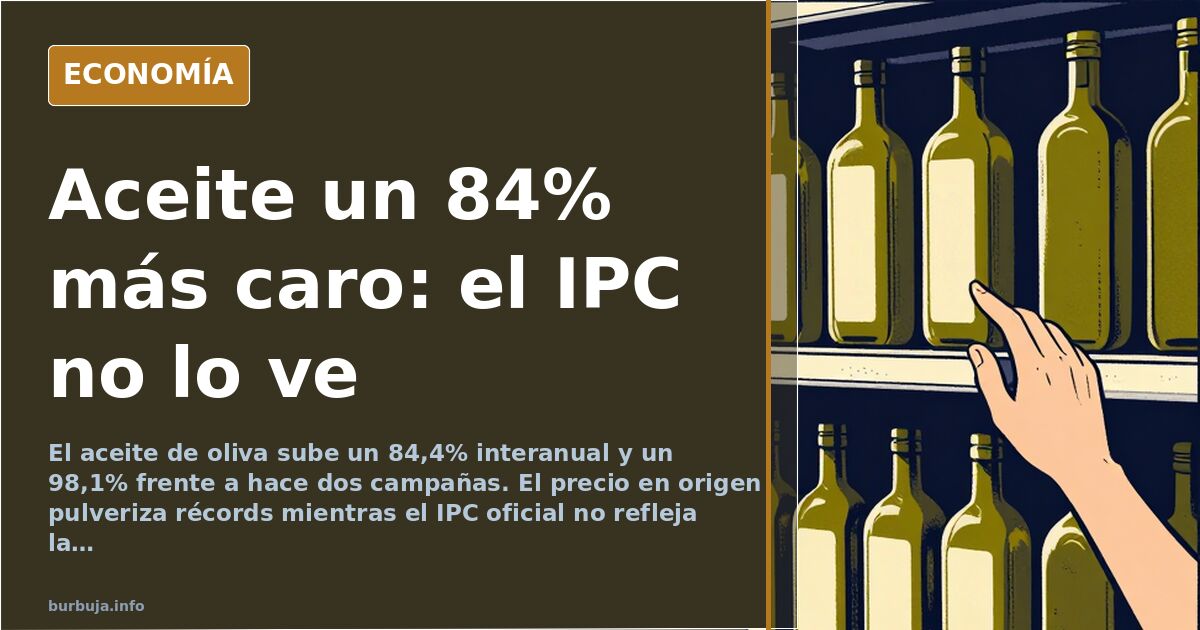
Olive oil prices jump 84.4%, creating a gap with official inflation
This season, a liter of olive oil costs 84.4% more than last year and 98.1% more than two seasons ago, according to data that has sparked debate. The increase is not isolated; similar price hikes are occurring across the Mediterranean region. Given this context, a troubling question arises: if farm-gate prices have quadrupled in three years—reaching an average of 7.34 euros per kilo—why does the official food inflation rate not reflect such a significant rise in the cost of living?
Why olive oil prices are rising and how long it will last
The agronomic explanation carries the most weight: Spanish olive groves are predominantly rain-fed (secano), making prices dependent on rainfall. Good rains lead to high yields and lower prices; drought causes trees to produce less fruit, driving prices up. After two poor harvests, if autumn rains remain scarce, a third bad season could keep prices elevated.
A structural limitation reinforces this trend: olive oil is almost exclusively a Mediterranean product, particularly from Spain. Unlike other foods, there is no alternative supply source like Vietnam to compensate for shortfalls. When domestic production fails, there is no escape valve in the international market.
The practical conclusion is uncomfortable for consumers: with current harvest levels, the product risks becoming as expensive as pharmaceutical goods. High prices are not due to retailer greed but result from supply shortages against steady demand.
Hidden inflation: shrinking portions, same price tag
Beyond olive oil, discussions highlight invisible inflation not captured by indices: the loss of quality and quantity in packaged goods. Snack bags and cookies contain fewer grams, and real ingredient percentages drop without price reductions. A frequently cited example is turkey breast deli meat, which once contained around 70% turkey but now falls below that threshold.
This silent reduction in value equates to hidden price increases absent from statistics. Consumers pay the same or more for less product of lower quality, a discrepancy unmeasured by the Consumer Price Index (IPC).
Cumulative estimates suggest the shopping basket may have become approximately 50% more expensive over the past two to three years. Items with stable reference prices for years have surged: spinach jumped from 1.00 to 1.50 euros, and a well-known German beer brand rose from 0.97 to 1.55 euros.
Euribor, mortgages, and the double blow
Rising grocery costs do not arrive alone. Those who took out a mortgage in 2017 for 180,000 euros over 30 years at Euribor plus 0.89 paid about 570 euros monthly. With Euribor at 4.13%, payments now approach 1,076 euros—nearly double. Financial literacy, ironically, was not prioritized.
A cynical view suggests non-mortgaged households will ultimately bear the cost. Mortgaged borrowers may see relief soon—as peine previously—while others continue to suffer the effects of monetary and fiscal policy. Central bank money printing and public debt are central to this criticism.
Official narrative versus supermarket reality
Contrary to basket data, institutional narratives claim Spain has the second-lowest inflation in Europe, with harmonized rates at their lowest since March 2021. Street-level responses argue these figures do not match checkout totals. The gap between macroeconomic data and actual spending is itself the phenomenon.
No index provides closure. It is the farm-gate price of olive oil, continuing to break records without ceiling. Until trees receive water, statistics can say what they want: the bottle price will keep rising.
This season, a liter of olive oil costs 84.4% more than last year and 98.1% more than two seasons ago, according to data that has sparked debate. The increase is not isolated; similar price hikes are occurring across the Mediterranean region. Given this context, a troubling question arises: if farm-gate prices have quadrupled in three years—reaching an average of 7.34 euros per kilo—why does the official food inflation rate not reflect such a significant rise in the cost of living?
Why olive oil prices are rising and how long it will last
The agronomic explanation carries the most weight: Spanish olive groves are predominantly rain-fed (secano), making prices dependent on rainfall. Good rains lead to high yields and lower prices; drought causes trees to produce less fruit, driving prices up. After two poor harvests, if autumn rains remain scarce, a third bad season could keep prices elevated.
A structural limitation reinforces this trend: olive oil is almost exclusively a Mediterranean product, particularly from Spain. Unlike other foods, there is no alternative supply source like Vietnam to compensate for shortfalls. When domestic production fails, there is no escape valve in the international market.
The practical conclusion is uncomfortable for consumers: with current harvest levels, the product risks becoming as expensive as pharmaceutical goods. High prices are not due to retailer greed but result from supply shortages against steady demand.
Hidden inflation: shrinking portions, same price tag
Beyond olive oil, discussions highlight invisible inflation not captured by indices: the loss of quality and quantity in packaged goods. Snack bags and cookies contain fewer grams, and real ingredient percentages drop without price reductions. A frequently cited example is turkey breast deli meat, which once contained around 70% turkey but now falls below that threshold.
This silent reduction in value equates to hidden price increases absent from statistics. Consumers pay the same or more for less product of lower quality, a discrepancy unmeasured by the Consumer Price Index (IPC).
Cumulative estimates suggest the shopping basket may have become approximately 50% more expensive over the past two to three years. Items with stable reference prices for years have surged: spinach jumped from 1.00 to 1.50 euros, and a well-known German beer brand rose from 0.97 to 1.55 euros.
Euribor, mortgages, and the double blow
Rising grocery costs do not arrive alone. Those who took out a mortgage in 2017 for 180,000 euros over 30 years at Euribor plus 0.89 paid about 570 euros monthly. With Euribor at 4.13%, payments now approach 1,076 euros—nearly double. Financial literacy, ironically, was not prioritized.
A cynical view suggests non-mortgaged households will ultimately bear the cost. Mortgaged borrowers may see relief soon—as peine previously—while others continue to suffer the effects of monetary and fiscal policy. Central bank money printing and public debt are central to this criticism.
Official narrative versus supermarket reality
Contrary to basket data, institutional narratives claim Spain has the second-lowest inflation in Europe, with harmonized rates at their lowest since March 2021. Street-level responses argue these figures do not match checkout totals. The gap between macroeconomic data and actual spending is itself the phenomenon.
No index provides closure. It is the farm-gate price of olive oil, continuing to break records without ceiling. Until trees receive water, statistics can say what they want: the bottle price will keep rising.
Summary of a discussion on Burbuja.info - Foro de economía, actualidad y política., translated from Spanish and reviewed before publication. Read the full discussion (154 replies).
More summaries
-
Inflation degrades food quality: shifting from olive to sunflower oil
Sunflower replaces olive oil; pasta replaces steaks. Inflation erodes basket quality, but no official index measures the nutritional loss.
-
Man sentenced to 4.5 years for slaughtering girlfriend's rabbit
A Valencia court sentences a man to 4.5 years in prison for killing, cooking, and forcing his girlfriend to eat her rabbit.
-
Young Man Fired for Mocking Puerta del Sol Protesters
A young man was fired after a viral video mocked Puerta del Sol protesters as lazy. The case sparks debate on fair dismissal and free speech in Spain.
-
Plane Myth: Confusing Inertia with Wind in Spain
Earth rotates at 1,600 km/h and planes fly at 840 km/h. The error is forgetting that air rotates with the planet.
-
Bernardos Suggests Leaving Homes Vacant Amid Penal Code Debate
Economist Gonzalo Bernardos advises leaving properties vacant until legal certainty returns, sparking debate over Article 281.1 of the Spanish Penal Code.
-
Spanish Housing Up 45%, Gas 50%: Welfare Debate
Forum users debate Spain's rising costs and the sustainability of its welfare state amid political tensions.