
Retiring with €1M: Investor Debate on Financial Freedom
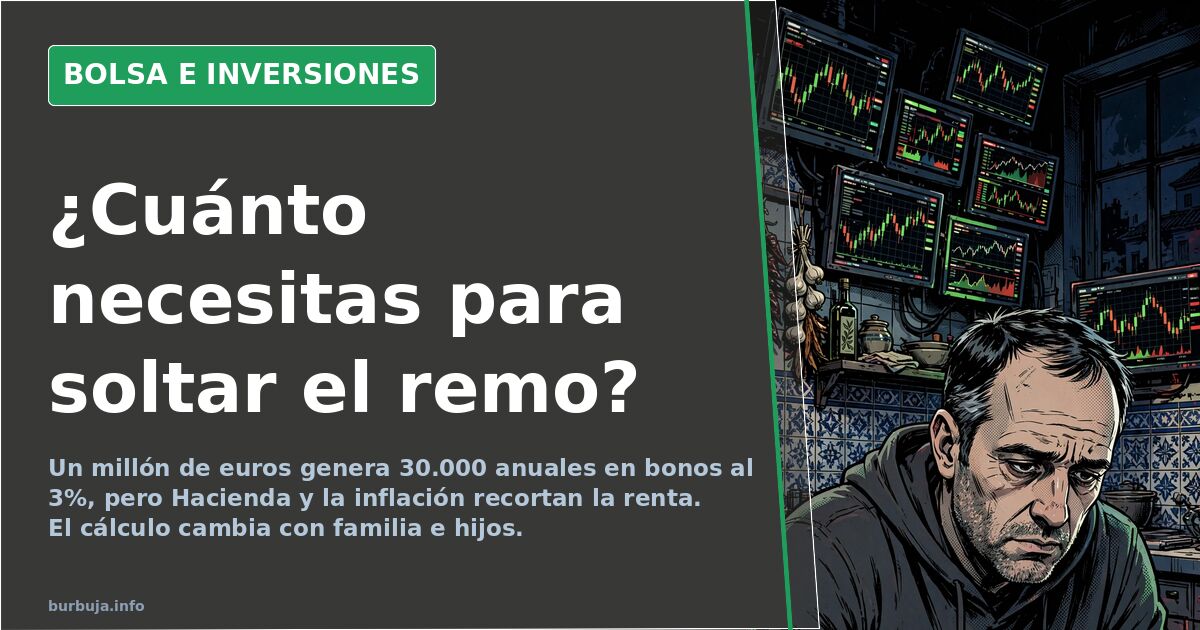
A €1 million portfolio yields €30,000 annually in bonds, but taxes and inflation reduce net income. Family size significantly alters the financial equation.
English · Original discussion in Spanish · Published
Retiring with €1M: The Calculation Dividing Investors
One million euros. The round figure many consider the boundary between waking up early for work and living off passive income. The question, posed in the context of a single person without dependents, becomes complex when a family with two children enters the equation. And that is where the dance of numbers, assumptions, and mutual accusations begins, summarizing well how money is viewed today in Spain.
The initial premise is deceptively simple: How much do you need to drop the oars and live the rest of your life on passive income from dividends, Treasury bonds, and similar instruments? The short answer is that no one agrees. The long answer occupies hundreds of messages and leaves an unintentional portrait of the economic expectations of a generation.
The Optimistic Calculation: €30,000 Annually and Live
The first figure on the table is stark: investing the million in bonds at 3% generates €30,000 annually. A calculation repeated with variations that, on paper, exceeds the average net salary of many Spanish employees. Those who defend it add that you can safely spend €30,000 before taxes and the money does not run out.
The problem arises with the tax authority (Agencia Tributaria). A detailed calculation lowers the net income: if €15,000 of those €30,000 are capital gains, taxation applies to the portion exceeding the exempt minimum, leaving a tax bill of just under €2,000. The final figure hovers around €28,000 net, about €2,000 per month. Not bad, but far from the image of opulence suggested by the word "millionaire."
Inflation is the other silent enemy. A calculation circulating in the conversation argues that, applying real inflation, a portfolio of that size can lose more than €50,000 in purchasing power in a single year. This data disorients many and explains why many insist that keeping the million idle in the bank is the recipe for slow ruin.
Family Changes the Equation
The scenario complicates when a family with two children enters. The original question anticipated this, and the response is unanimous on one point: with children, the required figure skyrockets. Some argue that €500,000 with a paid-off house is enough for a single person with a maximum annual expense of €10,000, broken down into food, fixed costs, leisure, and unforeseen events. Adding a second person and two children multiplies that budget without anyone daring to put a final number on it.
Age also weighs heavily. Retiring at 30 is not the same as retiring at 50. Life expectancy, years of contributions, and access to public pensions condition the entire calculation. A participant aged 56, with a paid-off apartment and six years of net savings, acknowledges needing a plan to stop working but lacks clarity.
The Work Debate: Slavery or Fulfillment?
Here the issue stops being arithmetic and becomes life philosophy. One current argues that work dignifies and retiring is for losers. Another responds harshly that such a mindset is slave-like and that, beyond a certain wealth level, what you want to buy is time, not more money.
The intermediate argument is the most nuanced: if you like your job and it allows you to grow, you can continue working at a different pace. If you hate it, the calculation changes. And here comes a fact no one disputes: most people work in something they are not passionate about. Early retirement, in that context, is not laziness; it is escape.
The conversation drifts toward longevity. Someone points out that advances in longevity could allow living 100 years longer, reopening the debate on pensions and whether working until age 120 would become the norm. The reply is swift: those preaching these advances are useful idiots of the system. Real life expectancy has not moved that much.
Investment Strategy: Index Funds, Dividends, and the Risk of Staying Put
On the practical ground, recipes multiply. One of the most repeated: leave €150,000 in short-term bills and bonds, even cash, and the rest in a couple of indexed portfolios. The idea is to draw from index funds when they perform well and use cash when they perform poorly, with a cushion for three bad years. With that scheme, it is argued, you would live better than 90% of your compatriots.
Another current insists on dividends. Calculate expenses, find companies that distribute those incomes stably, and live off them. The problem, they warn, is taxation: a distribution fund paying 3% annually forces you through the tax office every year, while an accumulation fund allows choosing when to sell and take advantage of compound interest. The full detail of that calculation, with tax brackets and optimal selling moments, is where the conversation gets most tangled.
There are also those betting on the short term and specific stock operations. Cases of securities that multiplied in months are mentioned, insisting on knowing how to identify low cycles and exit at highs. The warning comes naturally: if you are incompetent, you will burn the €100,000 allocated for trading and end up returning to work.
The Real Estate Cushion and Geography
A factor appearing and disappearing in the conversation is housing. Having a paid-off home completely changes the equation. With owned property, some place the minimum to live off rents at €500,000, with a luxurious-free life but better than many who still wake up early. Without a house, the figure skyrockets.
Geography matters too. Living in certain areas reduces the cost of life to extremes that allow retiring with much less. The recommendation to leave major cities appears several times, though not always with economic arguments: some frame it as an escape from a system that takes away what you have.
In the end, there is no answer to the initial question. One million may be enough for a frugal single person in a cheap area but fall short for a family with two children in a capital city. What remains clear is that the calculation is not just mathematical. It is a decision about what you want to do with your hours. And there, no Treasury bond gives you the answer.
One million euros. The round figure many consider the boundary between waking up early for work and living off passive income. The question, posed in the context of a single person without dependents, becomes complex when a family with two children enters the equation. And that is where the dance of numbers, assumptions, and mutual accusations begins, summarizing well how money is viewed today in Spain.
The initial premise is deceptively simple: How much do you need to drop the oars and live the rest of your life on passive income from dividends, Treasury bonds, and similar instruments? The short answer is that no one agrees. The long answer occupies hundreds of messages and leaves an unintentional portrait of the economic expectations of a generation.
The Optimistic Calculation: €30,000 Annually and Live
The first figure on the table is stark: investing the million in bonds at 3% generates €30,000 annually. A calculation repeated with variations that, on paper, exceeds the average net salary of many Spanish employees. Those who defend it add that you can safely spend €30,000 before taxes and the money does not run out.
The problem arises with the tax authority (Agencia Tributaria). A detailed calculation lowers the net income: if €15,000 of those €30,000 are capital gains, taxation applies to the portion exceeding the exempt minimum, leaving a tax bill of just under €2,000. The final figure hovers around €28,000 net, about €2,000 per month. Not bad, but far from the image of opulence suggested by the word "millionaire."
Inflation is the other silent enemy. A calculation circulating in the conversation argues that, applying real inflation, a portfolio of that size can lose more than €50,000 in purchasing power in a single year. This data disorients many and explains why many insist that keeping the million idle in the bank is the recipe for slow ruin.
Family Changes the Equation
The scenario complicates when a family with two children enters. The original question anticipated this, and the response is unanimous on one point: with children, the required figure skyrockets. Some argue that €500,000 with a paid-off house is enough for a single person with a maximum annual expense of €10,000, broken down into food, fixed costs, leisure, and unforeseen events. Adding a second person and two children multiplies that budget without anyone daring to put a final number on it.
Age also weighs heavily. Retiring at 30 is not the same as retiring at 50. Life expectancy, years of contributions, and access to public pensions condition the entire calculation. A participant aged 56, with a paid-off apartment and six years of net savings, acknowledges needing a plan to stop working but lacks clarity.
The Work Debate: Slavery or Fulfillment?
Here the issue stops being arithmetic and becomes life philosophy. One current argues that work dignifies and retiring is for losers. Another responds harshly that such a mindset is slave-like and that, beyond a certain wealth level, what you want to buy is time, not more money.
The intermediate argument is the most nuanced: if you like your job and it allows you to grow, you can continue working at a different pace. If you hate it, the calculation changes. And here comes a fact no one disputes: most people work in something they are not passionate about. Early retirement, in that context, is not laziness; it is escape.
The conversation drifts toward longevity. Someone points out that advances in longevity could allow living 100 years longer, reopening the debate on pensions and whether working until age 120 would become the norm. The reply is swift: those preaching these advances are useful idiots of the system. Real life expectancy has not moved that much.
Investment Strategy: Index Funds, Dividends, and the Risk of Staying Put
On the practical ground, recipes multiply. One of the most repeated: leave €150,000 in short-term bills and bonds, even cash, and the rest in a couple of indexed portfolios. The idea is to draw from index funds when they perform well and use cash when they perform poorly, with a cushion for three bad years. With that scheme, it is argued, you would live better than 90% of your compatriots.
Another current insists on dividends. Calculate expenses, find companies that distribute those incomes stably, and live off them. The problem, they warn, is taxation: a distribution fund paying 3% annually forces you through the tax office every year, while an accumulation fund allows choosing when to sell and take advantage of compound interest. The full detail of that calculation, with tax brackets and optimal selling moments, is where the conversation gets most tangled.
There are also those betting on the short term and specific stock operations. Cases of securities that multiplied in months are mentioned, insisting on knowing how to identify low cycles and exit at highs. The warning comes naturally: if you are incompetent, you will burn the €100,000 allocated for trading and end up returning to work.
The Real Estate Cushion and Geography
A factor appearing and disappearing in the conversation is housing. Having a paid-off home completely changes the equation. With owned property, some place the minimum to live off rents at €500,000, with a luxurious-free life but better than many who still wake up early. Without a house, the figure skyrockets.
Geography matters too. Living in certain areas reduces the cost of life to extremes that allow retiring with much less. The recommendation to leave major cities appears several times, though not always with economic arguments: some frame it as an escape from a system that takes away what you have.
In the end, there is no answer to the initial question. One million may be enough for a frugal single person in a cheap area but fall short for a family with two children in a capital city. What remains clear is that the calculation is not just mathematical. It is a decision about what you want to do with your hours. And there, no Treasury bond gives you the answer.
Also available in: Deutsch
Summary of a discussion on Burbuja.info - Foro de economía, actualidad y política., translated from Spanish and reviewed before publication. Read the full discussion (132 replies).
More summaries
-
Compound interest requires 30 years of rowing to become a rentier
Compound interest takes 30 years to show results: those with 13 years are in the red, while reinvesting dividends separates 338% from 541%.
-
Index funds: 15 minutes of Excel vs. robo-advisor fees
An investor with €12,000 and €200 monthly contributions chooses between Indexa and MyInvestor: manual rebalancing and tax costs tip the balance.
-
Indexed Funds: Tax Deferral Isn't What You Think
A calculator adapted for Spain reveals that tax deferral in indexed funds merely delays paying taxes, and inflation can eat away at the...
-
Hotel101 sells rooms in Valdebebas for €208,800
Hotel101 sells rooms in Valdebebas for €208,800 plus VAT with monthly income distribution and doubts about what happens if the operator goes bankrupt
-
Gold drops 5% for two straight days, sparking forum debate
Gold fell 5% over two consecutive days after rising from $2,800 to $3,500 in three months. Forum users are split between technical correction and cycle change.
-
Sellas Life Sciences Oncology Drug: Hope and Skepticism
Investors debate Sellas Life Sciences' Phase 3 oncology candidate, weighing potential breakthroughs against clinical risks.