
Retiring in Thailand on 1,500 Euros: The New Fiscal Trap
With a 1,500 Euro pension, Bangkok condos cost 400-500 Euros. Thailand and the Philippines now tax income after 180 days of residency, changing the retirement equation for expats.
English · Original discussion in Spanish · Published
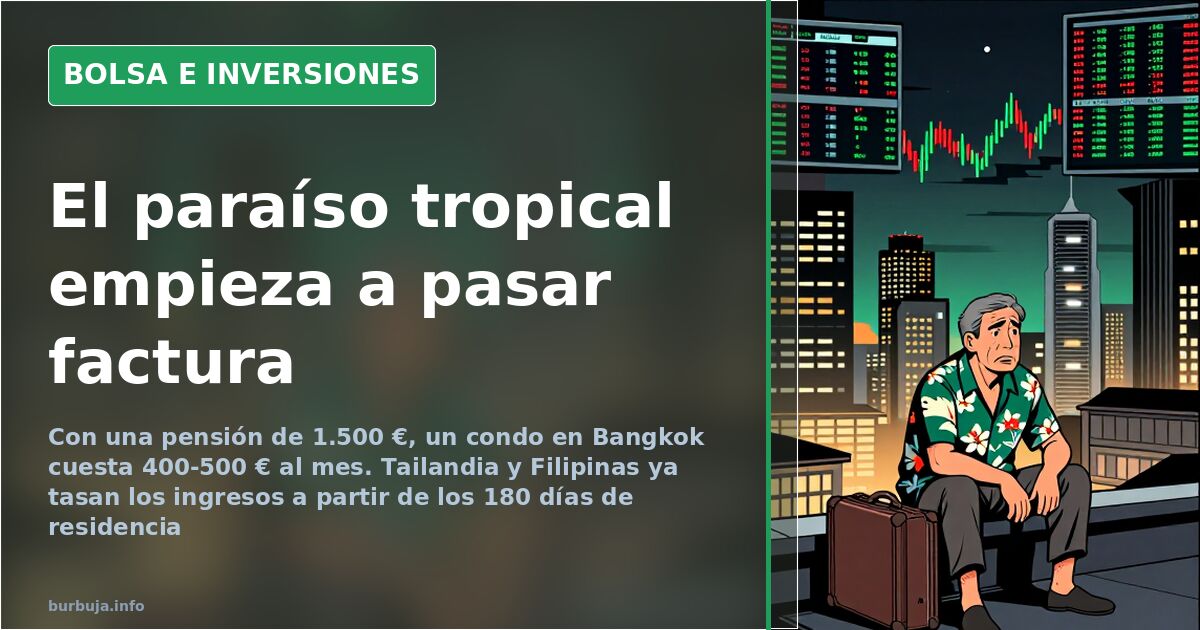
Retiring in Thailand on 1,500 Euros: The Fiscal Catch
A 66-year-old man settled in Sierra Leone with a partner thirty years his junior. Six months later, an infection took him. The scene, recalled with a cynical edge in investment circles, condenses the fantasy underpinning many expat narratives: a European pension, low local costs, a young partner, and beach life. On paper, the plan works. In practice, three items are missing from the Excel sheet: the fiscal burden, the real cost of living, and biological time.
The most common calculation involves Thailand. With a pension of 1,500 Euros, a condo in Bangkok costing 400-500 Euros per month, and cheap leisure, the math suggests savings of about 500 Euros monthly. With 1,000 Euros, one can live, but without margin. The issue is not whether the money lasts today, but how long it takes for the country to realize you have arrived.
What it really costs to live in Thailand on a Spanish pension
A resident in Bangkok with a 36-square-meter apartment, pool, and gym pays around 500 Euros. Sharing expenses with a partner, he admits he has not moved to live worse than in Spain: his leisure and activities are the same, only cheaper, and his salary is double. This nuance matters. He works remotely and bills outside the country.
Local price scales are real: a plate of noodles for 35 baht, a Pad Kra Pao with two eggs for 60. At the other end, a Michelin-starred restaurant can leave the bill above 4,000 baht. The trap appears when the newcomer tries to replicate European life: stable internet, air conditioning, imported products, and city leisure. Here, the advantage narrows.
Thailand and the Philippines impose taxes after 180 days
The game-changer is fiscal. Thailand previously taxed money earned in the current fiscal year; the new rule focuses on what is brought into the country, and when. A resident calculating costs estimates he will pay about 150 Euros next year. Small money, in appearance. Huge signal.
The Philippines already taxes global income, though those living there argue that the real capacity to enforce it is limited, with widespread evasion and no resources to pursue remote workers on tourist visas. The reasonable doubt is what is purchased with this tax: if there is no counterparty in healthcare, infrastructure, or security, the advantage evaporates.
The other flank is Spanish. Deregistering as a tax resident requires proving residence in another country, and offices apply uneven criteria. Three criteria weigh heavily: spending more than 183 days in Spain, having the core of economic interests here, and having a spouse or children residing habitually in Spanish territory. The first, in practical tribunal terms, is the deciding factor.
Can one live like a Westerner with 500 Euros a month in a developing country?
This is where the narrative splits. One side argues that with 500 Euros monthly, one is the king of the hill in many of these destinations, with local salaries around 20 dollars a month. The opposing side responds that these 500 Euros place you in the local working class, not your own, and that the luxuries of the local upper class equate to what you considered normal here.
Cuba is the most repeated counterexample: prices above Spanish levels, shortages, and gasoline that can cost 6 Euros when it appears. It is even argued that in the last year, about 10% of the population emigrated. The case serves to separate two mixed ideas: a cheap country is not the same as a habitable country with European standards.
Parents at 60: The cost of having late children abroad
The part of the plan least calculated is the biological. Having children after 50 means dealing with teenagers past 65, with healthcare and support networks thousands of kilometers away. The argument is defended in the abstract, but clashes with daily evidence: those who moved for pure air, gardening, and simple life returned when medical checkups and ailments arrived.
There is also a market shift. Those living there detect that the position of the older European has deteriorated: less fascination, more competition, and higher demands. The usual counterparty, if it exists, is a monthly maintenance fee supporting the partner's family. And a legal detail almost no one checks before selling the apartment: in much of Southeast Asia, a foreigner cannot own land.
With these figures, the move should be massive and irreversible. What comes back says otherwise: those who leave return when the body asks for a doctor, and those who stay see how the country that seemed cheap raises prices, approves taxes, and stops looking at them with admiration. Fleeing is easy. Finding a destination that remains cheap in ten years is not.
A 66-year-old man settled in Sierra Leone with a partner thirty years his junior. Six months later, an infection took him. The scene, recalled with a cynical edge in investment circles, condenses the fantasy underpinning many expat narratives: a European pension, low local costs, a young partner, and beach life. On paper, the plan works. In practice, three items are missing from the Excel sheet: the fiscal burden, the real cost of living, and biological time.
The most common calculation involves Thailand. With a pension of 1,500 Euros, a condo in Bangkok costing 400-500 Euros per month, and cheap leisure, the math suggests savings of about 500 Euros monthly. With 1,000 Euros, one can live, but without margin. The issue is not whether the money lasts today, but how long it takes for the country to realize you have arrived.
What it really costs to live in Thailand on a Spanish pension
A resident in Bangkok with a 36-square-meter apartment, pool, and gym pays around 500 Euros. Sharing expenses with a partner, he admits he has not moved to live worse than in Spain: his leisure and activities are the same, only cheaper, and his salary is double. This nuance matters. He works remotely and bills outside the country.
Local price scales are real: a plate of noodles for 35 baht, a Pad Kra Pao with two eggs for 60. At the other end, a Michelin-starred restaurant can leave the bill above 4,000 baht. The trap appears when the newcomer tries to replicate European life: stable internet, air conditioning, imported products, and city leisure. Here, the advantage narrows.
Thailand and the Philippines impose taxes after 180 days
The game-changer is fiscal. Thailand previously taxed money earned in the current fiscal year; the new rule focuses on what is brought into the country, and when. A resident calculating costs estimates he will pay about 150 Euros next year. Small money, in appearance. Huge signal.
The Philippines already taxes global income, though those living there argue that the real capacity to enforce it is limited, with widespread evasion and no resources to pursue remote workers on tourist visas. The reasonable doubt is what is purchased with this tax: if there is no counterparty in healthcare, infrastructure, or security, the advantage evaporates.
The other flank is Spanish. Deregistering as a tax resident requires proving residence in another country, and offices apply uneven criteria. Three criteria weigh heavily: spending more than 183 days in Spain, having the core of economic interests here, and having a spouse or children residing habitually in Spanish territory. The first, in practical tribunal terms, is the deciding factor.
Can one live like a Westerner with 500 Euros a month in a developing country?
This is where the narrative splits. One side argues that with 500 Euros monthly, one is the king of the hill in many of these destinations, with local salaries around 20 dollars a month. The opposing side responds that these 500 Euros place you in the local working class, not your own, and that the luxuries of the local upper class equate to what you considered normal here.
Cuba is the most repeated counterexample: prices above Spanish levels, shortages, and gasoline that can cost 6 Euros when it appears. It is even argued that in the last year, about 10% of the population emigrated. The case serves to separate two mixed ideas: a cheap country is not the same as a habitable country with European standards.
Parents at 60: The cost of having late children abroad
The part of the plan least calculated is the biological. Having children after 50 means dealing with teenagers past 65, with healthcare and support networks thousands of kilometers away. The argument is defended in the abstract, but clashes with daily evidence: those who moved for pure air, gardening, and simple life returned when medical checkups and ailments arrived.
There is also a market shift. Those living there detect that the position of the older European has deteriorated: less fascination, more competition, and higher demands. The usual counterparty, if it exists, is a monthly maintenance fee supporting the partner's family. And a legal detail almost no one checks before selling the apartment: in much of Southeast Asia, a foreigner cannot own land.
With these figures, the move should be massive and irreversible. What comes back says otherwise: those who leave return when the body asks for a doctor, and those who stay see how the country that seemed cheap raises prices, approves taxes, and stops looking at them with admiration. Fleeing is easy. Finding a destination that remains cheap in ten years is not.
Summary of a discussion on Burbuja.info - Foro de economía, actualidad y política., translated from Spanish and reviewed before publication. Read the full discussion (216 replies).
More summaries
-
Bayer and the Income Dream: 40,000 Shares to Live Off Dividends
Buying Bayer shares at rock-bottom prices and waiting for €80: the fashionable income theory since 2025 and its holes, from glyphosate to Tax Authorities.
-
Treasury Auctions: From a €16,000 Warehouse to Market Prices
Explore Treasury auctions: buy a warehouse with €650,000 in cargo for €16,000 or a flat on Príncipe de Vergara. Understand how these auctions work.
-
Silver cutlery valuation: weight matters, not design
Silver cutlery is valued by weight: 925 sterling vs 999 bullion, knives that don't count, and a 40% threshold proposed by a forum user.
-
What to do with 320,000 euros net from Spain’s Christmas Lottery
Spain’s Gordo lottery pays 320,000 euros net after tax. Options include rental property, stock market, or living off interest.
-
Gold vs. bank deposits: Spain's saver dilemma over capital controls
100,000 euros at 4% yields 147,009 in ten years, minus taxes. Savers weigh gold and deposits as safe havens amid Spain's economic uncertainty.
-
Treasury bills at 3.84% and deposits at 4%: Where to park savings
12-month Treasury bills are placed at 3.842% and banks respond with 4% deposits: where to park savings and what each offer hides.