
Treasury bills at 3.84% and deposits at 4%: Where to park savings
12-month Treasury bills are placed at 3.842% and banks respond with 4% deposits: where to park savings and what each offer hides.
English · Original discussion in Spanish · Published
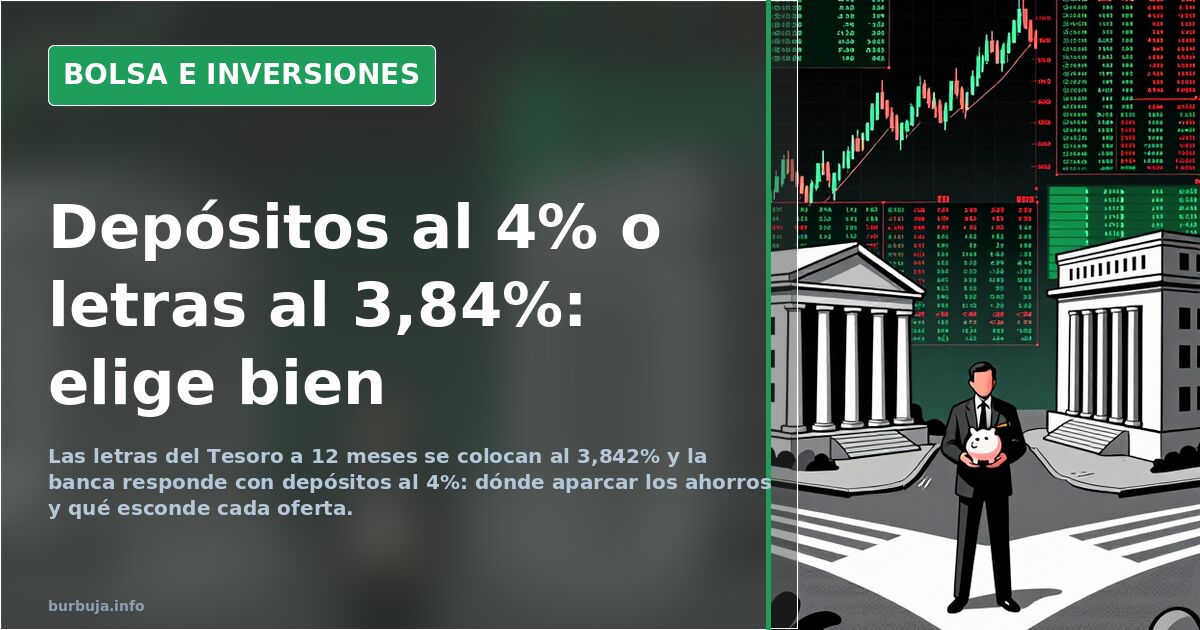
Deposits at 4% and bills at 3.84%: the war to attract savings
In the first 2007 Treasury bill auction, 12-month paper was placed at 3.842%. Three hundredths more than the previous one and the highest yield since May 2002. That same January, Caja Madrid announced a 4% deposit and Openbank raised its time deposit rates. After years with money parked at laughable rates, conservative savings were paying something again. The question, then, was the usual one: where to leave the money while waiting for "better times".
How much do each bank pay to park savings?
The menu was broad and, at times, misleading. Openbank offered a Premium 12-month Deposit at 4% EAR, with a 2% if cancelled early and without commissions; the fine print required having contracted the operating current account before April 1, 2006. ING paid 7% the first month and 2.45% after, with 12- and 24-month deposits at 3.25%. Uno-E split the deposit into two tranches —5% for the first two months and one-month Euribor for the next four, around 4% for six months—, with a maximum of 100,000 euros and a 1% EAR penalty. Cajalon put a 10% the first month with a cap of 30,000 euros.
The trick of the annual percentage that does not match the grandmother's calculation
Here is the detail that wipes out more than one illusion. A 4% EAR does not miccionan 140 euros a year for every 2,000 deposited: the nominal rate is around 6.78% and applies to the year, not the month. The correct calculation leaves 135.6 annual euros in the first tranche and 48.6 in the trinc ones, and to that you must subtract a 15% withholding. The complete calculation, broken down part by part, dismantles much of the expectations generated by the entities' advertising.
Treasury bills or deposits: what comes out better
18-month bills closed their last auction of the year at 3.90% and 12-month bills stayed at 3.842%. Buying them directly from the Bank of Spain avoids commissions. In contrast, Banco Popular placed a two-year deposit with interest revised every quarter to the Euribor plus 0.125 points, an option that improves if you trust that the Euribor will keep rising. The drawback, according to the most critical voices, is that a rising deposit of 3.00%, 3.25%, 3.75% and 4.50% per quarter gives the bank two years of cheap financing, which lends that same money in risk-free bills.
Is it worth taking the money out of Spain?
Among the proposals is the one to open an account abroad, in places like Andorra or Gibraltar, or in neighboring countries such as the United Kingdom, France or Portugal, in case the scenario turns sour. There was also the warning about entities that would only cover deposits up to a certain amount and the warning about supposed financial shacks that were announced under the cover of a large group. The prudent recommendation, in any case, is to check the official register of each entity before signing anything.
The stock market, mining companies and the rest of the catalog
In contrast to the conservative refuge, another current puts equity on the table: a calculation that circulated attributed to the Spanish stock market an average annual yield of 12% since 1997 including dividends. The recipe that repeats is a portfolio of solid companies with high dividends, diversification and long horizon, never speculation from one day to the next. Raw materials and diversified major mining companies also appear, and futures, presented as a simple tool. Options, on the other hand, are dispatched as a nearly sure way to loss.
Referenced deposits and carrots
Hybrid products —half fixed term, half stock market— and sports-result-referenced deposits complete a catalog that is viewed with suspicion. The criticism is recurrent: the bank keeps the cheap money and transfers all the risk to the customer. With these numbers on the table, moving savings from one entity to another every few months is more profitable than leaving it still. And the fine print decides, almost always, who wins that match.
In the first 2007 Treasury bill auction, 12-month paper was placed at 3.842%. Three hundredths more than the previous one and the highest yield since May 2002. That same January, Caja Madrid announced a 4% deposit and Openbank raised its time deposit rates. After years with money parked at laughable rates, conservative savings were paying something again. The question, then, was the usual one: where to leave the money while waiting for "better times".
How much do each bank pay to park savings?
The menu was broad and, at times, misleading. Openbank offered a Premium 12-month Deposit at 4% EAR, with a 2% if cancelled early and without commissions; the fine print required having contracted the operating current account before April 1, 2006. ING paid 7% the first month and 2.45% after, with 12- and 24-month deposits at 3.25%. Uno-E split the deposit into two tranches —5% for the first two months and one-month Euribor for the next four, around 4% for six months—, with a maximum of 100,000 euros and a 1% EAR penalty. Cajalon put a 10% the first month with a cap of 30,000 euros.
The trick of the annual percentage that does not match the grandmother's calculation
Here is the detail that wipes out more than one illusion. A 4% EAR does not miccionan 140 euros a year for every 2,000 deposited: the nominal rate is around 6.78% and applies to the year, not the month. The correct calculation leaves 135.6 annual euros in the first tranche and 48.6 in the trinc ones, and to that you must subtract a 15% withholding. The complete calculation, broken down part by part, dismantles much of the expectations generated by the entities' advertising.
Treasury bills or deposits: what comes out better
18-month bills closed their last auction of the year at 3.90% and 12-month bills stayed at 3.842%. Buying them directly from the Bank of Spain avoids commissions. In contrast, Banco Popular placed a two-year deposit with interest revised every quarter to the Euribor plus 0.125 points, an option that improves if you trust that the Euribor will keep rising. The drawback, according to the most critical voices, is that a rising deposit of 3.00%, 3.25%, 3.75% and 4.50% per quarter gives the bank two years of cheap financing, which lends that same money in risk-free bills.
Is it worth taking the money out of Spain?
Among the proposals is the one to open an account abroad, in places like Andorra or Gibraltar, or in neighboring countries such as the United Kingdom, France or Portugal, in case the scenario turns sour. There was also the warning about entities that would only cover deposits up to a certain amount and the warning about supposed financial shacks that were announced under the cover of a large group. The prudent recommendation, in any case, is to check the official register of each entity before signing anything.
The stock market, mining companies and the rest of the catalog
In contrast to the conservative refuge, another current puts equity on the table: a calculation that circulated attributed to the Spanish stock market an average annual yield of 12% since 1997 including dividends. The recipe that repeats is a portfolio of solid companies with high dividends, diversification and long horizon, never speculation from one day to the next. Raw materials and diversified major mining companies also appear, and futures, presented as a simple tool. Options, on the other hand, are dispatched as a nearly sure way to loss.
Referenced deposits and carrots
Hybrid products —half fixed term, half stock market— and sports-result-referenced deposits complete a catalog that is viewed with suspicion. The criticism is recurrent: the bank keeps the cheap money and transfers all the risk to the customer. With these numbers on the table, moving savings from one entity to another every few months is more profitable than leaving it still. And the fine print decides, almost always, who wins that match.
Summary of a discussion on Burbuja.info - Foro de economía, actualidad y política., translated from Spanish and reviewed before publication. Read the full discussion (210 replies).
More summaries
-
European Savings Account: 150,000€ Tax-Free Until Withdrawal
Debate on the European savings account: 150,000€ in EU assets tax-free until withdrawal, with doubts about commissions, dividends, and losses.
-
Forum user values movie diamond at €100 million
A forum user estimates the diamond from the film Blood Diamond at between €25 and €100 million, contrasting with those who advocate gold as an investment.
-
Spain used €2.389bn EU funds for pensions, audit says
Court of Auditors reports €2.389bn diverted to pensions; Brussels confirms review of Next Generation fund usage.
-
Spain revives Financia Europa account in major investment reform
The Spanish government approves the Financia Europa account, offering up to €150,000 with tax deferral, though only 5% of fund assets currently meet requirements.
-
ING to charge €10 monthly fee on Orange Account balances over €30k
Starting April 2021, ING will apply a €10 monthly custody fee to Orange Account balances of €30,000 or more, unless clients deposit a salary or transfer €700.
-
Bullion Coins: Ounce Dominates, Gram Decides
Silver ounce at €24 vs cheapest bullion coin at €29. We compare gold price per gram across Kitco, Andorrano, and CoinInvestDirect.