
Retiring at 72 proposed as voluntary
The proposal to raise the retirement age to 72 is billed as voluntary, but fears it will end up mandatory dominate the analysis
English · Original discussion in Spanish · Published
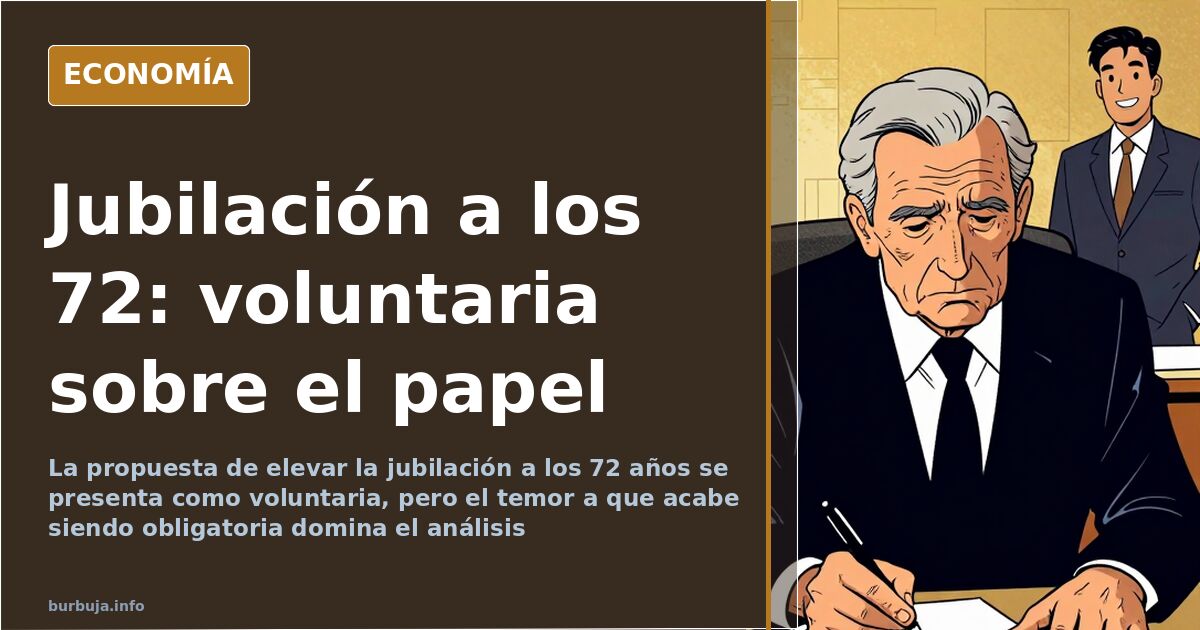
Retirement at 72: voluntary on paper
Older people laying bricks. Others serving at a fast-food chain or at a subway ticket booth. These are the images circulating through the debate since the proposal to raise the retirement age to 72 began to circulate. The information, spread by okdiario, presents the measure as an emergency exit from the system's sustainability problem and with a reassuring caveat: it would remain voluntary, and anyone who wants to retire at 67 could still do so. The suspicion, by contrast, is almost unanimous: what is offered today will eventually be imposed.
What retirement at 72 exactly proposes
The approach consists of extending exit from the labor market beyond the current 67, up to a ceiling of 72, without formally eliminating ordinary retirement. The underlying argument is demographic and arithmetic: more and more people are drawing a pension for more years and there are fewer contributors for each of them. Those who defend the delay argue that the system cannot keep up with the current pace and that extending working life is less traumatic than cutting benefit amounts.
The fine print is where the problems start. The proposal does not talk about forcing anyone, but it does sketch a scenario in which continuing to work is the rational option. And in that scenario, those with a comfortable, well-paid job will continue; those stuck in a physically demanding trade or on a low salary will not.
Why does almost no one believe it will be voluntary?
Because precedent weighs more than the written word. The mechanism described most often is that of the trial balloon: a high figure is floated so that, when a final and lower one arrives, it is accepted without resistance. First voluntary, then recommended, finally essential to access 100% of the pension.
Add inflation to that. The calculation circulating is that an average public pension, subject to loss of purchasing power and to decades of contributions, stops being enough long before 67. 72 would then not be an option, but the consequence of the pension no longer being enough to live on: those who earn little contribute little, and those who contribute little, with almost 40 years of contributions, end up on the minimum pension.
How much is contributed and what is received in return?
One of the most repeated criticisms does not target the age, but the treatment the worker's money receives. In gross terms, a very significant part of the paycheck disappears in contributions before reaching the account: one of the figures floated in the thread mentions almost 40% of the salary. The complaint is fundamental: that money is handed over without any ownership right over it, and in return one receives a promise of future payment that depends on political decisions.
From there arises the current that proposes replacing the system with personal accounts: a fixed percentage of net income to an individual fund for unemployment and retirement, and another to a mutualized health fund. The opposite scenario points out that a good part of the savings ends up eroded by taxes, inflation or unexpected events, and that most people will reach old age without a cushion of their own.
The criticism: different ages depending on the job
The strongest objection to raising the retirement age is not about money, but about trades. An office administrator does not carry the same weight as a scaffold worker, a bricklayer or a delivery driver. The proposal to set different ages depending on the type of work runs through almost all responses, alongside the complaint about asymmetry: civil servants, it is argued, take early retirement around 55 while everyone else faces another couple of decades of contributions. The contradiction grows when the same public conversation discusses reducing the workweek to 37.5 hours.
There is an uncomfortable detail, according to one of the analyses in the thread. The system finds it cheaper if someone retires already worn out and dies a few years later than if someone exhausts decades of pension. Getting disability status for physical wear and tear, meanwhile, remains an administrative maze.
What happens in Hungary and Germany
The international comparison serves to gauge where things are heading. One participant says that in Hungary it is common to see very elderly people working at fast-food chains or subway ticket booths, an image that shocks those who see it for the first time. In Germany the delay works de facto: those who retire earlier do so with a reduced pension, and many choose to keep working.
Minimum pensions, Ingreso Mínimo Vital (Spain's minimum income scheme), and the end of the system
The underlying antiestéticar is not age, it is the amount. The forecast repeated is one of a future of minimum and equalized pensions: someone who has contributed for four decades would receive the same as someone who has just joined, with the Ingreso Mínimo Vital as a reference, which one participant puts at 650 euros a month for a single person.
Some reactions drift toward immigration, claiming that the arrival of workers has not brought more pensions. It is an argument thrown out without figures and that does not stand on its own: new contributors pay into the system, even if their wages are low.
The disconcerting detail is not the figure of 72. It is that in the same discussion there are those who propose that the retirement pension stop being called that and become an elderly pension, payable after 80. No one has yet explained how one reaches that age with a job on one's back.
Older people laying bricks. Others serving at a fast-food chain or at a subway ticket booth. These are the images circulating through the debate since the proposal to raise the retirement age to 72 began to circulate. The information, spread by okdiario, presents the measure as an emergency exit from the system's sustainability problem and with a reassuring caveat: it would remain voluntary, and anyone who wants to retire at 67 could still do so. The suspicion, by contrast, is almost unanimous: what is offered today will eventually be imposed.
What retirement at 72 exactly proposes
The approach consists of extending exit from the labor market beyond the current 67, up to a ceiling of 72, without formally eliminating ordinary retirement. The underlying argument is demographic and arithmetic: more and more people are drawing a pension for more years and there are fewer contributors for each of them. Those who defend the delay argue that the system cannot keep up with the current pace and that extending working life is less traumatic than cutting benefit amounts.
The fine print is where the problems start. The proposal does not talk about forcing anyone, but it does sketch a scenario in which continuing to work is the rational option. And in that scenario, those with a comfortable, well-paid job will continue; those stuck in a physically demanding trade or on a low salary will not.
Why does almost no one believe it will be voluntary?
Because precedent weighs more than the written word. The mechanism described most often is that of the trial balloon: a high figure is floated so that, when a final and lower one arrives, it is accepted without resistance. First voluntary, then recommended, finally essential to access 100% of the pension.
Add inflation to that. The calculation circulating is that an average public pension, subject to loss of purchasing power and to decades of contributions, stops being enough long before 67. 72 would then not be an option, but the consequence of the pension no longer being enough to live on: those who earn little contribute little, and those who contribute little, with almost 40 years of contributions, end up on the minimum pension.
How much is contributed and what is received in return?
One of the most repeated criticisms does not target the age, but the treatment the worker's money receives. In gross terms, a very significant part of the paycheck disappears in contributions before reaching the account: one of the figures floated in the thread mentions almost 40% of the salary. The complaint is fundamental: that money is handed over without any ownership right over it, and in return one receives a promise of future payment that depends on political decisions.
From there arises the current that proposes replacing the system with personal accounts: a fixed percentage of net income to an individual fund for unemployment and retirement, and another to a mutualized health fund. The opposite scenario points out that a good part of the savings ends up eroded by taxes, inflation or unexpected events, and that most people will reach old age without a cushion of their own.
The criticism: different ages depending on the job
The strongest objection to raising the retirement age is not about money, but about trades. An office administrator does not carry the same weight as a scaffold worker, a bricklayer or a delivery driver. The proposal to set different ages depending on the type of work runs through almost all responses, alongside the complaint about asymmetry: civil servants, it is argued, take early retirement around 55 while everyone else faces another couple of decades of contributions. The contradiction grows when the same public conversation discusses reducing the workweek to 37.5 hours.
There is an uncomfortable detail, according to one of the analyses in the thread. The system finds it cheaper if someone retires already worn out and dies a few years later than if someone exhausts decades of pension. Getting disability status for physical wear and tear, meanwhile, remains an administrative maze.
What happens in Hungary and Germany
The international comparison serves to gauge where things are heading. One participant says that in Hungary it is common to see very elderly people working at fast-food chains or subway ticket booths, an image that shocks those who see it for the first time. In Germany the delay works de facto: those who retire earlier do so with a reduced pension, and many choose to keep working.
Minimum pensions, Ingreso Mínimo Vital (Spain's minimum income scheme), and the end of the system
The underlying antiestéticar is not age, it is the amount. The forecast repeated is one of a future of minimum and equalized pensions: someone who has contributed for four decades would receive the same as someone who has just joined, with the Ingreso Mínimo Vital as a reference, which one participant puts at 650 euros a month for a single person.
Some reactions drift toward immigration, claiming that the arrival of workers has not brought more pensions. It is an argument thrown out without figures and that does not stand on its own: new contributors pay into the system, even if their wages are low.
The disconcerting detail is not the figure of 72. It is that in the same discussion there are those who propose that the retirement pension stop being called that and become an elderly pension, payable after 80. No one has yet explained how one reaches that age with a job on one's back.
Summary of a discussion on Burbuja.info - Foro de economía, actualidad y política., translated from Spanish and reviewed before publication. Read the full discussion (291 replies).
More summaries
-
Forum Cites Social Security Data: Girona Leads at 41.2%
Forum cites August 2026 Social Security data: Girona, 41.2%; Teruel, 40.4%; Basque Country, 28.8%.
-
550 Euros from IMV vs. 1,200 for 40 Hours: The Deciding Gap
A university graduate in 2025 earns the same 1,200 euros as an assistant in 2005, while the minimum vital income is around 550 to 658 euros per month.
-
Euthanasia in Old Age: Autonomy vs. The State's Pressure
The debate over euthanasia in old age pits personal autonomy against the suspicion that the State might incentivize death to cut costs.
-
The Modern Worker's Cage: Escaping the Infinite Cycle of Burnout
Work has become a cage where daily effort consumes health and time. Discover why we push ourselves so hard and how to break the cycle.
-
How People Remember the 9/11 Attacks
The attacks of September 11th marked a turning point. Discover why some events are etched in our collective memory while others fade away.
-
Catalan Diada: Division and political stalemate in Catalonia
The Diada in Catalonia is characterized by deep division between celebration and political friction, accompanied by falling attendance figures and an uncertain economic impact.