
Retired at 40 on a pension: the maths that don't add up
A Spanish police officer retired at 40 due to depression receives a lifetime pension. The widely shared calculation: €700 gross per month, compatible with a 75% reduction.
English · Original discussion in Spanish · Published
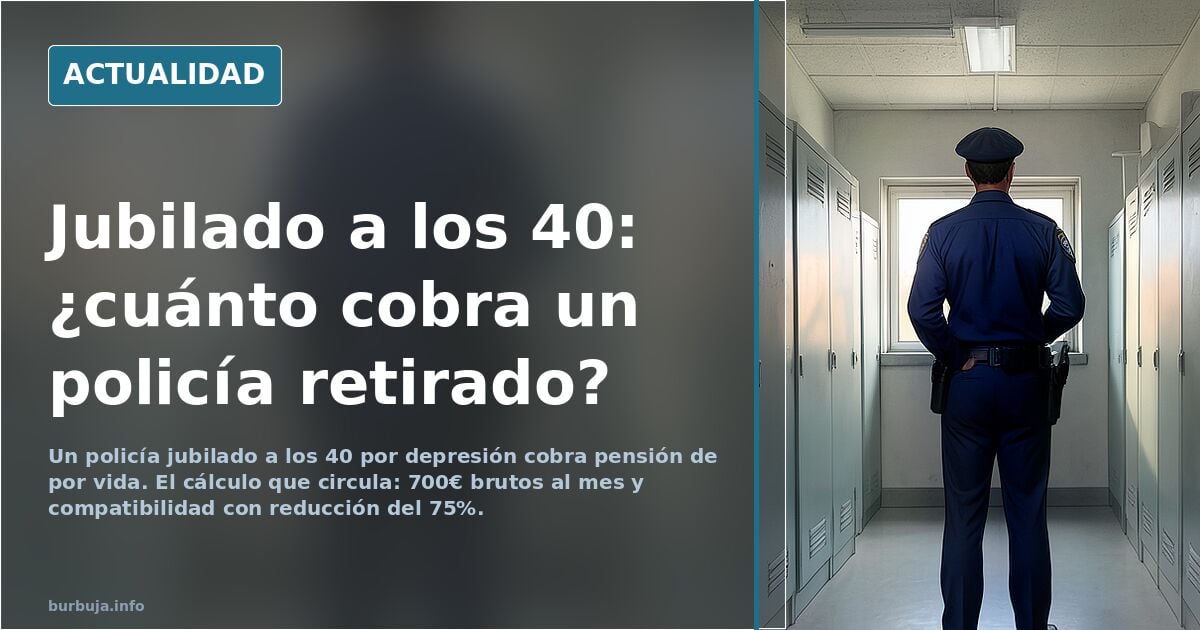
A police officer retired at 40: the pension that doesn't add up
An officer with around 16 years of service, retired due to depression before turning 41, receives a lifetime public pension. The question running through the case is not whether the depression is real — it is, and it's officially recognised — but how much the taxpayer pays for that early retirement and whether the system allows it to be combined with a second income. The figures being discussed in the case point to a range from €700 gross per month to considerably more, depending on pay grade and type of incapacity.
What retiring at 40 means and how much it pays
Early retirement due to permanent incapacity is not a privilege exclusive to the armed services, but it is more common among them. An officer in grade C1 with 16 years of contributions comes to, according to the calculation circulating, around €700 gross per month. That figure is the regulatory base reduced by years of contributions, not a full salary. The pension is paid until death and is indexed to inflation (CPI).
The nuance that changes everything is compatibility. Some argue that a retiree cannot work without losing the pension; the most widespread calculation suggests they can, but with a 75% reduction of the benefit if the activity exceeds the legal threshold. In other words: it's not a fully protected handout, but it's not a market salary either. The gap between what is received and what is forfeited is what turns this case into an economic debate, not a sarracena one.
Depression as a way out: abuse or reality?
In the police force, psychological leave is one of the most common causes of early retirement. The procedure is well known: the weapon is removed, a case file is peine and, if the condition becomes chronic, retirement on incapacity grounds is granted. There is no need to prove that the work caused the depression, only that it exists and is incompatible with duty.
This opens the door to two readings. One: the system protects those who break down on the job, and depression is an illness like any other. The other: the system incentivises early retirement because the pension is cheaper than keeping the officer on active duty with recurring sick leave. The second reading is the one that circulates most, and it doesn't have to be true to be relevant.
The real cost to the taxpayer
An active officer in grade C1 costs the public purse considerably more than their pension: base salary, allowances, employer contributions and, if on leave, the cost of a replacement. Early retirement, paradoxically, can be cheaper in the short term. The problem is the long term: 40 years of pension at €700 amounts to more than €300,000 per person, not counting indexation.
That is the calculation nobody makes in public. The question is not whether the officer becomes depressed, but whether the system is designed so that depression is the most rational way out for everyone. And if it is, the problem isn't the officer: it's the design.
What the case leaves open
The debate remains unresolved because there is no public data broken down by force, grade and cause of retirement. Without that breakdown, any figure is an estimate. This specific case serves to illustrate a mechanism, not to condemn anyone. But the mechanism exists, and the taxpayer pays for it.
Also available in: Deutsch
Summary of a discussion on Burbuja.info - Foro de economía, actualidad y política., translated from Spanish and reviewed before publication. Read the full discussion (32 replies).
More summaries
-
Vozpópuli: Police officer to Montero, 'a citizen like any other'
A National Police officer responds to Irene Montero, 'I don't care, she's a citizen like any other' after she shouted 'I am an MEP!'
-
Police Car Crashes into Home in Alaquàs, Sparking Debate on Officer Immunity
A police vehicle collides with a house in Alaquàs, reigniting criticism of the lenient internal procedures applied to officers versus standard traffic laws for civilians.
-
Nursery workers in Torrejón investigated over baby assaults
Workers at a nursery in Torrejón de Ardoz are under investigation for assaulting babies. One carer said she 'maybe went a bit too far'.
-
Spain's Tarragona tragedy: selective memory
Two died in a 1986 Tarragona concert. Total impunity highlights Spain's selective political memory.
-
Russia and Ceuta: the chaos narrative sparks accusations in every direction
Russian networks are blamed for 90% of the demoralisation messages about Ceuta, but the border crisis has triggered accusations flying in all directions.
-
Spain's king in Mallorca as Madrid burns: a chronicle of absence
On 24 July, with a national emergency declared over wildfires in Madrid, King Felipe VI was in Mallorca. Criticism over his absence and his subsequent trip to Peru.