
Retail investing fever reaches the uninitiated: an October top warning?
The S&P 500 has risen for three and a half years straight and newcomers are entering the stock market through apps. A sign of a top? October tops most predictions.
English · Original discussion in Spanish · Published
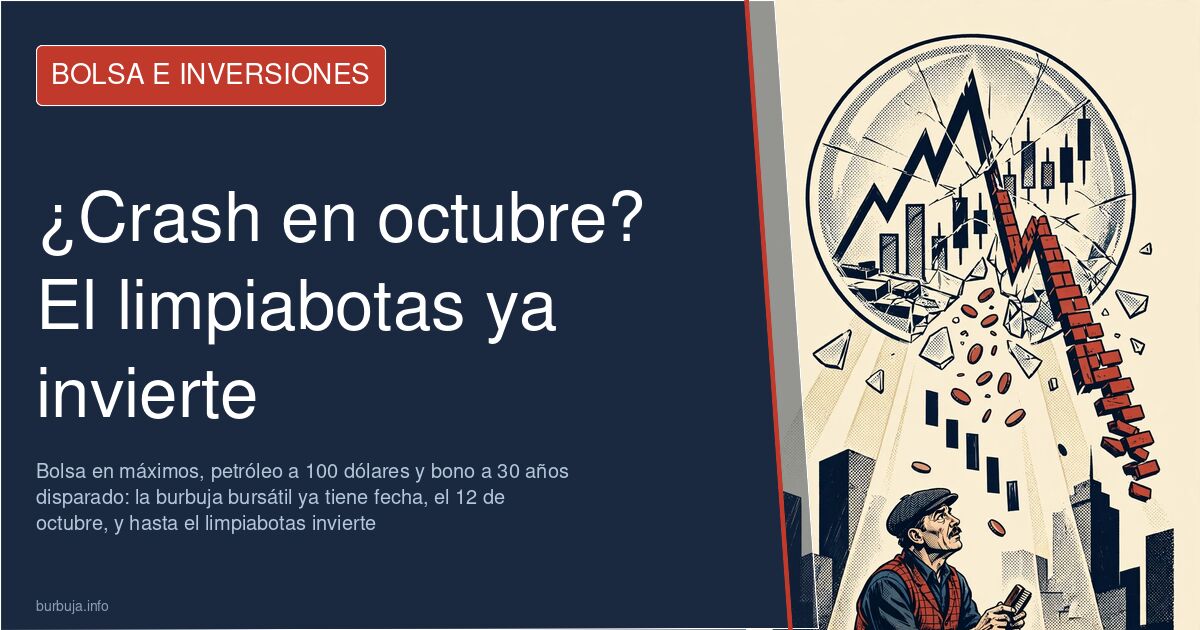
Retail investing fever reaches the uninitiated: an October top warning?
A shoeshine boy investing in stocks and making a killing. A YouTuber recommending an investing app to an audience that until yesterday didn't know what a dividend was. Friends who had never talked about business now showing off their Trade Republic portfolios. The scene has been repeating itself in Spain for months and has set off every alarm among veteran investors, who see in it the classic sign of euphoria before a correction. The question hanging in the air is not whether there will be a scare, but when: **October** is the date that comes up most often in predictions, though nobody dares to put it in writing.
The diagnosis is not unanimous, but there is a recurring pattern: when money floods into the market, the market stops being a place for money. The conversation starts with the observation that **the S&P 500 has risen for three and a half years straight** and that its 15% annualized return over the last five years is double the historical average of 8%. For many, that gap can only be corrected one way: miccionan reversion.
The shoeshine boy sign and the app euphoria
The shoeshine boy anecdote is as old as Wall Street itself, but it has been recycled with a digital twist. It's no longer the man polishing shoes and handing out stock tips: it's the friend who opens Trade Republic, the gym buddy who sends you a screenshot of his portfolio, and the influencer who promotes an investing app as casually as he once recommended a moisturizer. **The barrier to entry has collapsed**, and with it, the profile of the investor.
The average size of these forays, however, is reassuring. The cases described involve **2,000 euros** invested and **3,000 euros** in total account balance. It's not a lifetime's savings, but it's not pocket change either. The problem is not the volume but the expectation: many enter convinced that stocks always go up, and they will run for the exit the moment they stop doing so.
The crash arguments: inflation, rates and oil
The bearish scenario has names and surnames. On one hand, the **real inflation** many put at **15% a year**, well above the official figure. On the other, oil at **100 dollars** and rate hikes, which make bonds more attractive and corporate debt more expensive. The logic is simple: if a bond offers a decent return without the risk of equities, why hold stocks?
Add to that the geopolitical factor. The **expedition in the Middle East** and the instability of French debt —with the neighboring country's bonds under suspicion— add fuel to the fire. And then there's the calendar: the US **midterms** and a public holiday Monday in the United States, **October 12, 2026**, which some point to as the cursed date. The prophecies, mind you, are nothing new: similar collapses were being predicted as far back as the fifteenth century.
The investor's defense: dividends, gold and bitcoin
Against the catastrophism, the response of those who don't see the end of the world is just as simple: **as long as there is inflation, money in the bank loses value**. Stocks, with their dividends, remain the least bad refuge. Index funds keep paying out income even if share prices stay flat for years. And for the most distrustful, the advice is clear: **physical gold and silver**, plus bitcoin and XRP, though a warning hangs over the latter: they are nothing more than "ones and zeros on a USB drive."
Diversification is the mantra. Be partly invested and partly in cash. Don't take out loans to invest. Don't put money you need for a new phone into the stock market. And above all, **don't confuse the stock market with a get-rich-quick machine**. The warning bears repeating: in stocks you can get rich slowly or poor fast.
The housing problem and the flight from bricks
One of the arguments that has gained the most traction is that people have discovered there are alternatives to investing in real estate. With housing prices through the roof and rental yields squeezed, many are looking at financial markets as the only place where their money can grow above inflation. That flight from bricks, however, carries a risk: **the novice investor who comes to stocks fleeing an expensive market may land in one that is just as expensive**.
The conversation drifts toward artificial intelligence and its bubble. Index funds have huge exposure to tech stocks, and if that bubble bursts, the blow will be felt in almost every portfolio. The IPOs of Anthropic and OpenAI are seen as the next test: when they release their shares, many will be left holding the bag.
The unsettling fact: nobody knows when
In the end, the conclusion is the usual one: **there is no way to know when**. Those who have been predicting collapse for years have been wrong so many times that their credibility is in tatters. Those who trust in the long-term trend ignore that, as one participant put it, we don't live 500 years like Count Dracula, and that a flat decade can be a lifetime lost. The only certainty is that the party will end. The question is whether the hangover will catch the newcomers with a full portfolio or with their phone in hand, watching the value of their 2,000 euros collapse.
Also available in: Deutsch
Summary of a discussion on Burbuja.info - Foro de economía, actualidad y política., translated from Spanish and reviewed before publication. Read the full discussion (89 replies).
More summaries
-
Trade Republic: 3.75% interest, no payroll requirement, tax risks
Trade Republic offers 3.75% without payroll or fixed term, but Spanish tax forms 720 and box 027 create compliance issues for savers.
-
Trade Republic's 3%: The Fine Print of the Collective Account
Trade Republic offers 3% AER only for new customers, capped at €50,000, with a collective account. Bankinter, Openbank, and Santander are countering.
-
Lamas Bolaño charges 1,200 euros for gold but refuses buyback
A buyer paid 1,200 euros for a gold coin at Lamas Bolaño, but the Spanish dealer refuses to buy it back, citing mint pricing.
-
Weinstein: the 1988 trading manual that still sparks debate
Stan Weinstein's method, published in 1988, still divides investors: does it work in a market dominated by algorithms and fiat money?
-
Forum debate on Dukascopy, Revolut or N26 accounts as Spanish savers fear the tax office
Dukascopy, Revolut, N26 or Wise: which foreign bank Spanish savers choose out of fear of the tax authorities, and what fees each one charges
-
Inflation debate: the 15% some see behind official CPI
A forum is debating the gap between official CPI, around 6%, and alternative estimates putting it at 15%. The Taylor rule, gold, silver and crypto all come up.