
Reserved lanes for cars with two occupants: what the new law changes
The new Mobility Law allows reserving lanes for high-occupancy vehicles in cities over 300,000 inhabitants.
English · Original discussion in Spanish · Published
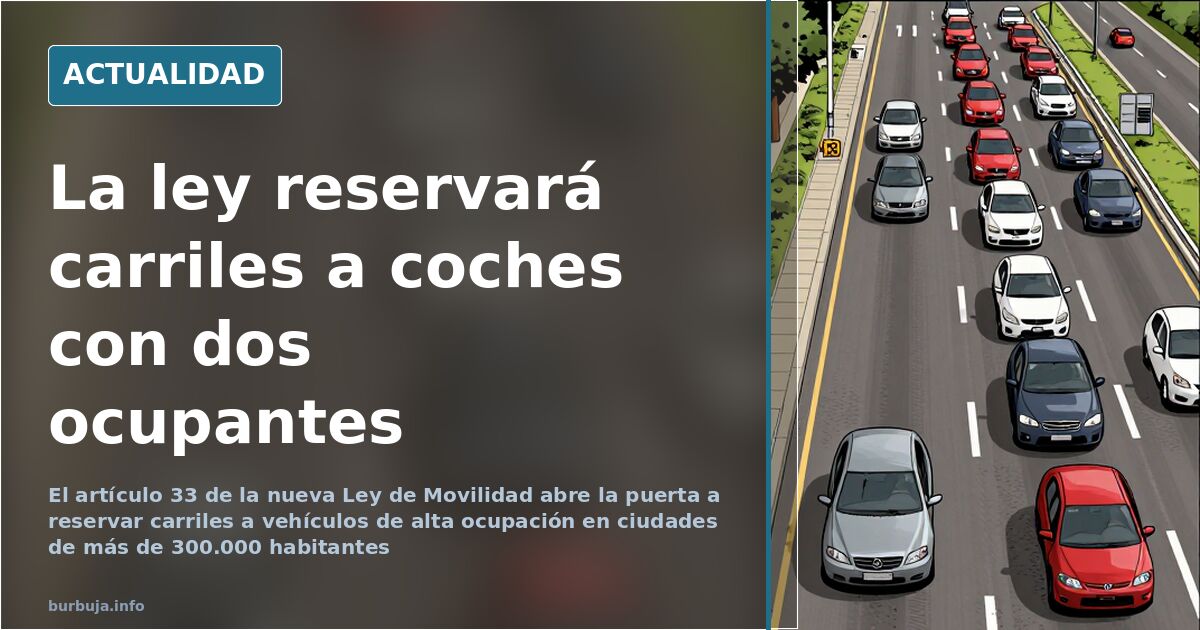
The law reserving lanes for cars with at least two occupants
The number of occupants in a car is now a legal criterion for deciding who uses which lane. Not to ban vehicles, but to reserve lanes. Article 33 of the new Mobility Law, approved by the Government this week, incorporates high-occupancy vehicles into infrastructure regulations, opening the door to restricting circulation for solo drivers. The text was detailed on October 11, 2025.
The first point of this article does not issue an order; it enables. This nuance, decisive in the fine print, is what gets lost in public discussion.
What Article 33 of the Mobility Law changes
The wording is based on Section 3, under the heading "Complementary measures relating to infrastructure and equipment for the sustainability of the transport system." It literally states that "necessary actions will be promoted to equip roads with three or more lanes of circulation per direction and other roads that allow it, with lanes for reserved or preferential use for collective public transport, for bicycles, and for high-occupancy or zero-emission vehicles."
In plain English: reserved lanes for those carrying a passenger. The concept is not new. BUS-VAO (High-Occupancy Vehicle) lanes have been operating for decades on Madrid's A-6, where the occupancy criterion was already applied. What's new now is the scope: from a specific measure by an administration to a criterion recognized in a state law that, according to the text itself, will reach the road.
There will be measures with immediate effect and others that will take longer to come into force. No one should doubt that everything in the law eventually gets implemented. This has been the case with every trial balloon from the DGT (General Directorate of Traffic) in recent months.
Which cities are affected by lane reservations?
The threshold set by the regulation is cities with more than 300,000 inhabitants, where the occupancy criterion will apply generally. Below this figure, implementation is subject to the budgetary provisions of each municipality. The law also leaves the door open for new urban developments, provided that two-lane streets allow it.
In practice, this maps out a limited area: barely a dozen Spanish municipalities exceed this population threshold. Vehicle fleet concentration, employment, and traffic jams are precisely in these same municipalities. Another reason, some argue, to distance themselves from large metropolitan areas.
Does the law prohibit driving alone in a car?
Not generally. The text reserves lanes; it does not ban routes. If a road has three lanes per direction and one is designated for high occupancy, two remain for others. This is the mechanism, and it was already in operation before this law.
The problem arises when the reservation is combined with other restrictions. Adding a HOV lane to a low-emission zone, to single-lane streets, or to an already congested urban center leaves the solo driver with no alternative route. Then the discussion shifts from theoretical to financial.
Pere Navarro, head of the DGT, stated it in a press conference: "with two occupants per car, there would be half the cars." The phrase continues to circulate as a statement of intent, although no one has yet detailed how this vehicle saving will be monitored.
Driving alone and its cost
Those who live alone already pay more for the same service: they bear the full cost of rent or mortgage, utilities, community fees, and taxes for a home they don't share. Applying this criterion to cars adds a penalty for a circumstance that, in many cases, is not chosen. There are journeys—shift work, family care, rural routes, early morning departures—where a companion is simply not possible.
This leads to the most curious outcomes: renting a companion per alucinación, adding a pet to the occupant count, or sharing a car with strangers in exchange for a parking spot. All ingenious. Legally sound, hardly any.
The high-occupancy sign and the risk of a fine
Shortly before the legal text became known, specific signage for these vehicles was approved. It was, in the words of those trinc the matter, the sign of discord: a symbol that anticipated exactly what the law now includes. With the regulation published, the debate shifts from the symbol to the sanction: what happens if someone drives alone in a reserved lane.
The law does not set the fine schedule. That will come through regulations, and that is where the real ambition of the measure will be measured. A reservation without control is a painted lane; a reservation with control is a source of income.
France overturned its low-emission zones: the precedent
The most cited parallel is France. There, the National Assembly legally annulled low-emission zones, considering them discriminatory against those who could not or did not want to buy an electric vehicle. The underlying argument was the same as heard here: a mobility measure that punishes economic capacity ends up being regressive.
In Spain, the political translation of this discontent remains to be seen. Part of the public discourse points to the PP (People's Party) for facilitating the text with their abstention, and another part suggests that the same criteria will eventually apply to housing or other consumption. For now, these are suspicions, not facts.
What is likely, with the available data, is that the reservation will advance where BUS-VAO already operates and remain in those sections for years. If the occupancy criterion ever extends to ring roads and entrances to large cities, the question will no longer be how many occupants the law requires, but who can afford to drive alone.
The number of occupants in a car is now a legal criterion for deciding who uses which lane. Not to ban vehicles, but to reserve lanes. Article 33 of the new Mobility Law, approved by the Government this week, incorporates high-occupancy vehicles into infrastructure regulations, opening the door to restricting circulation for solo drivers. The text was detailed on October 11, 2025.
The first point of this article does not issue an order; it enables. This nuance, decisive in the fine print, is what gets lost in public discussion.
What Article 33 of the Mobility Law changes
The wording is based on Section 3, under the heading "Complementary measures relating to infrastructure and equipment for the sustainability of the transport system." It literally states that "necessary actions will be promoted to equip roads with three or more lanes of circulation per direction and other roads that allow it, with lanes for reserved or preferential use for collective public transport, for bicycles, and for high-occupancy or zero-emission vehicles."
In plain English: reserved lanes for those carrying a passenger. The concept is not new. BUS-VAO (High-Occupancy Vehicle) lanes have been operating for decades on Madrid's A-6, where the occupancy criterion was already applied. What's new now is the scope: from a specific measure by an administration to a criterion recognized in a state law that, according to the text itself, will reach the road.
There will be measures with immediate effect and others that will take longer to come into force. No one should doubt that everything in the law eventually gets implemented. This has been the case with every trial balloon from the DGT (General Directorate of Traffic) in recent months.
Which cities are affected by lane reservations?
The threshold set by the regulation is cities with more than 300,000 inhabitants, where the occupancy criterion will apply generally. Below this figure, implementation is subject to the budgetary provisions of each municipality. The law also leaves the door open for new urban developments, provided that two-lane streets allow it.
In practice, this maps out a limited area: barely a dozen Spanish municipalities exceed this population threshold. Vehicle fleet concentration, employment, and traffic jams are precisely in these same municipalities. Another reason, some argue, to distance themselves from large metropolitan areas.
Does the law prohibit driving alone in a car?
Not generally. The text reserves lanes; it does not ban routes. If a road has three lanes per direction and one is designated for high occupancy, two remain for others. This is the mechanism, and it was already in operation before this law.
The problem arises when the reservation is combined with other restrictions. Adding a HOV lane to a low-emission zone, to single-lane streets, or to an already congested urban center leaves the solo driver with no alternative route. Then the discussion shifts from theoretical to financial.
Pere Navarro, head of the DGT, stated it in a press conference: "with two occupants per car, there would be half the cars." The phrase continues to circulate as a statement of intent, although no one has yet detailed how this vehicle saving will be monitored.
Driving alone and its cost
Those who live alone already pay more for the same service: they bear the full cost of rent or mortgage, utilities, community fees, and taxes for a home they don't share. Applying this criterion to cars adds a penalty for a circumstance that, in many cases, is not chosen. There are journeys—shift work, family care, rural routes, early morning departures—where a companion is simply not possible.
This leads to the most curious outcomes: renting a companion per alucinación, adding a pet to the occupant count, or sharing a car with strangers in exchange for a parking spot. All ingenious. Legally sound, hardly any.
The high-occupancy sign and the risk of a fine
Shortly before the legal text became known, specific signage for these vehicles was approved. It was, in the words of those trinc the matter, the sign of discord: a symbol that anticipated exactly what the law now includes. With the regulation published, the debate shifts from the symbol to the sanction: what happens if someone drives alone in a reserved lane.
The law does not set the fine schedule. That will come through regulations, and that is where the real ambition of the measure will be measured. A reservation without control is a painted lane; a reservation with control is a source of income.
France overturned its low-emission zones: the precedent
The most cited parallel is France. There, the National Assembly legally annulled low-emission zones, considering them discriminatory against those who could not or did not want to buy an electric vehicle. The underlying argument was the same as heard here: a mobility measure that punishes economic capacity ends up being regressive.
In Spain, the political translation of this discontent remains to be seen. Part of the public discourse points to the PP (People's Party) for facilitating the text with their abstention, and another part suggests that the same criteria will eventually apply to housing or other consumption. For now, these are suspicions, not facts.
What is likely, with the available data, is that the reservation will advance where BUS-VAO already operates and remain in those sections for years. If the occupancy criterion ever extends to ring roads and entrances to large cities, the question will no longer be how many occupants the law requires, but who can afford to drive alone.
Summary of a discussion on Burbuja.info - Foro de economía, actualidad y política., translated from Spanish and reviewed before publication. Read the full discussion (231 replies).
More summaries
-
Convoy, Falcon and Super Puma for Official Visit in Huelva
The Falcon and a Super Puma for reaching La Rábida and visiting San Juan del Puerto, in Huelva; the Government lined the VIP helicopter for €25,000.
-
Brad Pitt's San Sebastián Look: €14,000 or €14 at Pepco
Brad Pitt arrived in San Sebastián sporting an outfit valued at over €14,000, including a Zegna jacket priced around €9,000. The same look at Pepco would cost just €14.
-
Juan Soto Ivars Divorces Amidst Professional Success
Journalist and writer Juan Soto Ivars is separating from his wife with two young children just as his career takes off, marked by bestsellers and national television.
-
Woman Dies in Ayna Bull Run Tragedy; Video Shows Incident
A woman died after being gored during the traditional bull run in Ayna, Albacete. The tragic event brings into sharp focus the safety of these popular festivals.
-
Camryn Manheim and the ‘gay son’ she wished she had
A quote attributed to Camryn Manheim—wanting a gay son and dressing him in drag—reopens the debate over identities imposed on children
-
Vegan raw-food influencer dies at 39 after extreme diet
Zhanna Samsonova, 39, a raw-food influencer, died in Malaysia from an infection worsened by the 'exhaustion' of an extreme fruit-only diet