
Recreational Cialis: Prices Range from €40 to €160
Generic tadalafil costs €40 versus €160 for brand-name. Doses range from 2.5 to 20 mg, with headaches being the most common side effect.
English · Original discussion in Spanish · Published
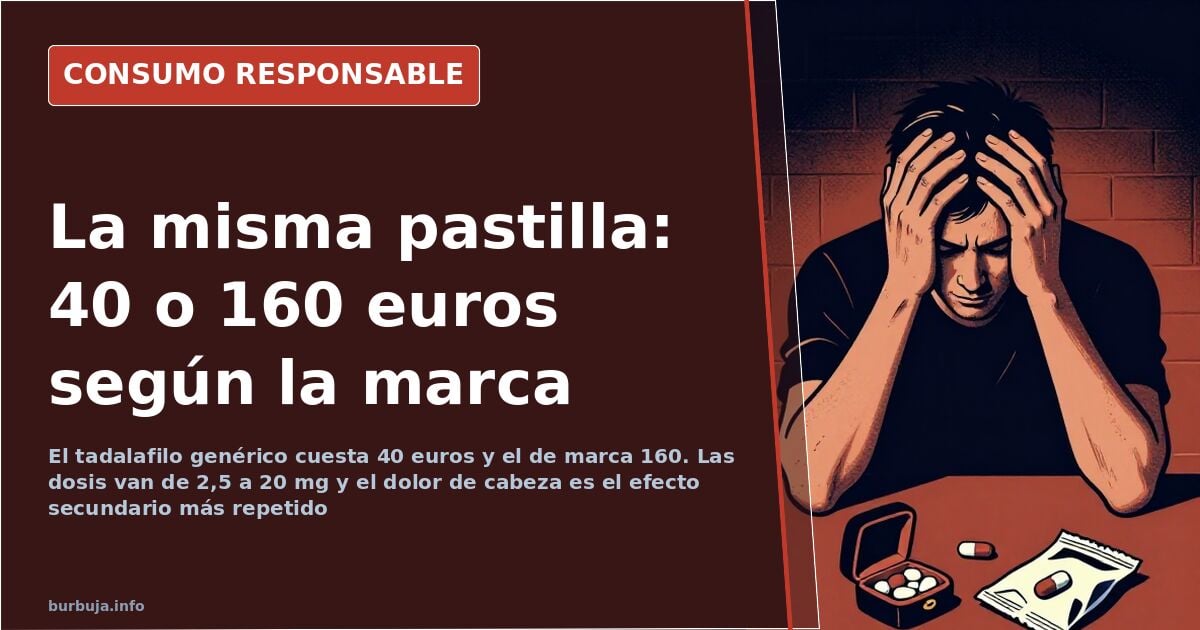
Tadalafil: Same Pill Costs €40 or €160 Depending on Brand
A tadalafil pill costs either €40 or €160. It does the same thing. The difference lies in the box, the packaging, and the printed brand name. The generic 20 mg version and the branded one share the same active ingredient, and the price gap reaches €120, three times the cost of the cheaper option. This data is not trivial when the drug starts being viewed outside the doctor's office.
The underlying conversation is not about the packaging. It is about why more men in their thirties are interested in a pill originally designed for patients with severe erectile dysfunction. A personal doubt turned into a catalog of doses, side effects, and bills. And it leaves an uncomfortable question: Are we medicalizing something that used to be resolved naturally?
Why Interest in Tadalafil Starts After Age 30
The most circulating explanation points to hormonal decline. Past thirty, it is argued, hormones drop and blood flow suffers, hence millions of pills are sold. This is not a thesis from an endocrinologist, but common sense repeated among those interested, and it should be treated as what it is: a popular hypothesis, not a diagnosis.
The initial doubt was different. The problem, it is said, is not what happens in a relationship, but not knowing why performance responds sometimes and not others. Sessions where the body holds up without antiestéticar and others where any distraction deflates it. That irregularity—more than a clear symptom—is what pushes people to try the pill.
What Tadalafil Doses Are Commercialized?
The cited doses range from 2.5 mg to 20 mg. The 20 mg dose was the first to hit the market, intended for severe dysfunction; later came the 10, 5, and 2.5 mg versions, better suited for recreational use. The recommendation appearing from those who have tried it is to start low: with 5 mg, they argue, it is usually enough.
Reference to the 20 mg dose generates division. Some warn that taking it is not enough: without stimulation, they say, it does nothing on its own. Others recall that this was the original dose, for patients with serious problems, not for those wanting occasional help on a weekend. The nuance matters: treating dysfunction is not the same as boosting existing performance.
Headache, the Most Recurring Side Effect
Headaches are the adverse effect most frequently mentioned in accounts. It is linked to increased blood flow and usually appears within hours. Experience varies: some never notice it with 20 mg, while others consider it almost certain. This dispersion fuels the discussion.
The underlying antiestéticar is not the discomfort itself, but what might lie behind it. There is concern that it signals a major circulatory problem and ruins vacations by leaving one out of commission the next day. Those who haven't suffered it downplay the issue; those who have warn that the technical sheet warning is not decorative. As explained in exchanges, applying a split pill requires a clean longitudinal cut so it doesn't fall apart, a practical detail revealing how familiar some users are with the product.
Generic, Brand, and Prescription: Where Is the Real Saving?
Price is the other front. The branded bottle costs €160; the generic 20 mg costs €40. The gap exceeds €100 for the same active ingredient. Added to this is the procedure: visiting a doctor is expensive, and some report paying €150 just for the visit, pushing them to seek alternatives through less orthodox channels.
Health advice repeats an obvious truth not always respected: this is obtained with a prescription, not at any stall. The temptation to skip the doctor clashes with a practical problem—knowing the correct dose—and a legal one. The cheapness of the generic is only real when bought where it should be.
The Underlying Debate: Psychological or Physical?
In the background lurks the question no one resolves. Some argue that forcing nature makes no sense and that if there is no desire, there is a reason. Others counter that the decline in desire and response with age is a fact and denying it helps no one.
Most agree on one uncomfortable point: every body responds differently and there is no universal dose. What gives one person a slight boost leaves another with numbed sensitivity. The lack of a clear pattern is precisely what generates the most consultations and is hardest to resolve based on others' opinions. With such dispersion, consumption and self-medication are expected to keep growing. And headaches will likely remain the price some pay for help that, deep down, no one knows exactly who should prescribe.
A tadalafil pill costs either €40 or €160. It does the same thing. The difference lies in the box, the packaging, and the printed brand name. The generic 20 mg version and the branded one share the same active ingredient, and the price gap reaches €120, three times the cost of the cheaper option. This data is not trivial when the drug starts being viewed outside the doctor's office.
The underlying conversation is not about the packaging. It is about why more men in their thirties are interested in a pill originally designed for patients with severe erectile dysfunction. A personal doubt turned into a catalog of doses, side effects, and bills. And it leaves an uncomfortable question: Are we medicalizing something that used to be resolved naturally?
Why Interest in Tadalafil Starts After Age 30
The most circulating explanation points to hormonal decline. Past thirty, it is argued, hormones drop and blood flow suffers, hence millions of pills are sold. This is not a thesis from an endocrinologist, but common sense repeated among those interested, and it should be treated as what it is: a popular hypothesis, not a diagnosis.
The initial doubt was different. The problem, it is said, is not what happens in a relationship, but not knowing why performance responds sometimes and not others. Sessions where the body holds up without antiestéticar and others where any distraction deflates it. That irregularity—more than a clear symptom—is what pushes people to try the pill.
What Tadalafil Doses Are Commercialized?
The cited doses range from 2.5 mg to 20 mg. The 20 mg dose was the first to hit the market, intended for severe dysfunction; later came the 10, 5, and 2.5 mg versions, better suited for recreational use. The recommendation appearing from those who have tried it is to start low: with 5 mg, they argue, it is usually enough.
Reference to the 20 mg dose generates division. Some warn that taking it is not enough: without stimulation, they say, it does nothing on its own. Others recall that this was the original dose, for patients with serious problems, not for those wanting occasional help on a weekend. The nuance matters: treating dysfunction is not the same as boosting existing performance.
Headache, the Most Recurring Side Effect
Headaches are the adverse effect most frequently mentioned in accounts. It is linked to increased blood flow and usually appears within hours. Experience varies: some never notice it with 20 mg, while others consider it almost certain. This dispersion fuels the discussion.
The underlying antiestéticar is not the discomfort itself, but what might lie behind it. There is concern that it signals a major circulatory problem and ruins vacations by leaving one out of commission the next day. Those who haven't suffered it downplay the issue; those who have warn that the technical sheet warning is not decorative. As explained in exchanges, applying a split pill requires a clean longitudinal cut so it doesn't fall apart, a practical detail revealing how familiar some users are with the product.
Generic, Brand, and Prescription: Where Is the Real Saving?
Price is the other front. The branded bottle costs €160; the generic 20 mg costs €40. The gap exceeds €100 for the same active ingredient. Added to this is the procedure: visiting a doctor is expensive, and some report paying €150 just for the visit, pushing them to seek alternatives through less orthodox channels.
Health advice repeats an obvious truth not always respected: this is obtained with a prescription, not at any stall. The temptation to skip the doctor clashes with a practical problem—knowing the correct dose—and a legal one. The cheapness of the generic is only real when bought where it should be.
The Underlying Debate: Psychological or Physical?
In the background lurks the question no one resolves. Some argue that forcing nature makes no sense and that if there is no desire, there is a reason. Others counter that the decline in desire and response with age is a fact and denying it helps no one.
Most agree on one uncomfortable point: every body responds differently and there is no universal dose. What gives one person a slight boost leaves another with numbed sensitivity. The lack of a clear pattern is precisely what generates the most consultations and is hardest to resolve based on others' opinions. With such dispersion, consumption and self-medication are expected to keep growing. And headaches will likely remain the price some pay for help that, deep down, no one knows exactly who should prescribe.
Summary of a discussion on Burbuja.info - Foro de economía, actualidad y política., translated from Spanish and reviewed before publication. Read the full discussion (125 replies).
More summaries
-
"22 wings for €9": less than €0.50 each, according to a forum user
"22 wings for €9", an order a forum user attributes to KFC: less than €0.50 per unit, cheaper than butcher's chicken according to their calculation.
-
VW 1.0 TSI: Reliable City Engine with Carbon Buildup Concerns
The Volkswagen 1.0 TSI is marketed as a reliable urban engine, though users report carbon buildup and fuel consumption that does not improve over diesel.
-
Gym costs €25/month: Why it fills up every afternoon
Monthly gym fees average €25, but motivations range from lifting weights to locker room socializing; only one in ten visibly shows results.
-
Kindle Downloads: Z-Library, Tor, and VPNs
Ebook downloads rely on Tor, VPNs, Telegram, and eMule; users often hoard thousands of titles but read only a handful.
-
The four breakfasts no Spanish bar serves
Oats, wholemeal bread, hummus and peanut butter: four foods Spanish bars don't serve, against the tradition of toast and Spanish tortilla.
-
Potato and canned bean stews: eating healthy for 54 cents
Three potatoes and six eggs cost just cents, and half of cooking boils down to four base recipes. Potato stews, broth and a pressure cooker for the week